Key events
Show key events only
Please turn on JavaScript to use this feature
US wants Ukraine to withdraw from Donbas and create ‘free economic zone’, says Zelenskyy Shaun Walker
in Kyiv
The US wants Ukraine to withdraw its troops from the Donbas region, and Washington would then create a “free economic zone” in the parts Kyiv currently controls, Volodymyr Zelenskyy has said.
Previously, the US had suggested Kyiv should hand over the parts of Donbas it still controlled to Russia, but the Ukrainian president said on Thursday that Washington had now suggested a compromise version in which Ukrainian troops would withdraw, but Russian troops would not advance into the territory.
“Who will govern this territory, which they are calling a ‘free economic zone’ or a ‘demilitarised zone’ – they don’t know,” said the Ukrainian president, speaking with journalists in Kyiv on Thursday.
Zelenskyy said Ukraine did not believe the plan was fair without guarantees that Russian troops would not simply take over the zone after a Ukrainian withdrawal.
Zelenskyy said: “If one side’s troops have to retreat and the other side stays where they are, then what will hold back these other troops, the Russians? Or what will stop them disguising themselves as civilians and taking over this free economic zone? This is all very serious. It’s not a fact that Ukraine would agree to it, but if you are talking about a compromise then it has to be a fair compromise.”
He said if Ukraine did agree to such a scheme, there would need to be elections or a referendum to ratify it, saying that only “the Ukrainian people” could make decisions on territorial concessions.
Under the US plans, said Zelenskyy, Ukraine would withdraw from Donbas, where Russia is advancing, while the frontlines would be frozen in the Kherson and Zaporizhzhia regions. Russia would give up a few small pockets of land it controls in other regions.
Zelenskyy has been under immense pressure from Donald Trump to sign up to the US peace plan. In recent days Trump has attacked Zelenskyy, claiming he “has not even read” the draft peace plan and suggesting he lacks legitimacy and Ukraine should hold an election.
Zelenskyy said the Ukrainian negotiating team had sent their revised plan back to Washington on Wednesday, and that questions over territory and control of the Zaporizhzhia nuclear plant were two of the remaining sticking points. “It’s not the final plan; it’s a reaction to what we received … the plan is constantly being worked on and edited, and this is a continuous process that is still going on,” he said.
If Washington and Kyiv do agree, the much bigger question remains of whether Vladimir Putin is really ready to sign a deal or is merely buying time with fake negotiations and hoping to continue his military advance over the winter.
Share Jakub Krupa
Let’s quickly remind ourselves on what is in the latest US proposal, as disclosed by Ukraine’s Volodymyr Zelenskyy yesterday.
ShareMorning opening: The softest of pushbacksJakub Krupa
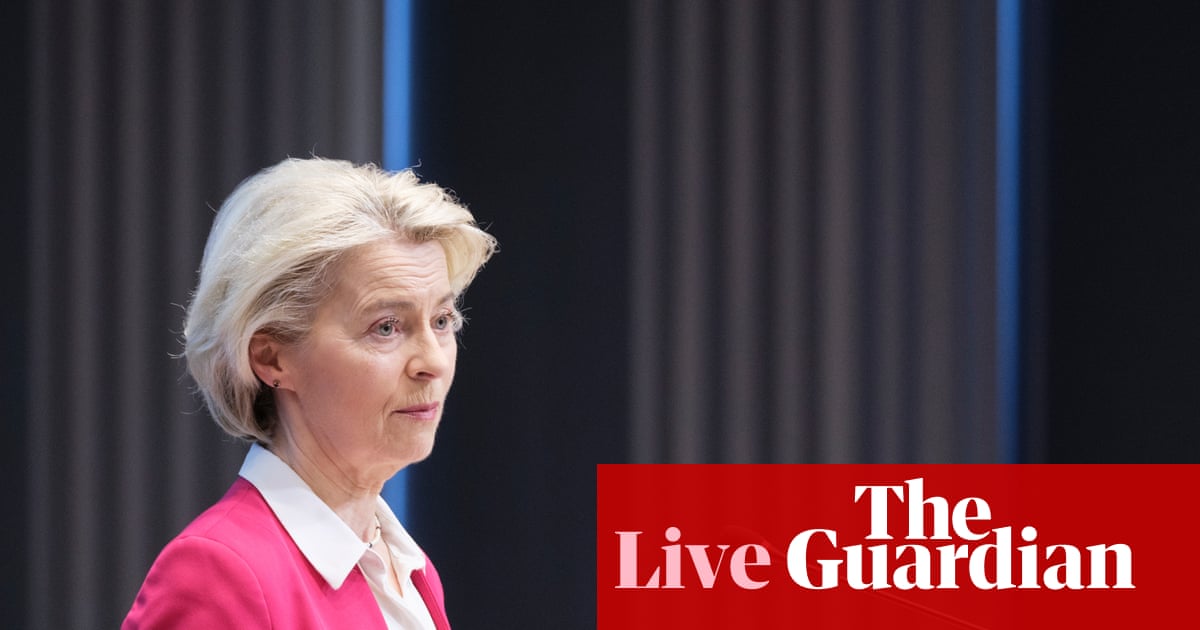
The European Commission president, Ursula von der Leyen, has delivered the softest of pushbacks to US president Donald Trump last night, telling him off in abstract terms for the suggestion that the US could try to influence elections in various EU countries.
Von der Leyen and Trump at the US president’s Turnberry golf course in Scotland earlier this year. Photograph: Jacquelyn Martin/AP
“It is not on us, when it comes to elections, to decide who the leader of the country will be, but on the people of this country … That’s the sovereignty of the voters, and this must be protected,” she told Politico.
I’m sure Trump is quaking in his boots.
As the talks on a potential peace deal on Ukraine continue today and into the weekend, the focus is on what involvement we will see from the US. Trump – and later his spokesperson Karoline Leavitt – insisted that the US would only join the Europeans for talks if they did not deem it a waste of time.
Let’s see what can be achieved before the Berlin summit, expected on Monday.
In the meantime, Europe continues discussing the contentious issue of frozen Russian assets, facing some opposition on both the idea of a permanent freeze (opposed by Hungary) and on using them for a reparations loan for Ukraine (opposed by Belgium).
The permanent freeze – meaning no more drama over rollovers every few months – is set to come into force today at 5pm, but Viktor Orbán is not happy. More on that shortly.
Meanwhile, after speaking with Germany’s Merz and von der Leyen last week, Belgium’s Bart de Wever is in London today for talks on security, migration, and – yes – frozen assets.
As co-chair of the Coalition of the Willing, Keir Starmer will no doubt try to convince him of the value of leveraging the frozen assets, likely with a promise that the UK could follow suit.
Lots for us to cover.
I will bring you all the key updates throughout the day.
It’s Friday, 12 December 2025, it’s Jakub Krupa here, and this is Europe Live.
Good morning.