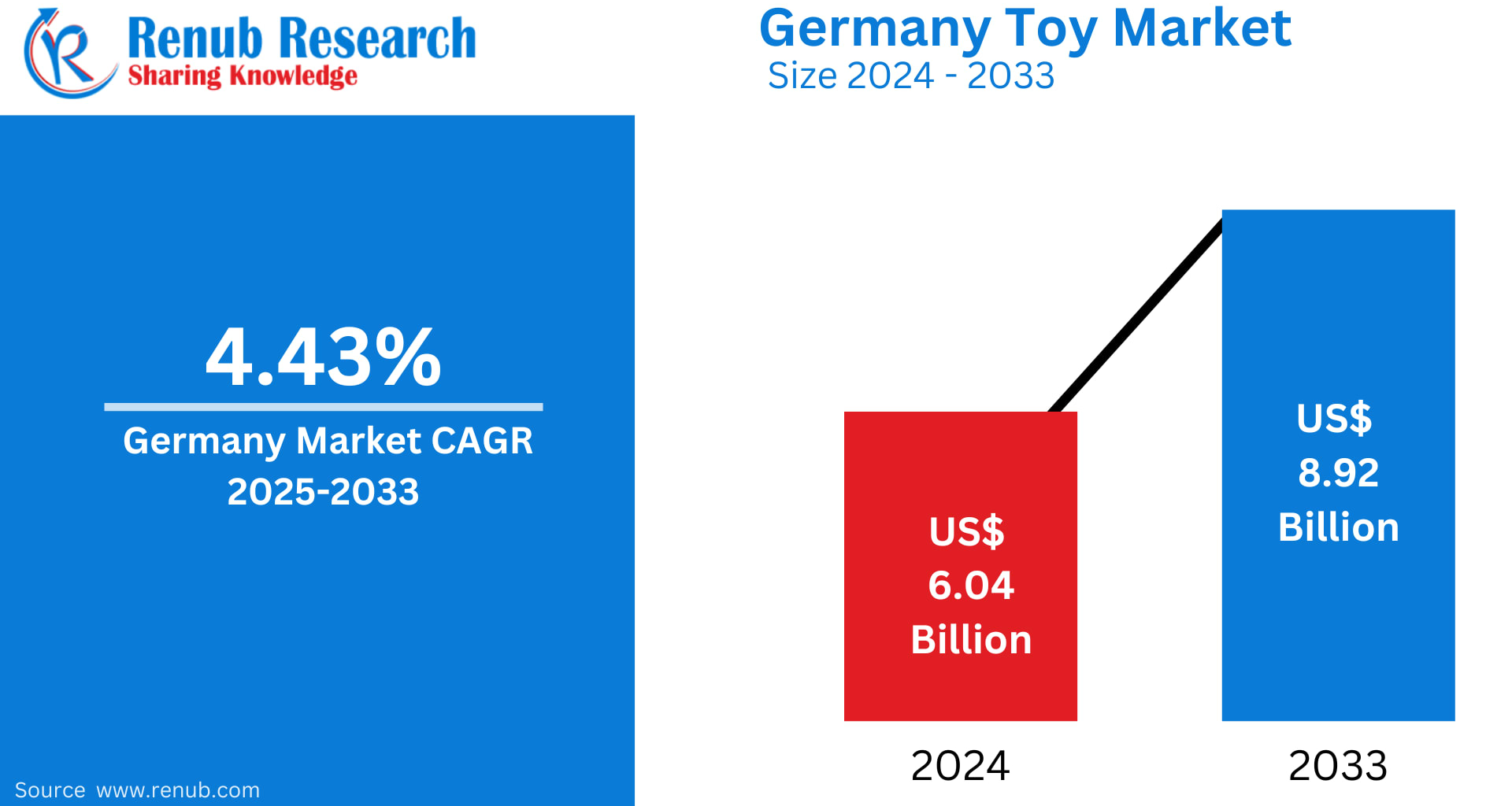
The Germany Toys Market is entering a decisive phase of transformation, supported by rising parental expectations, innovative brands, and a strong culture of quality-driven consumption. According to Renub Research, the German toys industry is projected to expand from US$ 6.04 billion in 2024 to US$ 8.92 billion by 2033, growing at a CAGR of 4.43% between 2025 and 2033. This trajectory positions Germany among Europe’s most dynamic toy markets, benefiting from a blend of tradition, craftsmanship, digital innovation, and sustainability trends.
With consumers increasingly seeking educational toys, eco-friendly options, and digital-interactive play offerings, manufacturers are leaning into creativity, design sophistication, and technology. This evolving interplay between consumer needs and product innovation continues to shape the long-term strength of Germany’s toy market.
Germany Toys Market Outlook: A Mature but Rapidly Diversifying Sector
Germany boasts one of Europe’s largest and most influential toy markets, deeply rooted in a culture that values quality, learning, creativity, and child development. The country is home to globally renowned toy producers known for their craftsmanship and safety standards. These qualities have enabled German toys to gain significant popularity not only domestically but internationally.
Key consumer shifts defining the current landscape include:
✔ Rising preference for educational and interactive toys
Parents increasingly seek products that support cognitive growth, motor skills, and problem-solving—particularly in STEM areas.
✔ Growing popularity of sustainable, eco-friendly toys
Germany’s environmentally conscious households prefer toys made of wood, organic cotton, biodegradable plastics, and recycled materials.
✔ Strong momentum in online toy shopping
E-commerce platforms have emerged as indispensable channels, offering convenience, choice, and price transparency.
✔ Hybrid play environments
Physical toys paired with digital experiences—AR games, app-enabled toys, coding kits—are reshaping childhood play behavior.
Despite occasional economic uncertainties, toy purchases in Germany remain resilient. Families’ consistent investment in high-quality toys signals a favorable long-term outlook for the industry.
Major Drivers of Growth in the Germany Toys Market
1. Rising Demand for Educational & STEM Toys
One of the biggest accelerators for the German toy market is the rising demand for educational toys, particularly those based on STEM (Science, Technology, Engineering, and Mathematics) learning. Modern parents prioritize toys that help children develop critical thinking, creativity, and problem-solving abilities.
Why this category is booming:
STEM toys align with early childhood learning frameworks
They offer long-term developmental value
Parents perceive them as investments in their child’s future
Increased focus on coding, robotics, and scientific thinking
Industry Example:
In January 2024, Team Genius Squad, launched by an 11-year-old entrepreneur, introduced a new line of STEM toys now available in Whole Foods stores.
This unique blend of youthful creativity and innovation reflects the shift toward intelligent play.
2. Sustainability and Eco-Friendly Innovation
Germany is at the forefront of environmentally conscious consumption. The toy industry has embraced this shift, offering products made from organic, renewable, or biodegradable materials.
Eco-focused parents now prioritize:
Wooden toys
Organic cotton plush items
Plant-based polymers
Recycled or biodegradable packaging
Brand Highlight:
In February 2024, Wild Republic launched “Earthkins,” the world’s first biodegradable plush toy line—designed to last through years of use before naturally decomposing.
This aligns perfectly with German families’ expectations and the nation’s strong sustainability culture.
3. E-commerce Expansion Reshaping Toy Retail
E-commerce has become a dominant force in Germany’s toy landscape. Consumers prefer online shopping due to:
Convenience
Extensive product variety
Fast delivery options
Easy comparisons
Customer reviews
The COVID-19 pandemic accelerated this shift—from occasional online shopping to habitual digital purchasing.
Latest Development:
In July 2024, Jammbo launched Jammbomart.com, a B2B e-commerce platform supporting suppliers and retailers, further accelerating digital transformation in the toy ecosystem.
Online retail’s role will continue to grow as digital-native families drive the demand.
Key Issues and Challenges in the Germany Toys Market
1. Strict EU Regulatory Standards
Germany requires all toys to meet strict European Union safety criteria, including:
Chemical safety
Non-toxic material standards
Durability testing
Child safety compliance
While these regulations protect consumers, they:
Increase manufacturing costs
Slow product approvals
Present hurdles for small-scale or foreign manufacturers
Companies must invest heavily in compliance and certification processes.
2. Growing Competition from Digital & Screen-Based Entertainment
Digital-first entertainment—mobile games, apps, virtual play, online gaming—poses a significant threat to traditional toys.
Challenges include:
Less attention for physical toys
Declining interest in conventional categories (dolls, action figures, puzzles)
The need for toy makers to incorporate tech or hybrid features
As children spend more time online, traditional toy makers must innovate to stay relevant.
Segment-Wise Overview of the German Toys Market
Germany Infant/Preschool Toys Market
This segment thrives on rising parental awareness of early childhood development.
Popular toys include:
Soft dolls
Rattles
Stacking blocks
Interactive sensory toys
Parents demand:
Safety-certified materials
Non-toxic products
Educator-recommended learning tools
Industry Event:
In September 2024, Bc Babycare made a major impact at Kind+Jugend 2024 in Cologne, showcasing innovative designs focused on mother and child.
The segment is expected to flourish as early learning becomes a national priority.
Germany Game & Puzzles Market
Germany is a country with a deep-rooted gaming culture—board games, puzzles, and strategy games enjoy cross-generational popularity.
Market strengths:
Strong culture of family game nights
High demand for logic-based and strategy-oriented games
Mix of classic games (Scrabble, Monopoly) and modern thematic games
Consumers value products that:
Encourage teamwork
Sharpen analytical skills
Offer social entertainment
This segment has maintained stable growth with recurring demand.
Germany Vehicles Toys Market
A consistently strong segment driven by the popularity of:
Cars
Trucks
Trains
Planes
Remote-controlled vehicles
Key growth drivers:
High engagement from children
Increased use of lights, sound, and motion technology
Strong tie-ups with entertainment franchises
STEM-linked mechanical design kits
Brands offering realistic models and tech-integrated vehicles are seeing growing traction.
Germany Plush Toys Market
One of the most sentimental and widely purchased toy segments.
Why plush toys remain evergreen:
Emotional comfort
Gift-driven demand
Popularity among both children and adult collectors
Strong licensing partnerships
Sustainability is reshaping this category as well—eco-friendly stuffing materials, organic cotton fabrics, and biodegradable plush lines are gaining momentum.
Personalized plush products are becoming a favorite among parents, helping brands create premium value.
Germany Specialty Store Toys Market
Specialty toy stores cater to parents seeking:
High-quality curated toys
Educational tools
Sustainable, handcrafted toys
Exclusive imported toys
These stores often host:
Workshops
Learning sessions
Product demos
As a result, specialty stores maintain strong consumer loyalty and a premium retail appeal.
Germany E-commerce Toys Market
The fastest-growing retail channel for toys in Germany.
Parents prefer online platforms because they offer:
Broad product selections
Competitive pricing
Online reviews
Seamless home delivery
Amazon, along with toy-specific e-commerce websites, is helping brands expand reach across the region.
Germany Toys Market Segmentation
By Toy Type
Infant/Preschool
Construction
Doll
Game & Puzzles
Vehicles
Action Figures
Outdoor & Sports
Plush
Arts & Crafts
Youth Electronics
Others
By Sales Channel
Specialty Stores
Department Stores
Discounters
E-commerce
Others
Key Players Covered
(Analyzed through Overview, Key Person, Product Analysis, Recent Developments, and Revenue)
Mattel Inc.
LEGO
Ravensburger
Spin Master Corp
VTech
HABA
Nintendo Co., Ltd.
Funko Inc.
JAKKS Pacific
Each of these companies is increasing its presence in the German market through product innovation, digital play extensions, sustainable lines, and omnichannel retail strategies.
Final Thoughts
The Germany Toys Market stands at an exciting crossroads—where heritage craftsmanship meets futuristic innovation. With a strong CAGR of 4.43% projected through 2033, the country’s toy ecosystem is poised for sustained expansion. Parents’ focus on STEM learning, sustainability, and quality will push manufacturers toward smarter, greener, and more interactive products.
As digital-native children reshape the definition of play, the most successful brands will be those that blend technology with creativity, and sustainability with emotional value. Germany’s toy market is not just growing—it is redefining the global standards of imaginative, responsible, and meaningful play.