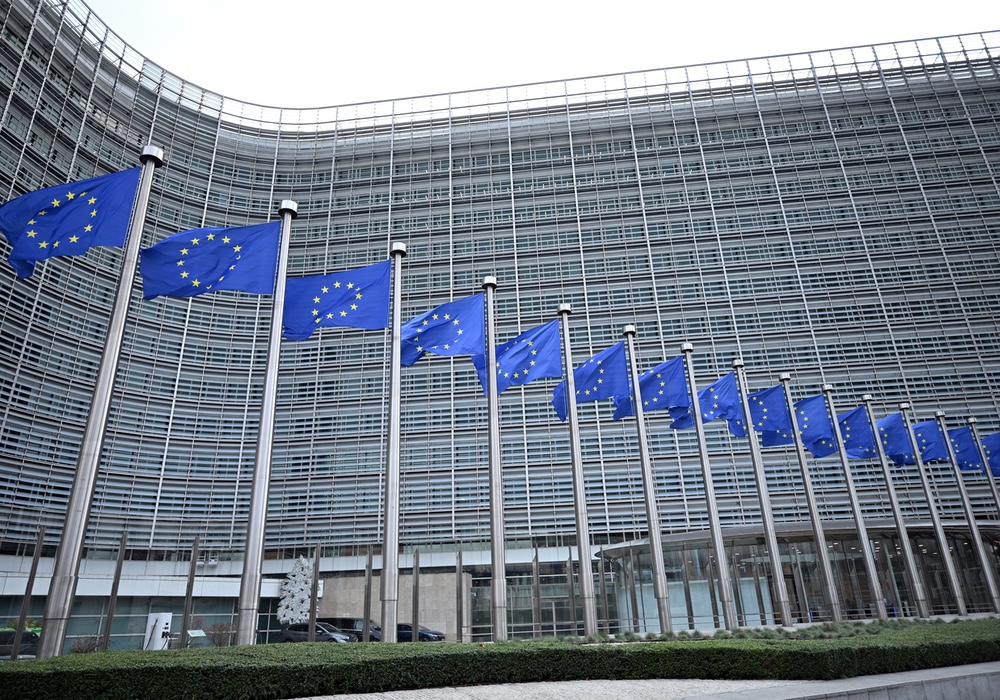
The European Union has arrived at a preliminary deal to reverse sustainability requirements that were once hailed as a groundbreaking effort to hold big businesses accountable for their social and environmental impacts but have now taken a U-turn that critics say indicates a “surrender” of the bloc’s climate ambitions.
In-scope firms, for one, will no longer need to prepare a transition plan that aligns their business models with the Paris Agreement, reducing their administrative burdens and delivering “historic” cost reductions for businesses, rapporteur Jörgen Warborn, a Swedish Member of Parliament, said in a statement on Tuesday.
But Julia Otten, senior policy officer at public interest law firm Frank Bold, disagreed. By deleting the climate transition plan implementation, she wrote in a statement, the EU is “weakening” the key legislative frameworks that businesses need to prepare for climate risks and other global challenges that can severely disrupt their operations and value chains.
“This is counter-productive for businesses, weakens accountability and jeopardizes the EU’s own plans and objectives on climate and the industrial transition,” Otten said. “The final omnibus agreement reflects short-sighted political decision-making, forced through with the far right, at a time when the EU needs to stand firm and speed up the transition for its own strategic interests.”
Other cuts to the corporate sustainability due diligence directive and the corporate sustainability reporting directive—ostensibly in the name of red-tape reduction but in what appears to be capitulation to pushback from fossil fuel interests, business associations and the Trump administration—have been equally drastic.
By requiring only the largest EU businesses with more than 5,000 employees and a net annual turnover of over 1.5 billion euros ($1.8 billion) to carry out due diligence to minimize potential harms in their supply chains, the original scope of the CSDDD has been slashed by 70 percent, leaving just over 1,000 businesses still needing to comply.
The CSRD, now abridged by 90 percent, will cover only companies with more than 1,000 employees and a net annual turnover of more than 450 million euros ($528 million), freezing out all but 4,800 businesses.
The tentative agreement also absolves businesses from systematic scrutiny, allowing them to take a looser risk-based approach while at the same time barring them from soliciting “unnecessary information” from companies not beholden to the same rules.
Doing so, its detractors say, not only allows companies to skirt responsibility for serious abuses occurring beyond their immediate business relationships, but it also severely undercuts the EU’s credibility as a trustworthy global actor on climate action, human rights and responsible business conduct.
“That the European Council, led by the Danish EU presidency, and members of the European Parliament agreed to undermine world-leading climate commitments is a colossal EU own goal,” Lotte Leicht, advocacy director at Climate Rights International, a climate and human rights monitoring and advocacy group, said in a statement. “The companies removed from reporting and due diligence obligations operate in sectors with well-documented risks, from deforestation to forced labor to toxic pollution.”
That actions are being taken to weaken oversight and curtail accountability when climate breakdown is happening at full throttle is particularly disheartening, she said. It was only this week that the world’s largest single market set a legally binding climate target of a 90 percent reduction in net greenhouse gas emissions by 2040. The revised legislation seems to make this challenge harder to square.
“These changes mark a profound shift in the EU’s direction,” Leicht said. “Europe must decide whether it wants to be a continent reshaped in Trump’s image, where corporate lobbyists successfully scrap rules, impunity for abuses continues and the climate crisis is ignored, or a place where facts, science, rights, the rule of law and the planet are defended and protected.”
But others have praised the deal for cutting complexity. They include Oliver Moullin, managing director for sustainable finance at the Association for Financial Markets in Europe, who welcomed “clear, workable rules” that will “support the mobilization of finance for the transition while minimizing unnecessary regulatory burdens and supporting competitiveness.”
In fact, the easing of requirements could go further, he said, adding that policymakers must “continue with efforts to streamline regulation and support competitiveness—including through the simplification of the European sustainability reporting standards, the review of EU taxonomy reporting and, as acknowledged in the omnibus agreement, reviewing banking legislation and supervisory requirements—to ensure it remains effective, proportionate and internationally competitive.”
Even so, as regulatory requirements become less comprehensive, so too will the risk of fragmentation increase. More rules are set to be whittled further, such as the waste framework directive, which could see the repeal of the only database that contains information on chemicals of concern used in Europe. The European Commission is also eyeing a version of the Circular Economy Act, poised for 2026, that will deliver “simpler” harmonized rules and lower costs for cross-border transactions. These could lead to gaps in implementation and enforcement, erode legal certainty and thwart investor confidence.
“While the omnibus agreement weakens key aspects of the CSRD and CSDDD, expectations across global value chains are not diminishing,” Gabriele Ballero, manager of public affairs at Cascale, the multi-stakeholder organization formerly known as the Sustainable Apparel Coalition, wrote in an email. “Even with fewer entities covered, multinational buyers, investors and consumers will continue to expect credible due diligence, transparent reporting and measurable progress.”
It’s Cascale’s job, he said, to continue to provide the tools, frameworks and shared expertise to help companies “navigate this shifting landscape, avoid duplicated effort and demonstrate leadership based on evidence rather than minimum thresholds.” Responsibilities to promote climate action and decent work across the value chain “do not disappear when legislation is weakened,” Ballero added.
The EU’s ombudswoman has called out the European Commission for what she described as a number of “procedural shortcomings,” amounting to “maladministration,” in the way it has rushed through the omnibus process. The CSDDD entered into force in July 2024 with significant compromises to its original vision. It would only be five months later that the European Commission would float the idea of simplification, and another two before the first amendments were tabled.
“With a self-declared urgency, the Commission essentially avoided input and potential pushback on its deregulatory plans,” Lara Wolters, the Dutch politician who was the European Parliament’s lead negotiator on the CSDDD, wrote on LinkedIn. “The stakeholder consultation was not ‘public,’ the internal consultation was barely existent and the Commission can’t demonstrate for certain they did the climate assessment they are legally obliged to conduct.”
Wolters said that in a “world of populists making it up as they go along,” the EU should “pride itself on weighing up evidence and expertise.” Instead, this European Commission is “pandering to ‘feelings’ instead as well as to lobbying that frankly, is starting to resemble pillaging,” she added.
But even the new rules, once rubberstamped, will take a while to go into effect. The revised CSRD will apply from January 2027. The updated CSDDD must be transposed by member states by mid-2028 for entry into force in mid-2029. For those who have decried the omnibus package as deregulation by another name, the regulations come too little, too late.
Faustine Bas-Defossez, director for nature, health and environment at the European Environmental Bureau, a network of 180 environmental citizens’ organizations based in more than 40 countries, describes the omnibus maneuverings as no less than a “coordinated attack” on the laws that protect Europe’s health, climate and nature. She cited a recent European Environment Agency report that found that the EU is “likely off track” or “off track” for most of its 2030 environmental goals.
“The Commission is breaking its own rules to tear up the laws that keep us safe. This is not simplification, it is self-sabotage,” she said in a statement. “It puts our health and environment at risk, weakens Europe’s competitiveness and creates chaos for businesses who rely on legal certainty. Who exactly are they doing this for?”