Your support helps us to tell the story
From reproductive rights to climate change to Big Tech, The Independent is on the ground when the story is developing. Whether it’s investigating the financials of Elon Musk’s pro-Trump PAC or producing our latest documentary, ‘The A Word’, which shines a light on the American women fighting for reproductive rights, we know how important it is to parse out the facts from the messaging.
At such a critical moment in US history, we need reporters on the ground. Your donation allows us to keep sending journalists to speak to both sides of the story.
The Independent is trusted by Americans across the entire political spectrum. And unlike many other quality news outlets, we choose not to lock Americans out of our reporting and analysis with paywalls. We believe quality journalism should be available to everyone, paid for by those who can afford it.
Your support makes all the difference.Read more
Stargazers should keep their eyes peeled for the chance to see up to 100 shooting stars in an hour this weekend.
The Geminid meteor shower is predicted to be visible until December 20 but will put on the greatest display overnight from Saturday to Sunday.
The meteors are visible all over the world, but those in the northern hemisphere will get the best display.
If the weather permits, astronomers say the UK could get a spectacular view.
“You can expect to see perhaps up to 100 meteors an hour, so that might be one or two a minute, which would be a brilliant view – it is one of the strongest showers of the year,” said Dr Robert Massey, deputy executive director at the Royal Astronomical Society.
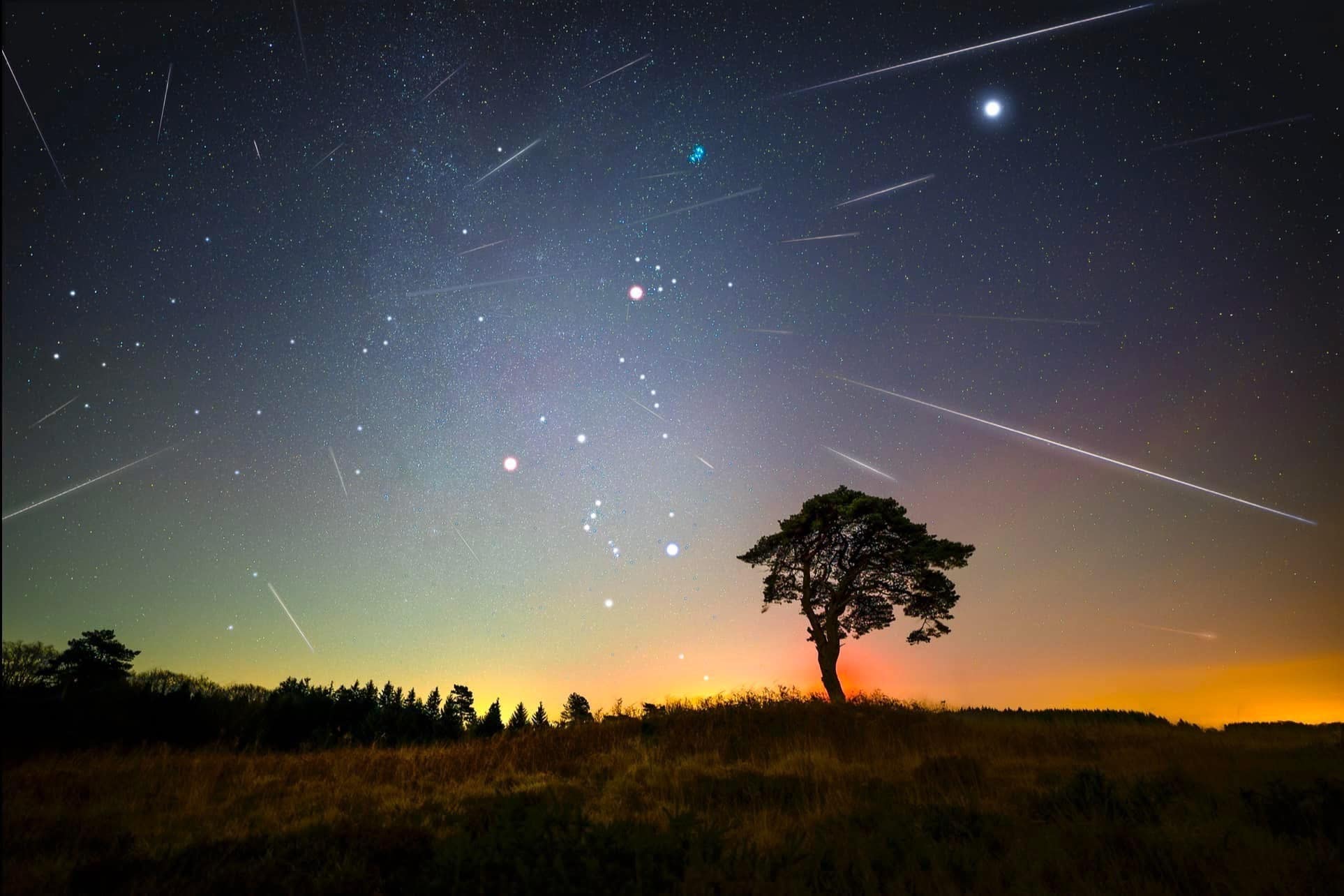
open image in gallery
Photographer Josh Dury captured a striking image of the Geminid meteor shower in Somerset (Josh Dury Photo-Media/PA) (PA Media)
What is the Geminids meteor shower?
Meteors are pieces of debris, which when they enter earth’s atmosphere at speeds of up to 40 miles per second, they vapourise and cause bright streaks of light.
The Geminid meteor shower is bright, fast and multi-coloured. The streaks have a greenish hue when they burn up in the Earth’s atmosphere, rather than being colourless or white like other meteors. This is because of their chemical composition – oxygen, magnesium and nickel usually produce a green colour.
The shower was first observed in 1862 and is thought to be intensifying every year.
It has been known to produce over 120 meteors per hour at its peak – but light pollution and cloud coverage could mean not all are visible.
How can I watch it?
The Geminids are best seen with the naked eye, so you do not need a telescope or binoculars to catch a glimpse.
“The great thing about a meteor shower, including the Geminids, is that the naked eye is the best way to see them,” Dr Massey said.
“If you get a telescope or a pair of binoculars you’re automatically restricting your view of the sky, and with a meteor shower what you want is the widest possible view – you want to be lying down, looking up at the broad panoply of stars, and watching for meteors,” he added.
Stargazers should keep an eye out for a short streak of light that lasts for about a second, Dr Massey explained.
“It’s usually so quick it’s impossible to point out to someone you’re with, so you need to keep your eyes up,” he said.
What will the weather be like?
Unfortunately, the weather may restrict the view of the meteor shower this weekend with outbreaks of rain and wind and clouds forecast over the weekend.
But if there are breaks in the gloomy weather, avoiding cities and towns will give viewers the best opportunity to see a shooting star.
“The best view is if you’re away from sources of light pollution, so try and get away from at least direct lights in towns and cities, ideally out in the countryside. Obviously you also need a clear sky – if it’s cloudy you’re not going to see anything,” Dr Massey said.