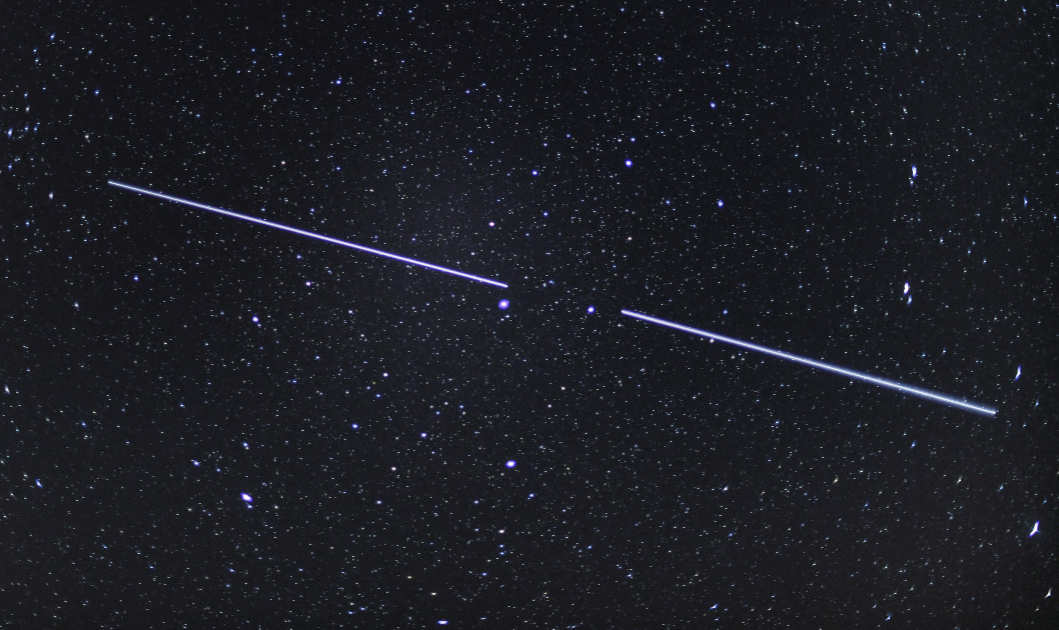
A SpaceX executive says a satellite deployed from a Chinese rocket risked colliding with a Starlink satellite.
On Friday, company VP for Starlink engineering, Michael Nicolls, tweeted about the incident and blamed a lack of coordination from the Chinese launch provider CAS Space.
“When satellite operators do not share ephemeris for their satellites, dangerously close approaches can occur in space,” he wrote, referring to the publication of predicted orbital positions for such satellites.
CAS Space reported successfully launching nine satellites on Wednesday using its Kinetica-1/Lijian-1 rocket. The payload included six Chinese satellites, two other jointly-developed satellites for clients from the United Arab Emirates and Egypt, along with a student-built satellite from Nepal.
But it looks like one of the satellites veered relatively close to a Starlink sat that’s been in service for over two years. “As far as we know, no coordination or deconfliction with existing satellites operating in space was performed, resulting in a 200 meter (656 feet) close approach between one of the deployed satellites and STARLINK-6079 (56120) at 560 km altitude,” Nicolls wrote.
This Tweet is currently unavailable. It might be loading or has been removed.
“Most of the risk of operating in space comes from the lack of coordination between satellite operators —this needs to change,” he added.
Astronomer and satellite tracking expert Jonathan McDowell says the close approach occurred at around 1:42 am EST Friday, December 12th over the eastern Pacific Ocean, citing US Space Force’s tracking data.
“A quick analysis of Space Force public tracking data suggests this was object 67001,” he told PCMag. “We don’t know which of the Lijian-1 payloads is 67001.”

Get Our Best Stories!
Your Daily Dose of Our Top Tech News

Sign up for our What’s New Now newsletter to receive the latest news, best new products, and expert advice from the editors of PCMag.
Sign up for our What’s New Now newsletter to receive the latest news, best new products, and expert advice from the editors of PCMag.
By clicking Sign Me Up, you confirm you are 16+ and agree to our Terms of Use and Privacy
Policy.
Thanks for signing up!
Your subscription has been confirmed. Keep an eye on your inbox!
For now, CAS Space told PCMag it’s in contact with Nicolls to learn more about the “alleged incident.” However, the company noted: “We value the responsible use and sharing of space as the utmost priority. Situations like these are the reason why nations should work together in space, build their common understanding instead of segregating emerging nations.”
But it doesn’t appear CAS has many details about what exactly occurred. The company said: “As a launch service provider, our responsibility ends once the satellites are deployed, meaning we do not have control over the satellites’ maneuvers. Nonetheless, it is everyone’s common interest to avoid collision, so CAS Space will provide help however we can.”
The company added: “Our first priority is to identify the exact timeline of the incident. Which of the nine satellites were involved? Did the incident happen during satellite deployment or during the orbit maneuver of one of the satellites? Once we have a clearer picture, we will be in a better position to provide assistance to Starlink.” the Chinese launch provider said.
Recommended by Our Editors
In addition, the company asserted that “All CAS Space launches undergo a mandatory process to align our deployment sequence with ground-based space awareness systems to avoid any potential collision with known satellites/debris. Kinetica-1 Y11 launched at 04:03:45 UTC exactly to an SSO at 550 km with LTDN at 10:30. Satellite separation was nominal. No collision risks were reported for the deployment process.”
It’s not the first time Chinese space activities have raised alarm bells in the US over potential collision risks. Last year, a different rocket carrying satellites for a Chinese version of Starlink broke apart in space, creating at least 300 pieces of orbiting debris.
Nicolls wrote the post when Starlink currently spans over 9,300 satellites in Earth’s orbit, according to astronomer and satellite tracker Jonathan McDowell. SpaceX’s satellite constellation has become so large it encompasses about two-thirds of all satellites in low-Earth orbit.

A map of Starlink satellites in orbit. (satellitemap.space)
To prevent potential collisions, SpaceX publishes its own satellite positioning data while employing “Starlink collision avoidance operators, which are available on a 24/7 schedule. The company’s Starlink satellites also feature propulsion, enabling them to maneuver in space, including dodging debris from a Russian anti-satellite missile test back in 2022.
Nevertheless, the growing number of satellites has fueled worries about the “Kessler syndrome,” or where a single satellite collision could trigger a self-perpetuating chain reaction of impacts when certain orbits are becoming increasingly crowded.
About Our Expert

Michael Kan
Senior Reporter
Experience
I’ve been a journalist for over 15 years. I got my start as a schools and cities reporter in Kansas City and joined PCMag in 2017, where I cover satellite internet services, cybersecurity, PC hardware, and more. I’m currently based in San Francisco, but previously spent over five years in China, covering the country’s technology sector.
Since 2020, I’ve covered the launch and explosive growth of SpaceX’s Starlink satellite internet service, writing 600+ stories on availability and feature launches, but also the regulatory battles over the expansion of satellite constellations, fights with rival providers like AST SpaceMobile and Amazon, and the effort to expand into satellite-based mobile service. I’ve combed through FCC filings for the latest news and driven to remote corners of California to test Starlink’s cellular service.
I also cover cyber threats, from ransomware gangs to the emergence of AI-based malware. Earlier this year, the FTC forced Avast to pay consumers $16.5 million for secretly harvesting and selling their personal information to third-party clients, as revealed in my joint investigation with Motherboard.
I also cover the PC graphics card market. Pandemic-era shortages led me to camp out in front of a Best Buy to get an RTX 3000. I’m now following how President Trump’s tariffs will affect the industry. I’m always eager to learn more, so please jump in the comments with feedback and send me tips.