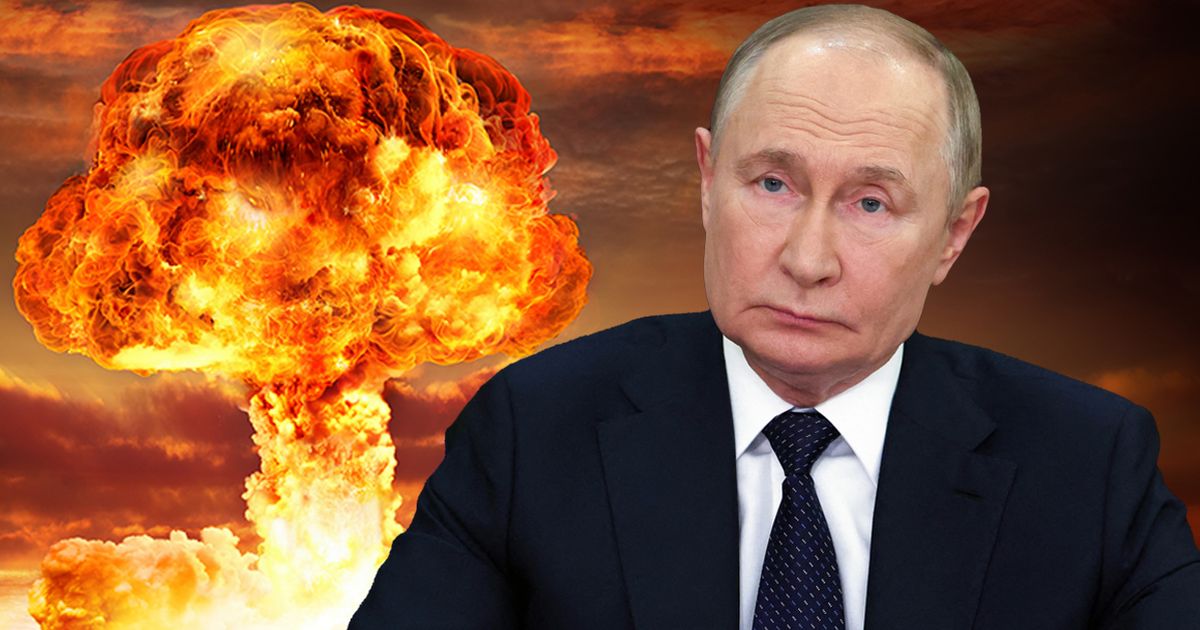
With Russian state TV claiming a nuclear attack on the UK is ‘inevitable,’ experts are expresssing concern about the ‘weak’ state of the British defences against the ‘grave threat’ One of Vladimir Putin’s closest allies has issued a chilling threat(Image: Getty Images/iStockphoto)
World War 3 anxieties have reached fever pitch this week after a Kremlin mouthpiece called a nuclear attack against the UK “inevitable”. When reports emerged that 28-year-old British paratrooper George Hooley had died during a defensive test in Ukraine, the Russian state propagandist claimed it was “casus belli” for a strike against the UK, due to the presence of British armed forces in the war-torn country.
Putin’s crony Vladimir Solovyov claimed to viewers of his nightly show: “Now a nuclear strike on Britain is inevitable.” While the concept of mutually assured destruction has not gone anywhere – despite the posturing on Russian state TV – international relations experts are still concerned about the “grave threat” Russia poses to the UK and other European countries.
US President Donald Trump has also been making his position on the world stage clear. From branding Europe a “decaying” continent filled with “weak” countries in a recent interview, to releasing a National Security Strategy that indicates the US will be taking a hands-off approach to its traditional Western allies, his decisions are ringing alarm bells for experts.
READ MORE: Chilling first signs of war with Russia – loss of phone signal and card failureREAD MORE: Safest areas in UK if WW3 broke out as Putin mouthpiece warns ‘nuke strike is inevitable’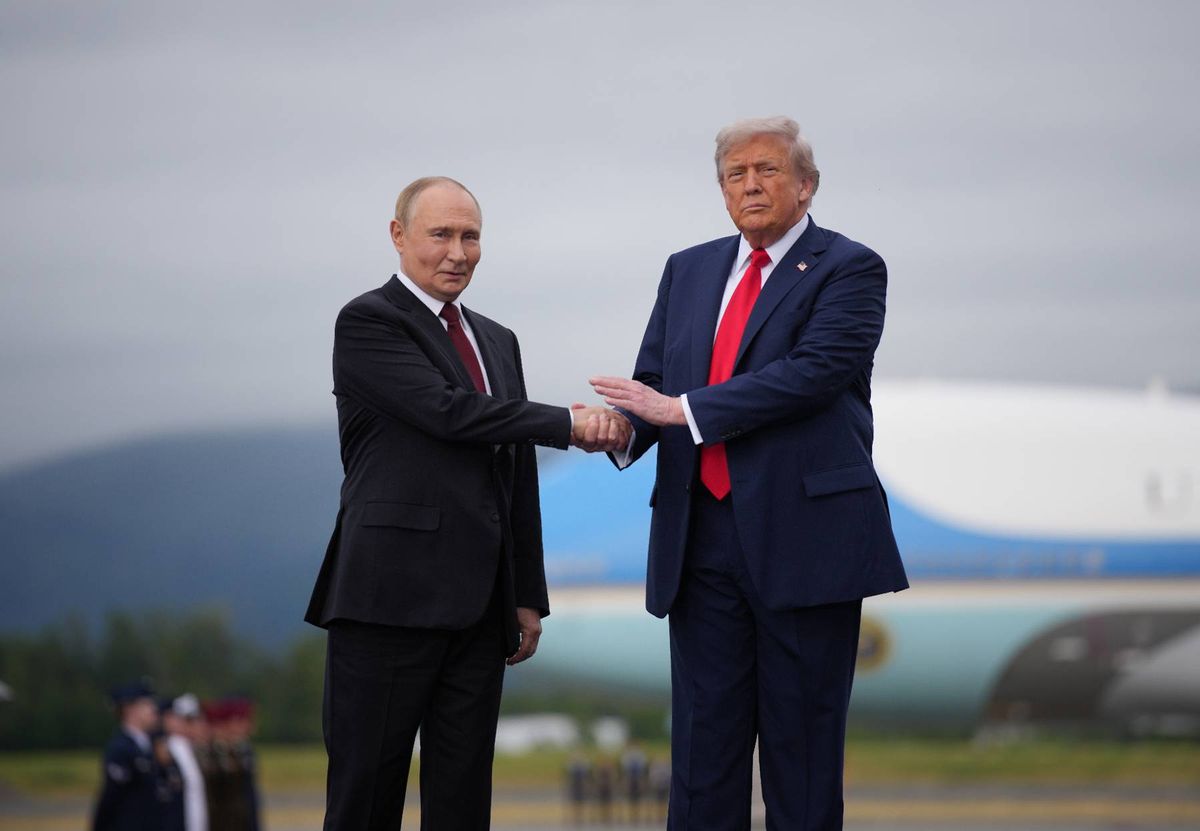 Trump and Putin met in August(Image: Getty Images)
Trump has also proposed “peace framework” for the Russia-Ukraine war that suggests Ukraine hands over huge swathes of the country to Putin – something to which President Zelensky is unlikely to agree to. This means that the days where the UK could reply on the US for a strong show of support are “over, full stop” according to one expert.
Britain’s ‘military weakness’
Professor Anthony Glees, from the University of Buckingham, tells to the Mirror: “What has changed is that Trump is forcing Ukraine to accept a peace that is Russia’s peace before Christmas. It rewards Russian aggression with Ukrainian territory. What’s not to like as far as Putin is concerned. Trump gets his ‘peace’ in the form of a ceasefire, which could become a lasting settlement if Putin has the whip hand.”
The expert adds that in his view, this could potentially be “our gravest hour since the 1930s.” Professor Glees expressed concern about the “military weakness” of the UK, and whether we currently have the ability to stave off potential threats. “We are too weak to resist Russia and too weak to resist Trump, even though we know that a peace that allows Putin to win will have the most appalling consequences for Ukraine but also for the whole of Europe,” he warns.
The Labour Government have significantly increased defence spending, with it making up 2.5 percent of GDP from 2027, and spending £62.2 billion on the Armed Forces this year, including £15bn investment into upgrading the country’s nuclear capabilities.
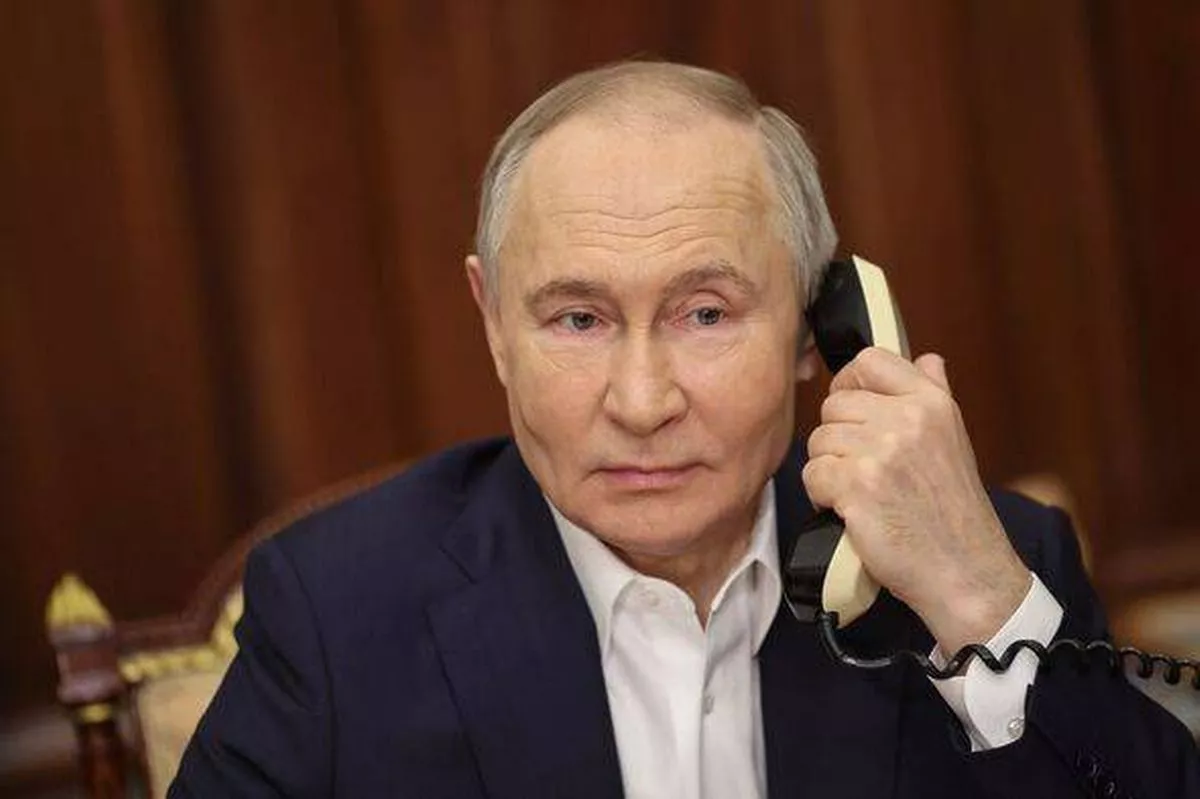 Putin’s mouthpieces have continuously stoked WW3 fears(Image: Getty)
Professor Glees adds that, in his opinion, we can no longer be sure that the US would enact Article Five of NATO – which sees an attack on one member country treated as an attack on all. Currently, the expert believes that the UK’s best defence is for ministers to try and persuade Trump that “he is wrong”.
“Since we are too weak right now, with more parking enforcement officers than troops in the UK, and Germany only slowly gearing up to mass conscription, we will have to try to persuade Trump he is wrong – as he is – and hope he changes his mind.”
Another expert, Dr Arnab Basu, CEO of Kromek, argues that the UK government is signalling they are moving in the right direction, but expresses concern about the speed at which the necessary investment might come into place to strengthen the British Armed Forces. “The UK MOD is saying all the right things about its defensive strategy, as outlined earlier this year in the Strategic Defence Review, but the gears of government and the bureaucracy grind so slowly,” he explains. “It’s difficult to see much real progress as CEO of a British company.
“They have promised more defence spending, but we are yet to see the benefits. The reality is that the UK, and by extension, the world, faces its greatest military threat of a generation. Failure to take definitive action to prepare for a worst-case scenario could be our greatest mistake.”
Grim map shows potential devastation of nuke attack in UK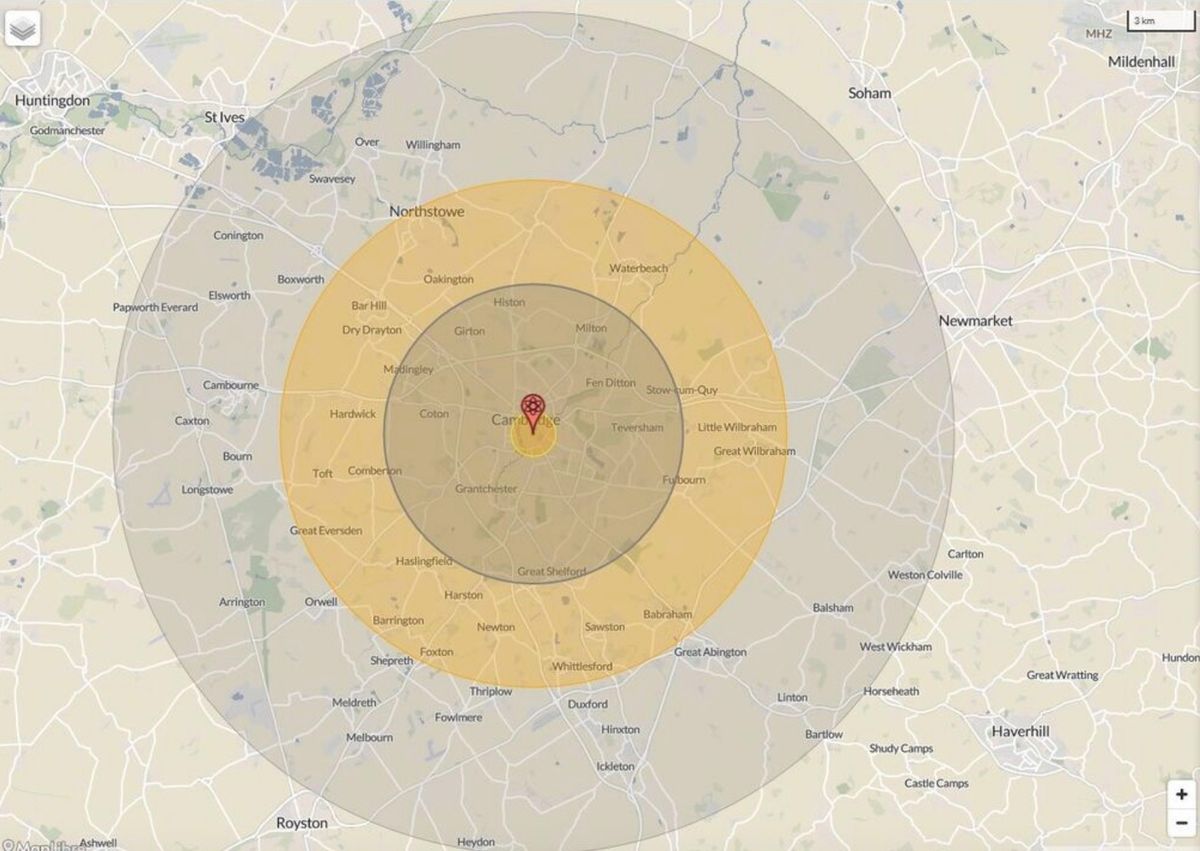 Blast map shows what happens if Russia nukes UK city(Image: NukeMap/Nuclear Secrecy)
NuclearSecrecy.com has created frightening Nuke Map tool, which aims to give a fair estimate of the potential damage caused by nuclear weapons. The brainchild of Alex Wellerstein, a science and nuclear weapons professor at the Stevens Institute of Technology, site users can ‘trial’ various horrifying tools, including a formidable 800-kiloton nuke known to be currently sitting in Russia’s arsenal.
The consequences of dropping this weapon over Cambridge, as jested about by Solovyov, would be nothing short of catastrophic. The nuclear fireball would engulf a radius of 2.97km squared, including the suburbs of Grantchester, Milton and Teversham, and the University’s main campus.
As claimed by the Nuke Map: “Maximum size of the nuclear fireball; relevance to damage on the ground depends on the height of detonation. If it touches the ground, the amount of radioactive fallout is significantly increased. Anything inside the fireball is effectively vaporised.”
The second zone, which would see “moderate blast damage radius”, would cover an area of 134Km2. Within this site, buildings would begin to collapse, and fires would break out. As explained by this terrifying map: “At 5 psi overpressure, most residential buildings collapse, injuries are universal, fatalities are widespread.
“The chances of a fire starting in commercial and residential damage are high, and buildings so damaged are at high risk of spreading fire. Often used as a benchmark for moderate damage in cities.”
The third zone, with an area of 384km2, would also be severely impacted, with the nuke map stating: “Third degree burns extend throughout the layers of skin, and are often painless because they destroy the pain nerves. They can cause severe scarring or disablement, and can require amputation.”
Meanwhile, those living in the light blast damage radius zone, situated around the edge of Cambridge, may well still suffer injuries, for example, to those who approach a window after seeing a flash. Given that flashes travel at quicker speeds than the pressure wave, this could still cause injuries to the population who may come up to a window after seeing a flash explosion.
According to the map’s predictions, Oxford will experience similar results. The inner zone, including the university campus, would be instantly vaporised, with damage extending as far out as Woodstock and Bicester.
‘Safest’ areas in UK during attack Experts have explained the safest areas to be in the UK (Image: Getty Images)
The International Commission on Radiological Protection (ICRP) states: “The best way to protect you and your family before, during, and after a nuclear blast is getting inside the centre of a building or basement.
“On August 6, 1945, Mr Eizo Nomura was in the basement of a building in Hiroshima, about 170 meters from ground zero. He survived the atomic bombing and died in 1982 at the age of 84. Most people within a few hundred metres of a nuclear detonation are not likely to survive, especially if unprepared.
“Be inside before the fallout arrives. After a detonation, you will have 10 minutes or more to find an adequate shelter before fallout arrives. If a multi-story building or a basement can be safely reached within a few minutes of the explosion, go there immediately. The safest buildings have brick or concrete walls. Underground parking garages and subways can also provide good shelter.”
Given this advice, many would naturally assume that London, with its extensive underground network, would be the safest place, with the tube tunnels having allowed some protection from blasts during the dark days of the Blitz.
However, some experts fear that modern nuclear weapons could penetrate much further than the bombs of World War II, meaning even the 58-metre-deep Hampstead station would still be too close to the surface.
Andrew Futter, a Professor of International Politics at the University of Leicester, previously told My London that the Underground “probably wouldn’t be deep enough if there was a direct hit”.
Therefore, should a nation such as Russia target one of the UK’s major cities – from London to Edinburgh – being outside of the blast zone would present the best chance of survival.
When it comes to the reach of nuclear blasts, several factors must be considered, including a radiation radius of 153 km2, a fireball radius of approximately 197 km2, an air blast radius between 321 km2 and 1,420 km2, and a thermal radiation radius of 12,960 km2.
Although these distances can vary depending on weather conditions, property researchers have previously compiled a list of places that could provide relative safety in this nightmare scenario. These 20 locations, listed by property portal EMoov back in 2017, are situated outside of the immediate range of blasts in major British cities:
- Cornwall
- Weymouth
- Folkestone
- Dover
- Margate
- Clacton-on-Sea
- Felixstowe
- Brixworth
- Bideford
- Aberystwyth
- Skegness
- Isle of Anglesey
- Barrow in Furness
- Lancaster
- Whitby
- Carlisle
- Dumfries
- Berwick-upon-Tweed
- Inverness
However, some of these areas are still close enough to blast sites to be affected by radiation swept over by winds. Therefore, the remote island Foula, on the Shetland Isles, could well be the safest place in the UK in this instance.