Trump’s administration has also pushed H1B visa changes that could raise employer visa fees to six figures and prioritize higher-wage applicants. The State Department paused visa interviews for weeks, canceled and later reinstated other student visas, and required applicants to disclose social media accounts. The government also tried to detain and deport pro-Palestinian student protesters before a federal court blocked the move.
Meanwhile, America’s commitment to academic freedom, openness, and free speech helped attract the world’s best scholars to U.S. campuses, shaping global business and science in the process. But, Trump has frozen or threatened to block millions in research funding to several top-tier universities over their DEI policies and alleged anti-Semitism, several of which have capitulated to administration demands.
Say Ja to Germany marks the first coordinated public effort among Mannheim, ESMT, and WHU. They will run joint media outreach, a shared social campaign with alumni and faculty voices, and appear side by side at international education fairs.

Joachim Lutz, president and dean of Mannheim Business School
Their message, Lutz says, is clear: “Germany is an excellent home for international students, as we stand for the highest quality, open-mindedness, and outstanding opportunities beyond higher education. We warmly welcome international students to Germany.”
The campaign echoes a broader push happening across Europe. The European Union this year launched Choose Europe for Science, pledging €500 million to support open research. National efforts have followed. This summer, ESMT Berlin was Germany’s first private university to secure an Alexander von Humboldt Professorship, a government initiative providing €1 million per year for research funds and support. Michael Weber from Chicago Booth was named to the role.
Poets&Quants recently sat down with Lutz to talk about Say Ja to Germany, what the country and Mannheim can offer international students and scholars, and how curiosity, strategy, and academic freedom will matter even more in an AI-driven era.
Yes, it’s a rather unusual story. I’m not originally from Mannheim, but I am an alumnus of Mannheim University. I studied business here from 1979 to 1984, and graduated in 1984. After university, I went into the corporate world including eight years in banking at Deutsche Bank, and then 15 years as a financial director at what may sound like a local company, but was actually the largest multinational sugar producer in the world at the time.
Following that, I spent 15 years as CFO and later CEO of a renewable energies company with a clear mission: to improve the world by decarbonizing transportation. We started in 2006, invested €1 billion in several factories, and yet transportation emissions have not changed. They remain at the same level today. While the electricity grid and recycling have improved, transportation has not moved much.
At a certain point, I felt I was old enough to consider retiring. In large multinational corporations like BASF, SAP, Exxon—you name it—executives typically retire at 63 or 64, so I thought that seemed like the right age. As CEO of a publicly listed company, you must publicly announce board changes. Within a couple of weeks of that announcement, I received three offers.
One was to go to Brussels, where I had previously spent a lot of time working on European renewable and climate issues. Another was to move to a similar corporate role. But the most meaningful offer was a call from my alma mater. It took me no time to decide. After a long and successful industry career, returning to the university felt right. That was five years ago.
I started as dean of the Business School, a role I still hold. Since September 1, I have also served as President of this part of the school. It’s wonderful work. Of course, you need a strong team, and it’s been an amazing journey moving from industry back into academia.
Mannheim Business School.
First, let me say that Mannheim may not be widely known globally, but as a city and region, it has unique characteristics that shape our identity. I like to call it the Mannheim DNA. It goes back to the 18th century in the palace where we are located and where we teach today. There was a very clever Prince Elector here, one of the group who chose the king in what is now Germany. He attracted many people, regardless of religion or nationality. This openness, innovation, and tolerance have stayed in Mannheim’s DNA.
Mannheim today is culturally rich and diverse, with a high level of ethnic integration. It’s also an innovative place—the first automobile was invented here. Carl Benz built his first car in Mannheim’s city squares. This spirit forms the background of our strategy.
Mannheim University, and Mannheim Business School specifically, has always been forward-thinking. We treated business as a science as early as 1907. In the early 2000s, we internationalized with triple accreditation, which was not common at the time. We used the Bologna reform to separate diploma programs into bachelor’s and master’s degrees, which increased student mobility. My predecessors recognized the opportunity, and I continued building on that direction.
Strategically, our focus has been to sharpen the school’s profile—international orientation in both student body and faculty, and greater visibility in the areas where Mannheim can contribute most. Today, our three core themes are transformation toward sustainable business and management, digitalization, and governance – not only in corporations, but also in states and public institutions.
Another pillar is thought leadership as a university and business school, meaning strong research and strong connections to real-world practice. We are planning to establish additional research centers in 2026.
The third pillar is our teaching portfolio, which continues to evolve to better prepare students for the job market. The skills needed today are changing rapidly with AI. Perhaps we need fewer books and more development of soft skills including managing people, strategic thinking, communication, empathy, and coordination. These are not traditionally emphasized in business education, but from my own management experience, the higher you rise in an organization, the more these skills matter.
The fourth pillar is connectivity with corporates, alumni, and our wider network. We listen to what industry needs, reflect that back into curriculum and research, and maintain close exchange. Our region is home to global players like BASF and SAP as well as many hidden champions. They hire locally and operate internationally, and this mindset helps shape our school.
Altogether, this forms Mannheim’s identity. It’s a small city – about 300,000 people – but the region has around 2 million residents, and the density of innovative companies is remarkable. This may be the secret behind our strong international rankings and visibility. We are a compact place with a very impressive global mindset.
If you look at the MBA programs, about 60% of our students are non-German, and most of them come from outside the EU. All teaching is delivered in English, as is the research environment. So anyone who is proficient in English and meets the qualifications can study here in Germany. There is no issue entering the country or obtaining a visa as a qualified person.
Yes. Particularly in the full-time MBA, this is the main driver for people coming to Mannheim. Looking at the statistics, around 85% of non-German full-time MBA graduates stay in Germany for work. This aligns with government policy aimed at attracting highly skilled workers.
The process works like this: if you are qualified to study here, you can enter Germany. After graduation, you have 18 months to stay and look for a job. If you find a suitable, qualified position, it is quite straightforward to obtain permanent residency.
This began last year, in response to changes we observed regarding academic freedom in some countries. We saw increasing restrictions on research and open discussion, and that was an igniting point for us. The top three German business schools – ESMT, WHU, and Mannheim – sat down together to discuss what we could do. We asked ourselves how we could respond and communicate our strengths as a collective.
At this stage, it is mainly a communication platform and a joint message. We wanted to make a coordinated statement, which in my former business career would have been impossible – coordination of interests was forbidden. But in academia, it’s necessary. Up until now, most attention in the MBA world has been on the U.S. and the UK. When you talk about MBAs, the landscape feels heavily Americanized.
However, Europe has advanced significantly in research-based academics and professional education. We don’t simply copy; we approach research differently, and our funding is different as well. Studying an MBA in Germany is far less expensive which allows us to attract more talent. Our educational system is not built on high fees but on cultivating talent. It’s a state objective to ensure that young people receive strong education, and that benefits the country in the long term.
The mission is to attract students from regions that traditionally choose the U.S., but not only students. A key focus is also on attracting professors. Student flows globally have not changed much; people still often go to American or UK business schools because of the strong brand reputation. An American MBA is still highly valued.
Where we see change is on the professorial side. Not necessarily among native American professors, but among non-American professors working in the U.S. Many are reconsidering where they want to work. We currently have about seven open faculty positions, and the number will grow as we expand and as retirements come up. When I last checked the applications, more than 15% of applicants were based in the U.S. This is new.
We believe academic freedom plays a role here. Germany offers a safe, less politicized environment for research and teaching, which is attractive. This gives us an opportunity to bring top talent here, and we are looking forward to hiring some of them.
So the message of Say Ja to Germany” is: Europe – and Germany in particular – is a strong, research-driven, affordable alternative for both students and academic talent.
Yes. Not only American professors, but also non-American professors currently working in the U.S. are applying. More than half of all applicants are non-German, and within that group, about 15% come from the U.S. This suggests Germany is becoming more attractive than before, and perhaps Mannheim specifically.
Success builds over time. When strong faculty come, they encourage others: Come to Mannheim. We are here. Let’s research together. Let’s collaborate across disciplines. We are at a point now where this international dynamic is working well, particularly on the professorial side.
I know that government officials from the EU, individual EU countries, and even German states travel to the U.S. to attend job fairs and recruit talent. I don’t want to criticize that, but I believe it’s more effective when universities speak for themselves – university to researcher, workplace to workplace – rather than as a broad national campaign.
When a professor considers moving, their questions are about the faculty, colleagues, research environment, not about the country in general. Politicians naturally want talent to come to Germany, France, Belgium, the Netherlands, the EU as a whole. But this goes beyond political messaging. It needs to happen at the academic level, based on reputation and quality.
That’s why the cooperation between Mannheim, WHU, and ESMT is powerful. These three universities are known for their quality, their networks, and the strength of their faculty. That credibility is what matters most when attracting researchers.
Yes. The U.S. remains one of the most important academic job markets. Our faculty actively participate in hiring platforms and job markets there, particularly the large annual recruiting event, usually in January.
It’s important to meet people face-to-face. You learn more by speaking with someone, looking them in the eyes, understanding their style and how they think, than by reading a CV alone. These interactions build comfort and trust. So yes, we actively use these opportunities in the U.S. for recruitment.
We do not have an active cooperation where we share hiring or operations. Each school continues its own recruitment activities. The initiative is primarily about communication and visibility.
If you want people abroad to think of Germany as an option, you need recognizable names: strong brands that signal quality. A small business school in the Black Forest, or in the Alps, may not gain international attention alone. But when Mannheim, WHU, and ESMT speak together, it creates a lighthouse effect. Like choosing a car brand, people look for names they know and trust.
Each of the three partners invests in its own brand and identity, and “Say JA to Germany” communicates that collectively. It is about awareness, making sure prospective students and professors see Germany as a serious, research-driven destination.
Yes, I believe so. We do not see many U.S. students – that remains extremely rare, and there is no trend there. But we clearly see growth from India, China, and other parts of Asia. These are strong regions for high-skilled applicants.
Students today look not only at education, but also at the job market. They ask, Does this degree give me access to work opportunities afterward? In the U.S., immigration conditions and job security for foreign graduates are less predictable than they were ten years ago. So some students consider alternatives. Germany is stable, central in Europe, and connected. From Mannheim, you are three hours by train to Paris, five hours to Berlin, and Frankfurt Airport is close by. Our region has major industry and lots of companies.
Germany is undergoing structural changes away from traditional automotive manufacturing and toward life sciences, hospital management, biotech, data, and related sectors. There is enormous investment happening now, and many new jobs will be created in the coming years. This is attractive for students, especially from Asia and Eastern Europe, who are looking for strong technical and business environments.
They choose business schools that can prepare them for this job market – its character, expectations, required hard skills and soft skills. Soft skills, for example, differ between regions. What is needed in California might be different from what is valued in Germany. Young people today are mobile and adaptable. My son is a chemist and he studied in Switzerland, California, and Japan. He could work anywhere, but he said his place might be Europe, or maybe Japan and not the U.S. That is an example of this shift.
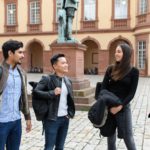
Mannheim Business School is joining ESMT Berlin and WHU to welcome international students through the Say JA to Germany campaign.
This is a very relevant question, and we are already in the middle of that process. We are expanding our master’s portfolio. Alongside our Master in Management, which is currently our main program, we are adding two new specialized master’s programs: one in Finance and one in Operations & Supply Chain Management.
This helps sharpen our profile for students aiming at emerging industries. Operations and supply chain, for example, have become critical areas. Everyone remembers the ship blocking the Suez Canal. Suddenly the world realized how fragile supply chains are. With deglobalization and shifting tariff systems, supply chain expertise is in demand. We will launch this program next year, with applications opening in spring.
The second new program is the Master in Finance. Regulation is evolving rapidly in Europe. Industries must adapt, even when not everything works perfectly. Finance, reporting, and accounting are gaining new importance. The landscape is changing, and education must adapt accordingly.
Beyond the new master’s programs, we expect changes in how AI affects the workforce. Tasks like gathering information or preparing files will be automated, reducing lower-level operational roles. But decision-making will become faster, requiring stronger soft skills at higher levels: communication, cooperation, strategic thinking, innovation. The most important trait may be being open-minded and adaptable. Negotiation means sometimes you win, sometimes you give. In politics we often see the opposite attitude, but in corporations you need integration and teamwork to spark ideas.
To address this shift, we are also expanding customized executive programs for companies, acting as sparring partners to develop the skills they need. So growth will come in two areas: New master’s programs in Finance and Operations & Supply Chain as well as customized programs for corporates, which we expect to grow significantly We are preparing facilities and infrastructure to support this growth.
In every business program – marketing, finance, operations – AI will play a major role. We must integrate it everywhere. Without it, modern management education doesn’t work.
We need to approach AI positively. I come from a generation that was skeptical of change: I remember in 1990, when I became finance director, we debated whether we even needed email. In 1999, I needed special board approval to get a mobile phone in my company car. But technology moved forward, and so must we with AI.
Students expect this. MBA students – and bachelor’s and master’s students – want to know how to use AI in research, in writing their thesis, and in business practice. We must adapt how we teach and even how we design exams. AI will make access to basic knowledge extremely fast. But one thing AI cannot fully replace, at least not yet, is strategy.
Successful corporate strategy is seldom pure logic. It involves unexpected combinations of products, markets, innovations, ideas others haven’t seen yet. If AI could solve strategy fully, competitors would all make the same decisions, financial markets would move uniformly, and everything would be predictable. It isn’t. Strategy still requires human judgment, creativity, and courage.
Curiosity drives success. In career, research, partnerships, curiosity is essential. It is what we must instill in students at all levels. In fact, executive MBA participants are often the most curious group. They come with questions, experience, and motivation to explore new approaches.
So the MBA remains strong and relevant at Mannheim. AI will shape the content, but human creativity, strategy, and curiosity will continue to define its value in Germany and beyond.
I followed the full Senate hearing on the recent incidents related to Palestine. I watched how the three university presidents responded to questioning, and I was shocked by how defensive the answers were. I don’t believe those were their personal views; I suspect they were speaking under legal advice. But still, it was surprising.
In Germany, such a situation is unimaginable, culturally and legally. Our constitution guarantees freedom of speech, research, and science. No institution, no government body – not even I as dean – can tell a professor to change their research direction. It would be nearly impossible. Academic freedom is protected by Article 5 of the German Constitution. This is deeply rooted in historical experience, especially from the Third Reich. We learned how dangerous interference in universities can be. We never want to go back to that.
This protection is strongly valued. When hiring, researchers choose a place not only based on funding or salary, but on who is there, what they research, and whether collaboration is possible. And in truth, the world of top researchers is small – they know each other. My professors know far more about peers at other high-ranked universities than I do, because they collaborate closely.
So when I watch events in the U.S., I’m concerned. Academic freedom is essential. It’s what attracts talent, fuels innovation, and sustains courageous leadership. Germany takes this seriously, and it is one of our strongest assets.
Academic freedom cannot be measured in money. Quality of life cannot be measured only in money. A society’s openness, how people speak to one another, how freely researchers can pursue ideas, these things matter deeply when choosing where to live and work.
We see this with young scholars. They may go to the U.S. first and find success in a highly competitive environment. But many later ask themselves: Do I want to live like this for 40 years, or for 5 or 10? Should I return to Europe, or try another country? That is happening now.
Anything else you’d like to add?
Students who come to Mannheim have a special mindset. They want to achieve something, to reach out, to move forward. They choose Mannheim deliberately.
Just yesterday, I spoke with the editor of one of the major newspapers in our region. She is still new here, and she said, “Wow—this is impressive.” It’s a city of around 300,000 people, yet everyone seems to know everyone. You speak on one side, and someone hears it on the other. You connect very quickly.
Mannheim was historically an industrial city in the 19th and early 20th century. Now it is becoming an educational city. The university has about 12,000 students, and we contribute 5,000 of them, plus additional institutions in town. People who come to Mannheim come because they want to work and accomplish something. That drive is part of our DNA.
DON’T MISS: JENS WÜSTEMANN ON BUILDING GERMANY’S MOST AMBITIOUS BUSINESS SCHOOL AND ESMT BERLIN PRESIDENT JÖRG ROCHOLL ON GROWTH, DEEP TECH & COMPETING FOR GLOBAL TALENT
The post ‘Say Ja To Germany:’ 3 Top Business Schools Partner To Woo World’s Students appeared first on Poets&Quants.