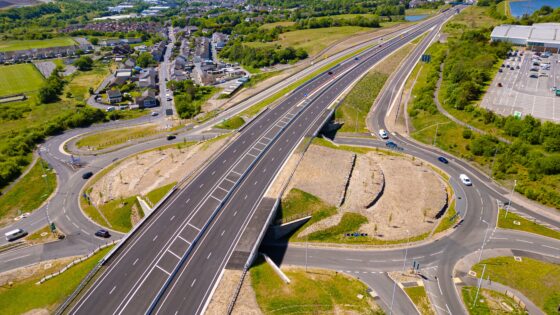
Completion of the final stage of the A465 Heads of the Valleys upgrade has stirred controversy about the viability of the scheme’s funding model.
The £590M dualling scheme for the 17.3km stretch of the A465 between Dowlais Top and Hirwaun in South Wales was officially re-opened on 30 May, having begun in May 2021 under design and construction contractor Future Valleys Construction (FCC Construcción).
The scheme – which has transformed the road from a three-lane single carriageway into a 70mph (110kph) dual carriageway with six junctions – is the final stage of the wider Heads of the Valleys upgrade programme. With a total estimated cost of £1bn across six separate schemes to upgrade 40km of the A465 between Hirwaun and Abergavenny, the overall scheme’s aim has been to modernise the A465 – a key route through South Wales first constructed in the 1960s – to enable better traffic flow and safe overtaking.
Challenges and solutions
Described as the biggest road infrastructure project ever commissioned by the Welsh Government, the Dowlais Top to Hirwaun scheme is also considered one of the most challenging, entailing widening online within a transport corridor hemmed in by steep slopes.
It is also groundbreaking because of its funding model – as it is one of the first projects to use the Welsh Government’s Mutual Investment Model (Mim). That funding model has proven a testing one due to unforeseen factors that impacted the project from inception.
From a technical point of view alone, the scheme would test the smarts of most engineering specialists. Crossing two steep valleys, it entailed moving 2.2Mm3 of earth and rock and includes a raft of structures: three steel truss footbridges, five underpasses, 13 single-span concrete bridges, three two-span concrete bridges, six single-span steel bridges, construction of the new Nant Hir three-span steel bridge, the new Taf Fawr three-span balanced cantilever concrete bridge and the widening of the existing concrete open spandrel arch bridge over Taf Fechan. Also folded into the scope are 28 retaining walls, 38 culverts and the upgrading of existing junctions.
According to FCC director Mike Cummine, the area’s industrial past presented a specific challenge, with historic mineworking present over about one third of the footprint. As a result, under the carriageway, a risk-based approach was followed with a geogrid included under the subbase, he says.
He explains that in the “very rare event” that a void migrated to the surface under a carriageway, the grid was designed to prevent collapse, with a depression visible on the carriageway allowing for planned maintenance interventions.
Cummine adds that “complicated” natural geography was a key element of the scheme, as this area of Wales is characterised by deeply incised river valley with steep-sided slopes.
“Across the scheme, there’s 210m of variation just in altitude – crossing some very steep river valleys. So if you want to put a bridge across the top of that, the temporary work required just to get to the work sites down a steep slope can be very challenging.
“This entailed all sorts of techniques to get down to the work site and then build ourselves back up to the road surface and because you’re doing an online improvement, the corridor is very narrow.
“To access the bottom of the valleys to construct foundations required extensive temporary earthworks and retaining solutions. These included soil nails, temporary shotcrete facing, block stone and gabion basket retaining walls.”
In addition, the confined route required online reconstruction of the existing carriageway, changing its level by up to 10m in the exiting footprint, Cummine says.
“This led to very challenging traffic management requirements. Over 110 traffic diversions were required to move the traffic over to allow sections to be partially built before moving traffic onto them to create enough space to allow the second carriageway to be constructed.”
The A465 also passes close to environmentally sensitive areas, including the edge of the Brecon Beacons National Park and the habitats of protected species such as bats, dormice and great crested newts. This required mitigation measures including habitat creation and mammal crossings within culverts.
Mim lessons
Established to finance major capital projects and support investment in social and economic infrastructure projects, Mim enables private partners to build and maintain public assets, while the Welsh Government pays a fee to the private partner to cover the cost of construction, maintenance and financing the project.
Under Mim, the Welsh Government invests in the scheme from the outset and acts as a shareholder in the project. At the end of the contract, the assets are transferred into public ownership.
However, as this scheme eventually illustrated, the devil is in the detail, because what Mim ensured for the construction of the Dowlais to Hirwaun stretch was a fixed-price contract. This means risks are carried by the contractor, who had to deliver the scheme on budget and on time or risk penalties for non-delivery.
In this respect, timing and global events were not on FCC’s side; the outbreak of the Covid19 pandemic in early 2020 caused initial disruption and while FCC was able to manage that impact, the pandemic caused delays. These were compounded by later geopolitical impacts such as the Ukraine conflict and the Palestine-Israel conflict, which disrupted supply chains, increased energy and material costs, and sparked market volatility.
These challenges tilted the scheme’s delivery and ultimately its risk profile into unknown territory.
“Mim puts a real focus on delivery, which is one of the benefits it brings, but if you mix that in with, for example statutory utilities which don’t have a contractual relationship with the main contractor and operate in a different way, particularly when something like Covid-19 comes along, that can really interfere with your plan for delivery,” Cummine notes.
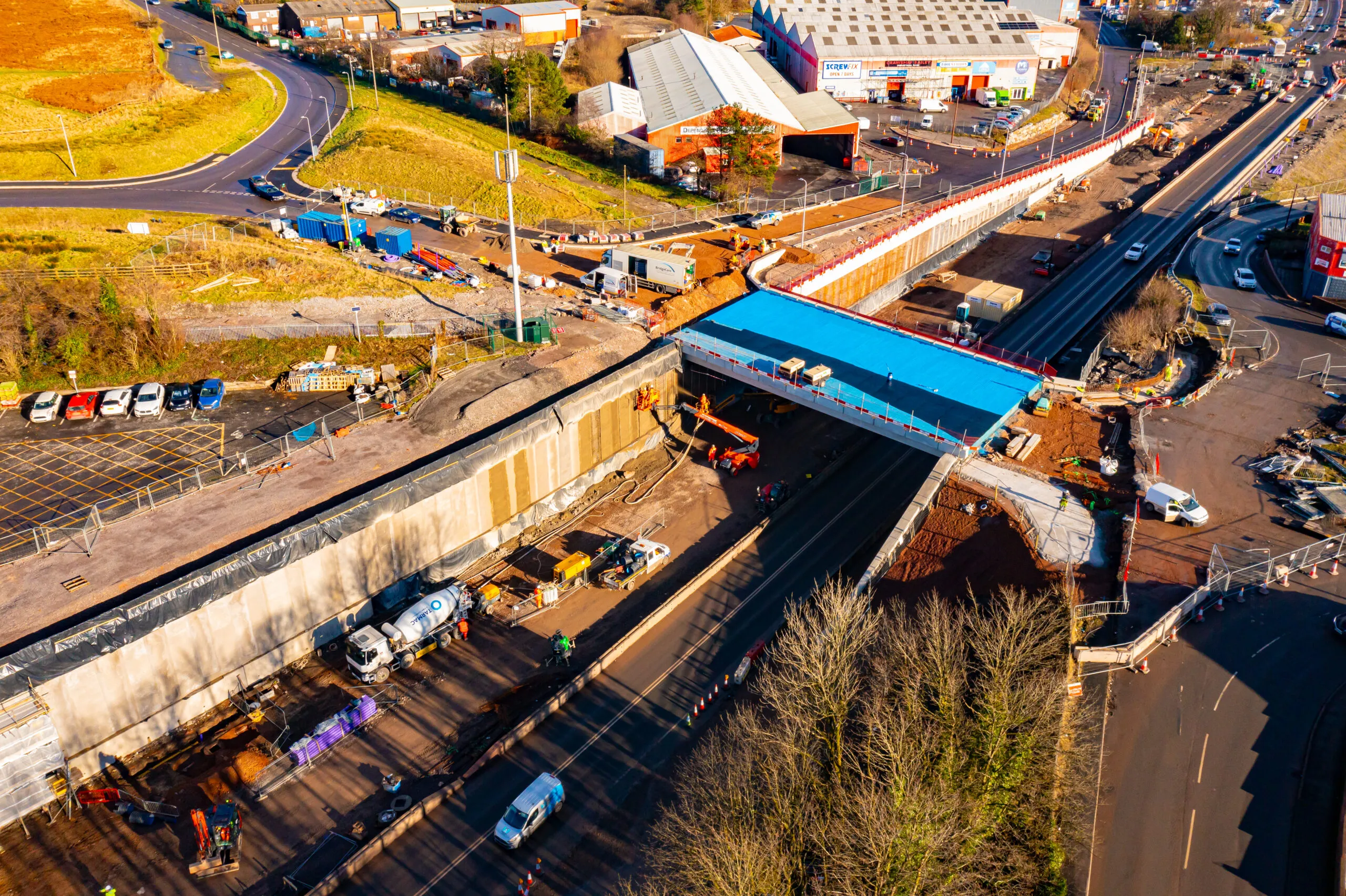
The demolition and reconstruction of Bryniau Bridge was one of a number of bridge works entailed in the Dowlais Top to Hirwaun scheme
Extraordinary efforts
FCC Construcción project director Ignacio Poyales Morales explains that ballooning material costs, in particular as a result of the pandemic and the Ukraine conflict, heavily impacted FCC’s bottom line.
“Steel, concrete, aggregates, timber – all the materials required in construction were affected,” he says. “For example, we were procuring the steel at a price three times higher than expected, while concrete was around 40% higher. Additionally, in 2021 we had around 5.4% inflation, which went up to 10.5% in 2022, while in 2023 it was 4%, with fuel prices and energy prices affected. Our financial model was based on 1.6% inflation.”
To deliver the project on time and on budget, FCC had to wear many of these costs. And it had to implement extraordinary efforts, he says.
“We decided to try to always have the resources available at any time, regardless of when we were going to need them, because we didn’t know when, for example, the utilities were going to finish and were in a condition to resume the work. Our machinery, plant and equipment are very big, so we could not constantly be going in and out of the project.”
The measures also included changing the sequence of works; altering the earthworks strategy including increasing earthwork haul distances; creating intermediate material stockpiles and designing complex traffic management strategies.
These efforts also supported dealing with Wales’ wetter than typical weather during construction. The years 2021, 2022 and 2023 each had an average of 250 rainy days per year in that area, although last summer, the last year of the project, reversed the trend by proving unusually dry.
The measures meant FCC was ready to make the most of every dry day, Poyales Morales says – but “they came at a very high cost”, with the team working through weekends, nights and holidays and deploying additional resources.
Other strategies utilised by FCC to keep the project on track – and that had the potential to heighten its risk burden – included construction of some structures prior to getting the final design approved, instead relying on advice from FCC’s technical experts; implementing variations prior to agreement, and implementing changes that required variation to things like Side Roads Orders – the document that grants alterations to local roads and private accesses during construction – in advance of authorisation.
Mitigating disruption was also key. Road users and stakeholders were kept informed via channels including social media, newsletters, information hubs and meetings, supported by the Welsh Government website. Mobile phone data was also used to provide real-time journey information on variable messaging signs at entry points to the works.
Without these efforts, FCC estimates the project would have been delayed by a year, Poyales Morales notes.
Bearing the cost
Given the original budget of £590M, the final cost was respectably in line with that figure, Poyales Morales says. However, he notes: “As a result, we entered into substantial losses.”
Those losses represent an important lesson on the future viability of the Mim model. He indicates that in the case of unexpected impacts, the existing funding model’s transfer of risk relating to FCC could have longer-term implications for other Mim-funded projects.
“The Mim model is a very good way to develop major infrastructure projects in Wales. It gives additional funding to the authority and the preliminaries of the Mim model are quite reasonable, because it is based on a reasonable risk transfer to a private partner.
“The big difference in this case however is that FCC entered the Mim contract before the Covid-19 pandemic, before the Ukraine war and before the Palestine-Israel conflict – and it’s a model that is not valid when extraordinary events happen.
The way this model is written means that all the risk is transferred to a private company that is not capable of managing all these events and the consequences for the project.”
“We consider that this not a reasonable risk transfer and is something that the private company cannot bear – in short, we’re currently carrying all the risk in the project,” he says.
“This is also in the context that the Welsh Government has been heralding this as an incredibly successful project,” he confirms, adding that FCC is currently in discussions with the Welsh Government to address the situation.
At the time of writing, FCC cannot disclose or quantify the financial hit the company has taken, as those discussions are ongoing, while potential ways to address the structure of the Mim to deal with unexpected impacts are also a work in progress. But Poyales Morales says he is optimistic that FCC and the Welsh Government can resolve this “discrepancy”.
“We don’t have any problem in terms of taking all the risk that a construction company has to take to do a lump sum price, and we know how to deal with weather, ground conditions, temporary works – all this is part of a contractor’s risk. We are not questioning that at all. The difficulty is if a contractor has to deal with something that is happening worldwide, like a pandemic or a conflict, we consider that this risk is not logical.”
The outcome of discussions with the Welsh Government could have implications for Mim.
“In the case that we would like to tender another Mim project, either we would need to provide an extraordinary risk allowance that could ruin the project, or the public will end up paying an extraordinary amount that maybe is not worth it. So there has to be a commonsense approach with this contract.”
“So, we are trying to convince the Welsh Government that their approach will decide the future of the Mim model, because who is going to tender under these circumstances?” he says.
Poyales Morales concludes: “It’s been more painful than should have been, but while we are in discussions, we have to be optimistic. Everybody has recognised the impressive work we did. We only we need the final colour to the painting, which is to iron out these contractual issues.”
Like what you’ve read? To receive New Civil Engineer’s daily and weekly newsletters click here.