Using the James Webb Space Telescope, astronomers may have discovered the first evidence of dinosaur-like monster stars that existed shortly after the Big Bang. These prehistoric stellar titans are theorized to have had masses as great as 10,000 times that of the sun.
Like the dinosaurs, these monster stars aren’t around anymore, but like Earth’s geology is populated by fossils of dinosaurs, the universe is filled with the “cosmic fossils” left behind by these earliest stars: black holes. In fact, confirming these stars existed at such tremendous masses in the early universe could help explain how supermassive black holes grew to masses equivalent to that of millions of suns before the cosmos was even 1 billion years old.
You may like
“Our latest discovery helps solve a 20-year cosmic mystery. With GS 3073, we have the first observational evidence that these monster stars existed,” team member Daniel Whalen of the University of Portsmouth in the U.K., said in a statement. “These cosmic giants would have burned brilliantly for a brief time before collapsing into massive black holes, leaving behind the chemical signatures we can detect billions of years later. A bit like dinosaurs on Earth — they were enormous and primitive. And they had short lives, living for just a quarter of a million years — a cosmic blink of an eye.”
A galaxy with strange chemistry
The “smoking gun” in this case was an imbalance of nitrogen to oxygen in GS 3073 that can’t be accounted for by any known type of star. The galaxy has a nitrogen-to-oxygen ratio of 0.46, which is much greater than can be explained by any known type of star or stellar explosion.
“Chemical abundances act like a cosmic fingerprint, and the pattern in GS3073 is unlike anything ordinary stars can produce. Its extreme nitrogen matches only one kind of source we know of — primordial stars thousands of times more massive than our sun,” team member Devesh Nandal from the Center for Astrophysics (CfA), Harvard and Smithsonian, said in the statement. “This tells us the first generation of stars included truly supermassive objects that helped shape the early galaxies and may have seeded today’s supermassive black holes.”
The team took this information and modeled the evolution of stars with masses ranging from 1,000 to 10,000 times the mass of the sun to determine what elements the stars would forge and then seed through their galactic homes following their supernova deaths. This revealed a specific mechanism that could create a massive amount of nitrogen.
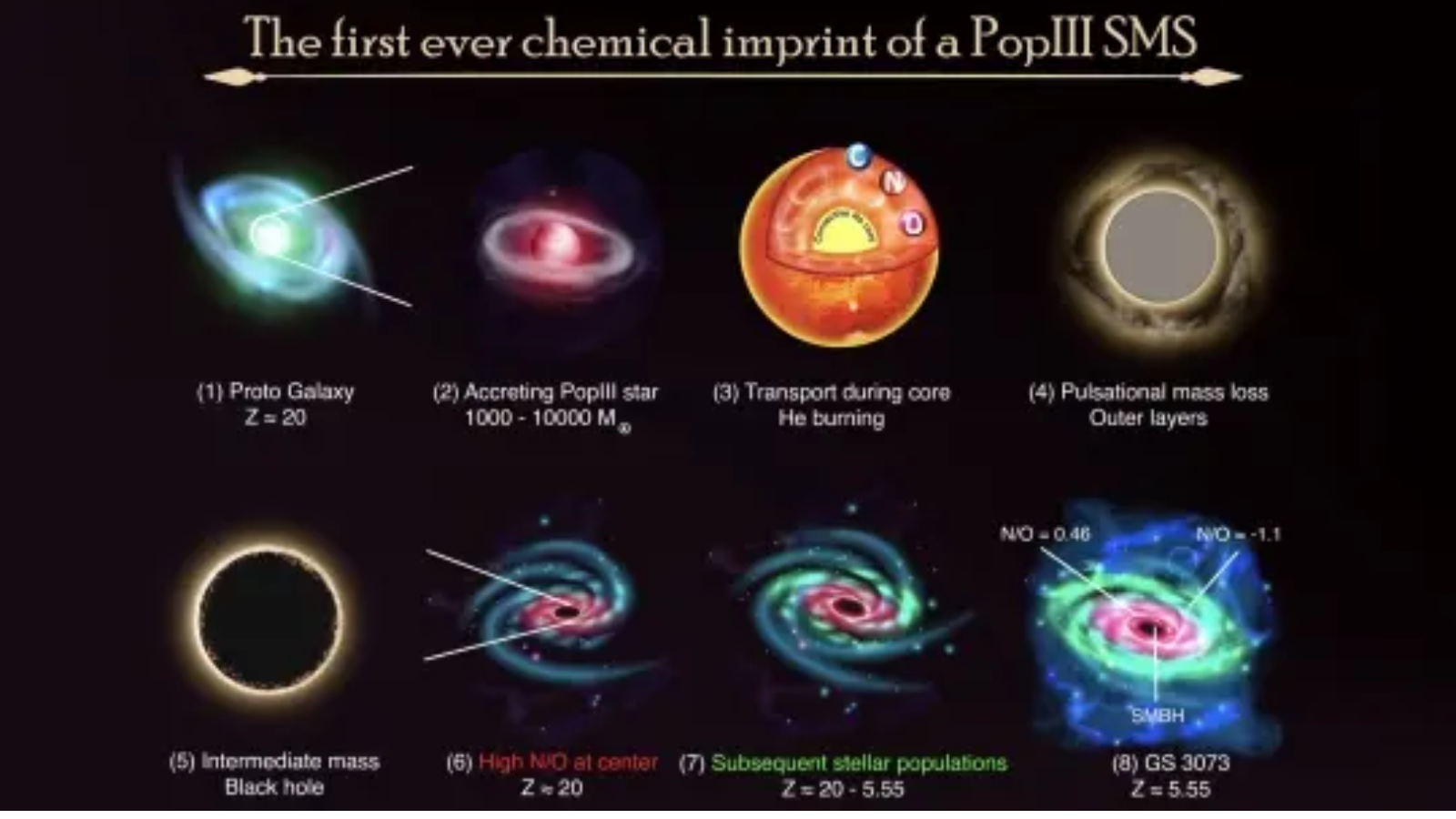
A diagram showing how the first stars enriched the chemistry of their galaxies (Image credit: University of Portsmouth)
These monster stars burn helium in their cores to create carbon, which then “leaks” into an outer shell of the star where hydrogen is burning. The fusion of carbon and hydrogen then creates nitrogen, which is disturbed through the star via convection. Following this, nitrogen-rich matter escapes into space, enriching the surrounding gaseous material.
The fact that this process continued for millions of years can account for the nitrogen abundance in GS3073. Stars with masses less than 1,000 solar masses, or greater than 10,000 solar masses, don’t produce the same chemical enrichment.
The team’s research also predicts what would happen when these dinosaur stars reach the ends of their lives, suggesting that they directly collapse into black holes. The absence of a supernova blast means these black holes can still have masses thousands of times that of the sun, which would give them a major head start in supermassive black hole growth.
Indeed, there is a feeding supermassive black hole at the heart of GS 3073 that could be the “daughter” of mergers between the black holes created by these monstrous stars.The team will now hunt for other early nitrogen-rich galaxies in the early universe, which will add strength to the existence of these monster stars.
The team’s research was published in November in The Astrophysical Journal Letters.