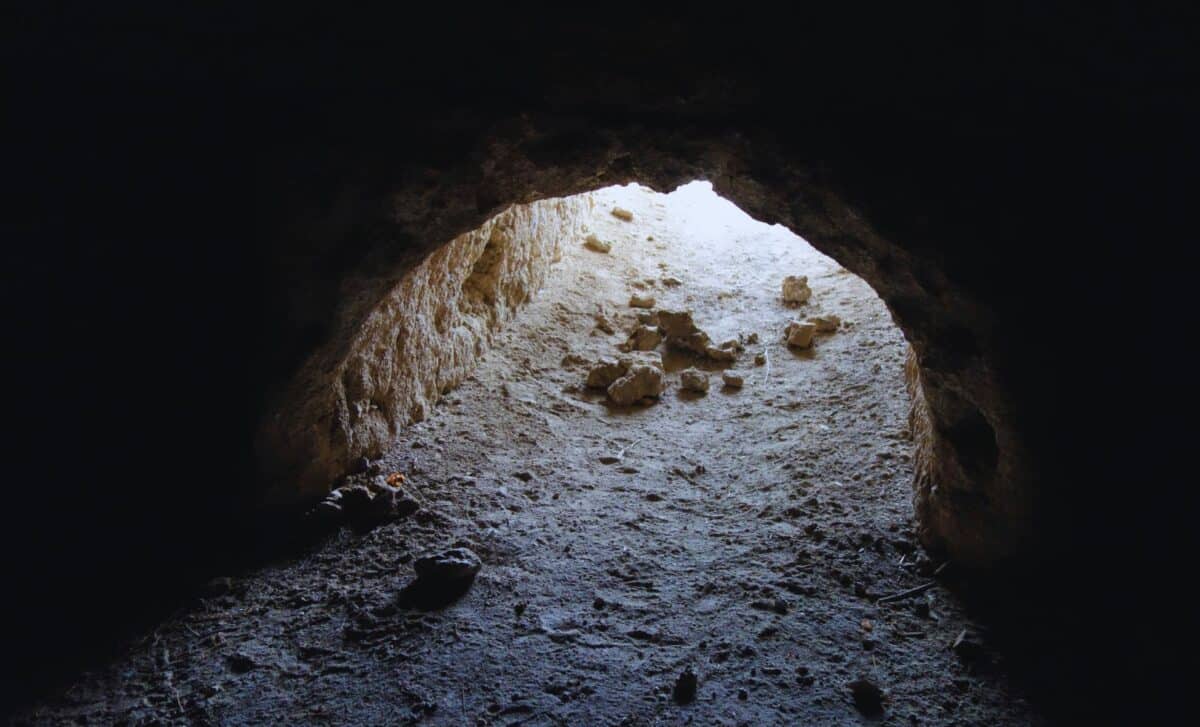
Beneath the rolling hills of southern Brazil and northern Argentina, an extraordinary discovery has stunned scientists: giant tunnels carved into solid rock. These ancient structures, some stretching over 600 yards, were not created by humans or geological forces.
Unlike the usual geological formations such as river channels or caves, these tunnels have a distinct, purposeful design. Their size and complexity point to large animals as the creators, and the leading theory is that these tunnels were crafted by megafauna—specifically, giant ground sloths.
A Tunnel Network Shaped by Giant Sloths
According to recent research published in Science Advances, the size of these tunnels is nothing short of impressive. Some are long enough to span the length of two football fields and tall enough for an adult to walk through without bending down. When first discovered, the sheer magnitude of these burrows raised eyebrows.
These tunnels are carved into materials like sandstone, weathered volcanic rock, and consolidated sands, materials so tough that humans or simple tools would struggle to excavate them. Yet, the underground passages are remarkably uniform, with long, smooth walls etched with parallel claw marks.
Heinrich Frank, a geologist at the Federal University of Rio Grande do Sul, and his team have mapped over 1,500 of these burrows, spread across southern and southeastern Brazil. These passageways appear to follow a network pattern, crisscrossing in dense clusters. It’s almost as if they were deliberately dug and maintained over many generations.
“There’s no geological process in the world that produces long tunnels with a circular or elliptical cross-section, which branch and rise and fall, with claw marks on the walls,” Frank explained.
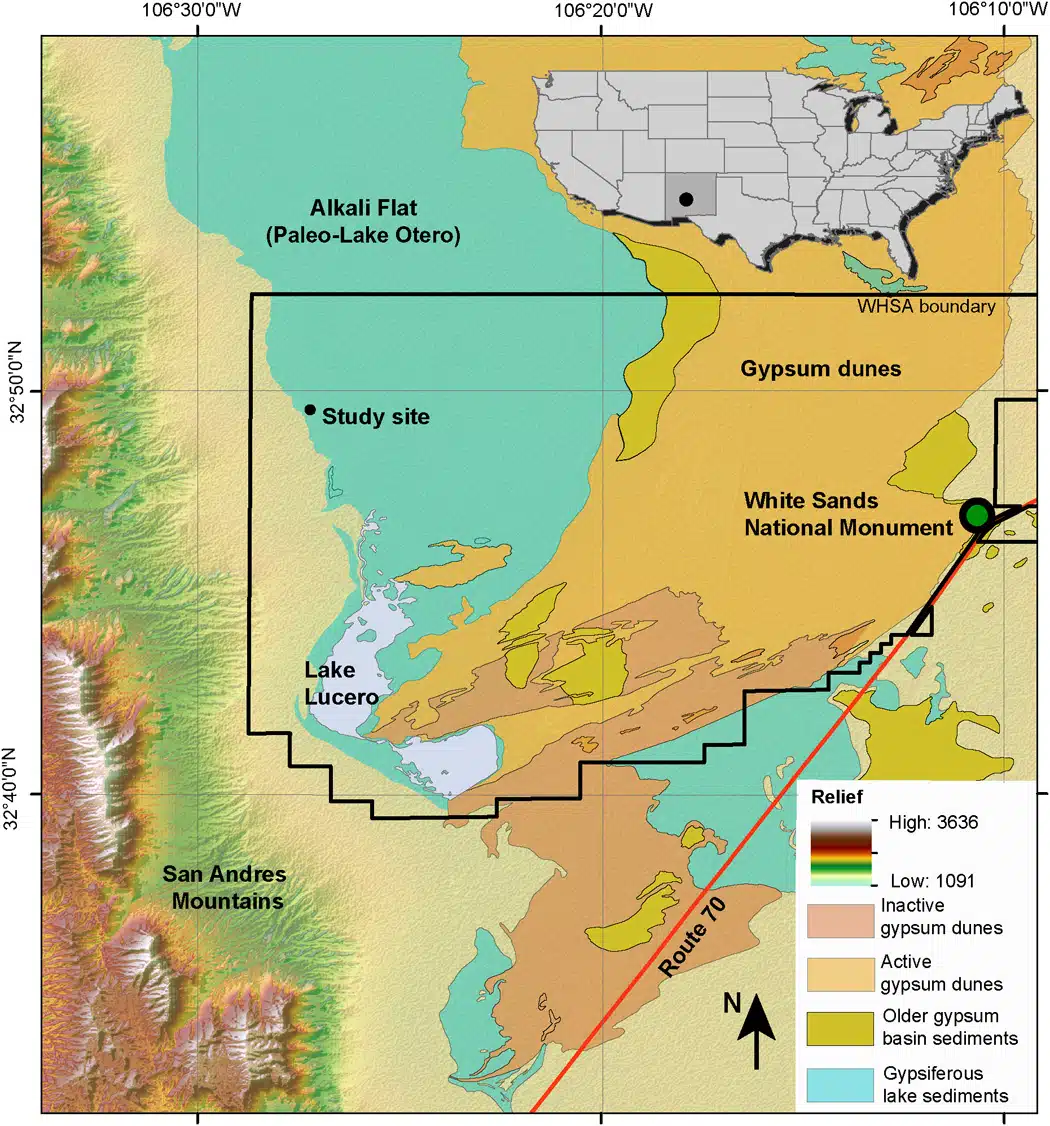 Map showing the study site within White Sands National Monument. Credit: Science Advances
The Claws That Carved the Earth
One of the most striking pieces of evidence in identifying the tunnel’s creators is the claw marks left on the walls. They are deep, parallel grooves that match the distinctive claws of the giant sloth, Megatherium. While some researchers initially suggested other candidates, like armadillos, the shape and size of the claw marks align more closely with the giant ground sloth, which had massive, curved claws ideal for digging into the earth.
The Megatherium was no small creature. Standing 12 feet tall and weighing up to four tons, this behemoth was as large as an elephant and likely used its massive claws to dig deep into the earth.
The tunnels, about six feet across and just as tall, align perfectly with the dimensions of Megatherium. These sloths, equipped with powerful forelimbs, were capable of reshaping the landscape over time, digging these tunnels for shelter or protection from predators.
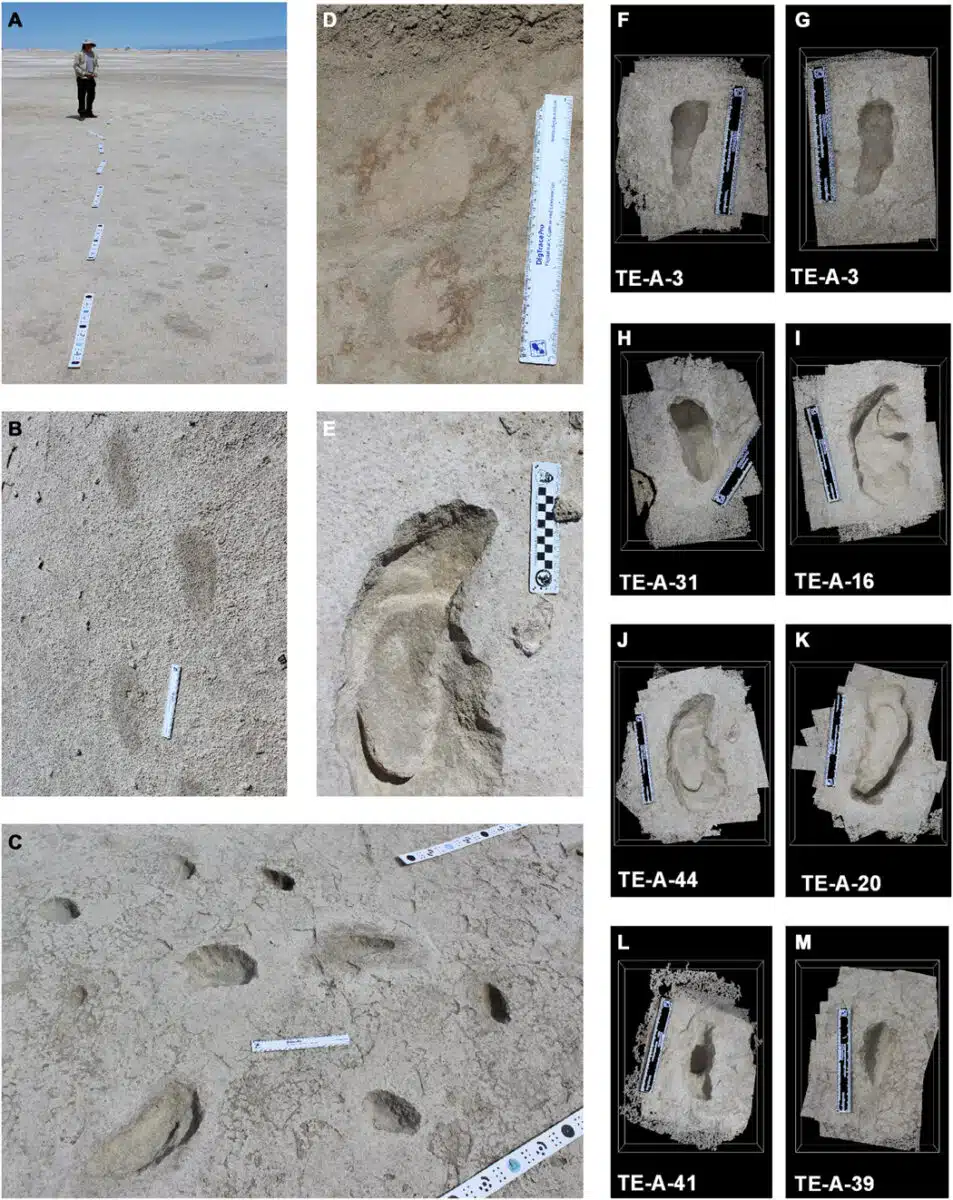 Detailed images and 3D scans of human and animal footprints uncovered at White Sands. Credit: Science Advances
Human and Giant Sloth Interaction: Was It Hunting or Play?
In fact, during the Ice Age, humans and these enormous creatures coexisted, and there’s evidence suggesting that humans hunted them.
“It is possible that the behavior was playful, but human interactions with sloths are probably better interpreted in the context of stalking and/or hunting,” the researchers wrote. “Sloths would have been formidable prey. Their strong arms and sharp claws gave them a lethal reach and clear advantage in close-quarter encounters.”
Perhaps the giant sloth retreated into the safety of its underground den, seeking refuge from the dangers of the outside world. The design of these burrows—large, winding, and deep—would have made them an ideal hideout.