PLANS to remove restrictions on cycling on Edinburgh’s busy, pedestrian-heavy Rose Street have met local opposition.
The local community council and Living Streets, a group campaigning for greater pedestrianisation in the capital, have claimed that introducing more cycling traffic onto the street could make the street more dangerous and introduce conflict between pedestrians and cyclists.
The council is due to consider a traffic regulation order (TRO) to provide exemptions for cyclists to allow contraflow cycling on eight currently one-way streets in Edinburgh, with council officers recommending the order for approval.
One of the streets concerned is Rose Street – one of Edinburgh’s most famous lanes – which is currently one way and has been described as the closest thing Edinburgh has to a pedestrianised avenue.
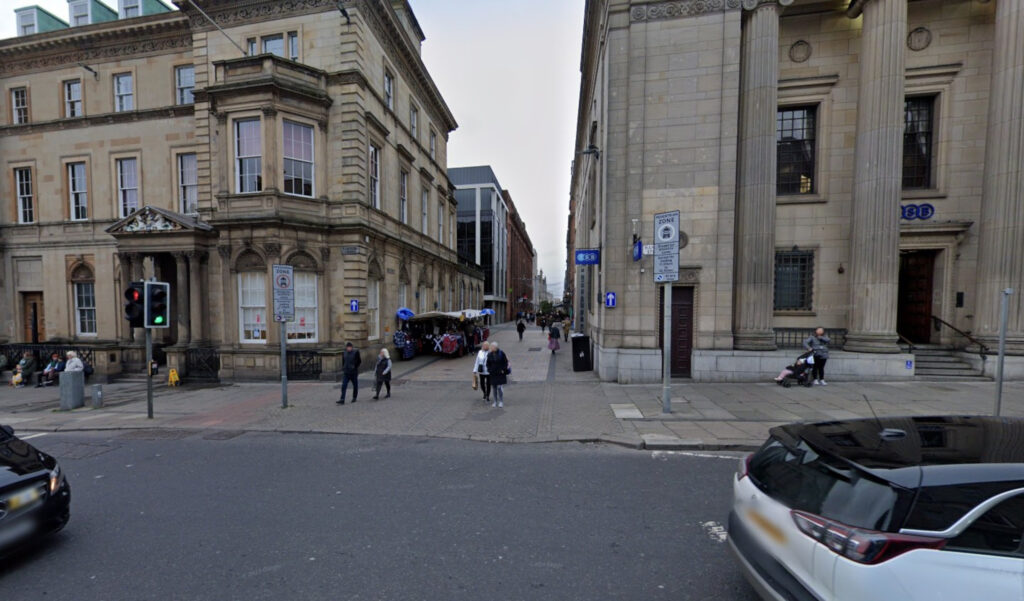
 While Rose Street can often seem like an entirely pedestrianised street, it is in fact not. Cars and cycles are permitted to travel down the street westbound (away from St David Street towards Hanover Street) at specific times (C) Google
As it is, cars rarely make their way through Rose Street, in Edinburgh’s New Town, and the busy street usually bustles with pedestrian activity.
This is why Edinburgh Living Streets, the New Town and Broughton Community Council (NTBCC), and the Edinburgh Access Panel claims that the plans for increased cycling traffic would represent a danger to pedestrians on the busy street.
The council, however, wants to remove restrictions to make cycling a more attractive proposition to Edinburgh residents.
If approved at the meeting of the council’s TRO sub-committee tomorrow, two-way movement will be introduced on Cassel’s Street, Circus Lane, Drummond Street, Richmond Lane, Roe Street, Simpson Loan, Thistle Street, and Wishaw Terrace.
Objections were also raised by the NTBCC and six other individuals to the proposals on Thistle Street, while a general objection was raised by the Edinburgh Access Panel to two-way cycle provision without dedicated segregation between pedestrians and cyclists.
In a report into the potential lifting of restrictions, the council officers said they hope to “improve the connectivity of the cycling network by creating more active travel links, improve road safety on one-way streets and associated junctions, facilitate growth in cycling by making it safer and more attractive, and reduce illegal behaviour by cyclists”.
Responding to the specific complaints, officers said: “Cyclists are already legally permitted to travel along all of these streets in the same direction as vehicular traffic.
“The proposals do not introduce cycling into any street where this does not already occur.
“The risk of conflict on these streets between cyclists and pedestrians is considered to be low as cyclists are likely to be travelling at low speeds, for a variety of reasons, and advanced visibility is generally good.
“A stage two road safety audit (RSA) has been undertaken for the designs for all streets.
“A stage three RSA will be undertaken post-implementation.
“The risk of any areas of poor surfacing distracting a cyclist are considered to be low as cyclists are likely to be travelling at low speeds and advanced visibility is generally good.”
On Rose Street specifically, they added: “Cyclists are already legally permitted to travel along Rose Street in the same direction as vehicular traffic.
“While outdoor seating areas and street furniture do narrow the space at some locations, the RSA did not highlight this as a problem.
“The risk of conflict is considered to be low as cyclists are likely to be travelling at low speeds, and advanced visibility is generally good.”
While the report and entailed actions still have to be agreed upon by councillors at tomorrow’s meeting, the TRO has been recommended for approval.
In an open letter, the NTBCC, Living Streets, and the Edinburgh Access Panel said: “Rose Street is the closest thing that Edinburgh has to a pedestrianised street.
“Cycling through the street, as opposed to accessing the shops and restaurants on it by bike, should be strongly discouraged.
“Encouraging cycling on this unique street would invite conflict with pedestrians, as has been widely acknowledged and especially create a more hostile space for older, disabled and blind people.
“The risk of conflict and injury would be exacerbated by the likely proliferation of e-bikes.
“Space on this street is already restricted due the need to service the businesses operating on this street and due to the number of tables and chairs permits that have been granted.
“Even in the Netherlands and Copenhagen’s famous Strøget, cycling on pedestrian shopping streets is discouraged – or prohibited entirely.”
Edi.bike, a newsletter discussing cycling news in Edinburgh, penned a response to Living Streets’ and the NTBCC’s complaints.
It read: “Naturally, rather than taking the opportunity to champion the rights of those travelling actively and noise up the council for less vehicular intrusion on Rose Street, Living Streets Edinburgh have penned an objection to the proposed introduction of two-way cycling on Rose Street, ignoring the many examples from across Europe where pedestrians and cyclists manage to coexist in the same space.
“Such spaces include, but are not limited to, the very street they’re claiming shouldn’t have two-way cycling access, on which cycling is already permitted.
Edi.bike went on to argue that Rose Street is a quiet “non-entity” when it comes to cycling traffic, and that simply adding another direction for travel on the road won’t make it a convenient or popular route for cycling.
It concludes: “This won’t be surprising to our readers, but at times of high footfall, it is generally easier and safer for all involved if the rider dismounts (for those who are able to).
“It’s also possible to cycle at a slower than walking space, to pause and wait for gaps or to give way, and generally co-exist. All of this happens already on Rose Street.
“There is a real ‘those others over there’ vibe to a lot of this written objection – out there in the real world, user conflicts in public space are largely mitigated through our own humanity and compassion rather than requiring handwringing, policy-led mediation.
“Nobody is looking to use Rose Street as their new commuting go-to.
“The changes being proposed are consistent with elsewhere in the city, will enable certain cycling journeys more direct access to their destination, and otherwise are a tiny sliver of the active travel story in Edinburgh.
“It’s exhausting to see so much hand-waving from folks over something with so little impact.”
The open letter from Living Streets, et al added a point about the RSA, noting that the audit has not yet been made public, and may not contain what it purports to contain: “We note that the report states that a stage two RSA has been performed and has not raised any concerns about the proposed implementation of these cycling exemptions including on Rose Street.
“The results of the RSA are not included in the report to the sub-committee nor are these available on the council’s website.
“It is therefore impossible for the public to assess whether the RSA has properly considered the risks to all users of this space including pedestrians.”
In the event of the exemptions’ implementation, however, the council has pledged to install mitigation measures such as “share with care” signs should there be reports of conflict between cyclists and pedestrians.
Related