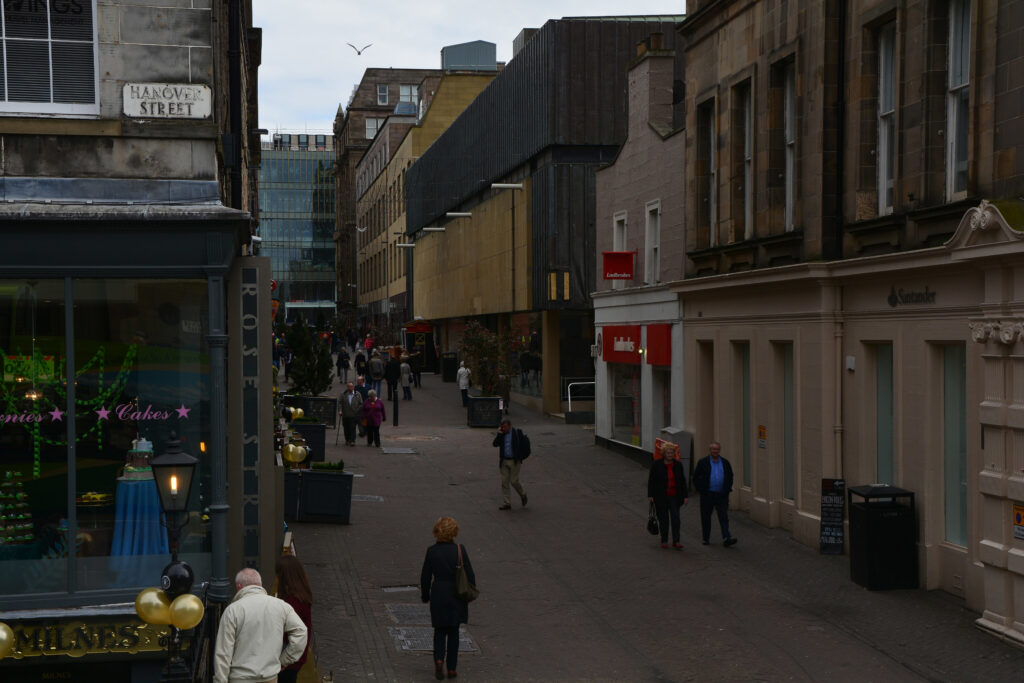
PLANS to lift restrictions on two-way cycling on Edinburgh’s famous Rose Street have been shot down by the City of Edinburgh Council.
The plans would have seen two-way cycling introduced on the busy street, which currently only allows westbound cycling and sees heavy foot traffic.
The council’s traffic regulation orders (TRO) sub-committee voted to reject these plans yesterday, overruling the recommendations of council officers, who wanted to set aside objections and proceed with a TRO.
Plans for two-way cycling on other city streets, such as Thistle Street, did pass through, however, but an exception was made for Rose Street.
 Rose Street has been described as the closest thing Edinburgh has to a pedestrianised street, but is not actually pedestrianised (C) Lewis Clarke / Wikimedia Commons
Four members of the council voted against the proposals, while four voted for them, with convener Margaret Arma Graham deciding to reject the proposals but reserving the right to return to the matter in the future.
Cycling is already permitted in one direction on Rose Street, and limited motor vehicle traffic is only permitted after 8pm and before 10:30am most days.
However, there were fears, raised by the local community council and Living Streets Edinburgh, that increased cycling traffic both ways could lead to conflict between cyclists and pedestrians.
Deborah Paton, lead officer of the council’s Transport and Environment Committee refuted these claims after a question from Conservative councillor Phil Doggart, who described Rose Street as pedestrianised.
She said: “I want to emphasise that pedestrians remain at the top of the hierarchy on Rose Street.
“Vehicular movement is already permitted in one direction at some times of the day, and, to reiterate, cycling in one direction is already in place.
“All this order is doing is making it legal for those that want to [cycle].
“It is primarily to access destinations on the street, we don’t have any particular reason to think that it would be used more as a through route, because it logically doesn’t make sense as a through route.”
She added: “Cycling is already in place in one direction, and this would support cycling in both directions, which would align with city mobility plans.”
Prior to the meeting, objections to the plans were raised by Living Streets Edinburgh, a group campaigning for greater pedestrianisation in Edinburgh, and the New Town and Broughton Community Council.
They feared that the plans would introduce unexpected dangers to pedestrians on Rose Street, endangering “a more hostile space for older, disabled and blind people”.
SNP councillor Catherine Fullerton echoed these fears, saying: “People don’t expect cyclists to be on Rose Street, that’s the bottom line.
“When such cyclists get too close, there’s a lot of harsh words spoken between cyclists and pedestrians.
“I think there should be signs along Rose Street saying that there will be cyclists and that it’s not just purely pedestrians.”
Councillor Fullerton expressed her support for a fully pedestrianised Rose Street, and there was also discussion of the fact that cyclists already go both ways, legal or otherwise.
Greens councillor Kayliegh Kinross-O’Neill also expressed concern for disabled people on Rose Street and enquired whether signage indicating different uses for the street could be used to reassure vulnerable road users.
Lib Dem councillor Hal Osler questioned why the report was being forwarded to the council if it wasn’t expected that many cyclists would make use of Rose Street eastbound.
Councillor Kevin Lang another Liberal Democrat councillor, however, pointed out that cyclists already use Rose Street both ways and that the restrictions are likely unenforceable: “I wouldn’t have instinctively known that Rose Street had a one-way restriction in place on Rose Street.
“I’m also one of those people who gets a little bit nervous about setting in place restrictions which are unenforceable.
“For that reason, I came in quite comfortable with the officer report and the TRO.
“If we are allowing cyclists on Rose Street, I don’t see any discernible difference between them going one way or two ways.”
Unusually, convener Margaret Graham decided to go against the council’s recommendations, and moved to approve the report but omitting Rose Street.
There were four votes for Margaret Graham’s proposal to omit Rose Street, including Councillor Osler of the Lib Dems, and four against.
Councillor Lang, however, voted to move forward with the TRO as advertised, splitting the Liberal Democrat vote.
Two-way cycling has, however, been approved on Cassel’s Street, Circus Lane, Drummond Street, Richmond Lane, Simpson Loan, Thistle Street, and Wishaw Terrace.
Related