(Credits: Far Out / Alamy)
Wed 17 December 2025 20:05, UK
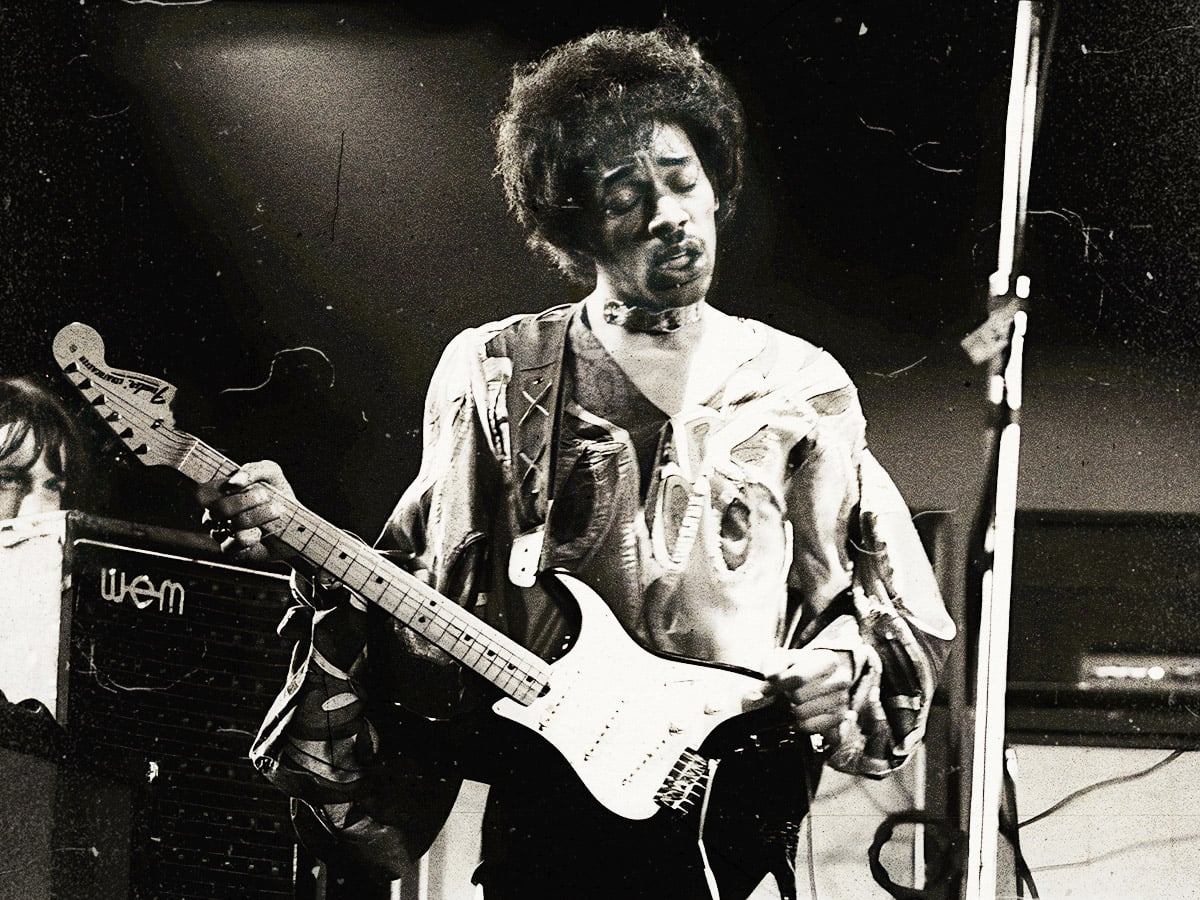
Undoubtedly, Jimi Hendrix could write some fantastic songs. However, he is remembered first and foremost for his unrivalled instrumental virtuosity and innovative approach to the guitar. As a leading force in London’s psychedelic rock scene, the American held a candle at the feet of Eric Clapton, Jeff Beck and Jimmy Page and inspired a spurt of healthy competition.
The only people who haven’t been awestruck by Hendrix’s talents are those who haven’t heard his music. Throughout his three seminal albums with The Jimi Hendrix Experience and the solo endeavours thereafter, he exhibited an appreciation for the blues tradition and an insatiable thirst for rock ‘n’ roll evolution.
In his first album, Are You Experienced, Hendrix wrote all the songs appearing on the UK version, including the enduring hits ‘Foxy Lady’ and ‘Manic Depression’. The tracks are particularly potent reminders of just how powerful he could be with his words as well as his guitar playing. Add to this tunes like ‘Purple Haze’, perhaps the defining anthem of the era, and you have a more serious songwriter than most give him credit for. Even his covers showed originality.
On the US issues of that debut, Hendrix also included his debut single with the Experience, a cover of Billy Roberts’s ‘Hey Joe’, which showcased the artist’s astonishing ability to reimagine classic songs in a contemporary psych-rock guise. This talent is not only showing what songs he likes, a range of incredible standards, but how he can shape them to sound like his own.
Hendrix again showed his eye for a discerning cover in his third studio album with the Experience, Electric Ladyland. A cover of Earl King’s ‘Come On’ appeared on the B-side of the double LP release, but Hendrix saved most of the fun for side D, which closed on an incredibly strong note with a cover of Bob Dylan’s ‘All Along the Watchtower’ and Hendrix’s ‘Voodoo Child (Slight Return)’.
Dylan released ‘All Along the Watchtower’ as the second single on his 1967 album John Wesley Harding. Many people hold the album in high regard despite the screeching harmonica sound by which most of its songs can be identified. ‘All Along the Watchtower’ was the album’s highlight, and Hendrix picked up on Dylan’s powerful and evocative lyrics.
Many music fans regard Hendrix’s Dylan cover as the greatest of all time. Thus, the folk-rock troubadour can’t be too peeved that the song swiftly became more commonly associated with Hendrix than himself. On several occasions, Dylan has commended Hendrix’s cover, noting how the guitarist totally transformed the original and made it his own.
 (Credits: Far Out / Columbia Records)
Speaking to the Sun Sentinel in 1995, Dylan revealed that he often channels Hendrix’s version while playing the song live. “It overwhelmed me, really. He had such talent. He could find things inside a song and vigorously develop them. He found things that other people wouldn’t think of finding in there. He probably improved upon it by the spaces he was using,” he admitted. “I took license with the song from his version, actually, and continue to do it to this day.”
He added in his Biograph liner notes, “I always feel it’s a tribute to him in some kind of way.”
When MusiCares announced Dylan as its ‘Person of The Year’ in 2015, he accepted the honour with a speech that examined his long career. He also took a moment to thank several people; among them was the late Hendrix. “I actually saw Jimi Hendrix perform when he was in a band called Jimmy James and the Blue Flames,” Dylan recalled. “He took some small songs of mine that nobody paid any attention to and pumped them up into the outer limits of the stratosphere and turned them all into classics. I have to thank Jimi, too. I wish he was here.”
Ever the humble and conscientious creative, Hendrix never failed to send credit where it was due. In return, he greatly admired Dylan’s songwriting abilities and thanked him wholeheartedly for the success of ‘All Along the Watchtower’. Speaking to Steve Barker in 1967, Hendrix remembered meeting Dylan at “this place called The Kettle of Fish” in New York. “Both of us were stoned out of our minds,” he noted.
Continuing, Hendrix observed that Dylan is often harshly criticised, especially following his early success and controversial decision to “go electric”. “People have always got to put him down,” he said. “I really dig him, though. I like that Highway 61 Revisited album and especially ‘Just Like Tom Thumb’s Blues’!”
Since the pair have skill sets in different areas, Hendrix in the instrumental department and Dylan in the lyrical, their talents led to unbound greatness when combined. “He doesn’t inspire me, actually, because I could never write the kind of words he does,” Hendrix concluded. It’s an admission that almost e very songwriter will have to come to in their due time.
To try and match Dylan’s words is to fail undoubtedly. Especially during Hendrix’s era, the power that Dylan could effortlessly infuse his lyrics with put him in a league of his own. One can only dream of what a collaborative album between the pair might have sounded like.
Related Topics
The Far Out Bob Dylan Newsletter
All the latest stories about Bob Dylan from the independent voice of culture.
Straight to your inbox.