Nobody can doubt that Britain has undergone an unprecedented social change in the past five years.
In just 36 months between 2021 and 2024, 3.9million new immigrants arrived on our shores – a figure that dwarfs the entire 3.2million population of Wales.
The job of fully integrating these people – from lands as far afield as India, Pakistan and Nigeria – would be a formidable task for any country.
But any successful integration is impossible if we have no idea of who these newcomers actually are, how many of them live in certain areas and what their circumstances and affiliations might be.
That is why, in my capacity as an academic specialising in social cohesion, I am demanding an emergency census next year in England that would provide an instant and accurate snapshot of the current composition of the country, as laid out in my new report for the think-tank, Policy Exchange.
This census would give the Government real, up-to-date information on which parts of the country are experiencing the highest rate of new settlement and therefore where resources should be spent on schools, surgeries, hospitals and housing.
This data-driven allocation of resources is essential if we are going to maintain social cohesion at a time when immigration consistently polls as one of voters’ main concerns, if not the most important.
It will also provide a factual basis to inform public debate in the run-up to the next general election, which must be called before the middle of August 2029 – well before the next scheduled national census in 2031.
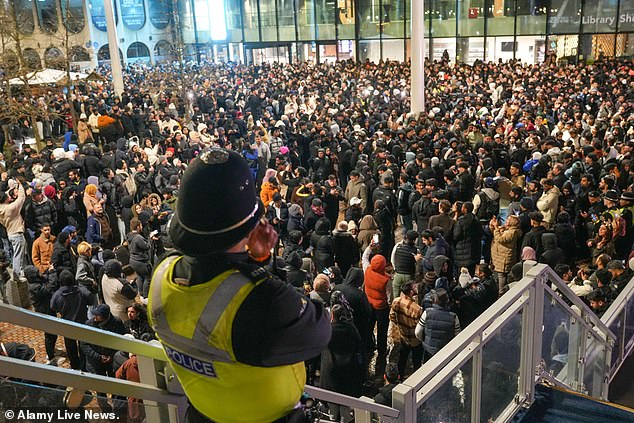
Britain’s population increased by over 2.3million in the three years to June 2024 – more than the combined populations of Birmingham, Manchester and Liverpool
The need is even more acute when you consider that the 2021 national census was carried out online at the height of the Covid pandemic and it is widely accepted much of the information it contained was flawed.
Many young people, for example, moved out of England’s big cities during lockdown to live with their parents, resulting in a substantial underestimate of inner-city populations and a misleading picture of urban areas’ true demographics. Questions about nationality and sexual identity were also poorly drafted, with misleading results.
The idea of an emergency census is not arbitrary. Indeed, mid-decade censuses are permissible under the 1920 Census Act and there is a remarkably similar precedent from 60 years ago, when Britain was equally unsure of how to react to rapid social change.
In 1966, a mid-decade ‘snapshot’ census was carried out between the 1961 and 1971 survey on the back of cross-party concerns over the impact of high levels of Commonwealth migration on social cohesion and public services, as well as the scale of internal north-to-south movement in England.
It was aimed at providing accurate information so the right resources could be allocated to the right area and based on a 10 per cent sample of the population, a principle I believe can be successfully copied today to save time and taxpayers’ money.
The emergency census should be based on a nationwide sample confined to England, which has seen far higher levels of immigration than Scotland, Wales or Northern Ireland.
In addition, there should be full local censuses in five crucial areas: Preston, Middlesbrough, Leicester, Luton and Bournemouth. These towns and cities have recorded some of the highest rates of population growth in recent years.
Preston has seen its population rise by 10.2 per cent between June 2021 and June 2024, Middlesbrough saw an 8.5 per cent surge and Leicester nearly 6 per cent – 21,400 extra people in the East Midlands city in the space of only three years.
Perhaps not coincidentally some of these cities and towns have also seen significant social unrest. For example, large-scale disorder broke out in Leicester in the summer of 2022, primarily between Hindu and Muslim male youths.
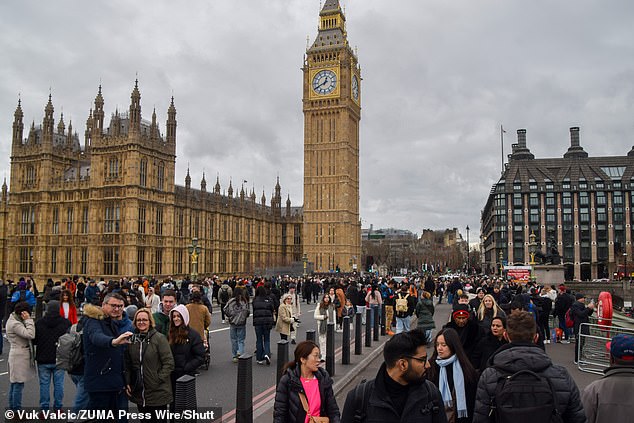
In just 36 months between 2021 and 2024, 3.9million new immigrants arrived in the UK
A failure to integrate ‘new and emerging communities’ was cited as a contributory factor, with new arrivals from the subcontinent blamed for a rise in anti-social behaviour.
Middlesbrough similarly saw considerable disorder in the summer riots of 2024, with many locals telling journalists the root cause was a widespread feeling that immigrants received preferential treatment for state support.
If local and national governments were shocked by these outbreaks of violence, the lack of accurate information about the people they were dealing with might have been a contributory factor. This proposal would remedy that situation at a stroke.
The emergency census should have a special focus on racial identity, ethnic heritage, religious affiliation, length of UK residency, place of birth, level of educational attainment, employment status and housing tenure.
I’d also recommend asking how long respondents have been living at their current home and where they lived immediately before. This would help develop a richer understanding of internal population movement, including people relocated within England by local authorities for reasons such as homelessness and social care.
The census should also change its flawed methodology for questions of national identity, which would avoid the dramatic fluctuations between the 2011 and the 2021 censuses blamed on the changed ordering of responses and their restrictive nature.
The introduction of denominational options for Christian and Muslim populations (such as Protestant and Catholic, or Sunni and Shia) would allow politicians to better understand the religious diversity of modern Britain, as well as provide an early-warning system for potential sectarian flashpoints.

There must be an emergency census next year in England that would provide an instant and accurate snapshot of the country, demands DR RAKIB EHSAN
Britain has long been one of the most open and tolerant countries in the world, with a proud record of integrating immigrants.
But the scale and nature of the extraordinary surge in migration from non-European countries means that policy making must be based on accurate information.
And the uncomfortable truth is that the British state doesn’t have a clue how many people are here, who they are, where they come from, and where they live.
We need up-to-date answers to these questions and then use that information to target spending effectively so that the people who have lived here for generations don’t feel overlooked.
This information is not only vital for the very peace and stability that has long been a feature of the British way of life – but it is also a democratic imperative.
Voters need to feel the political system is working in their interests. They also deserve the opportunity to see on paper the effect that the immigration policies of successive governments have had on their country.
Britain’s population increased by over 2.3million in the three years to June 2024 – more than the combined populations of Birmingham, Manchester and Liverpool.
They also need to be able to use the hard facts of the census results to inform the way they vote. Because without that information, we can’t have an informed electorate.
And without an informed electorate, we can’t claim to have a true democracy.
Dr Rakib Ehsan is a Senior Fellow at Policy Exchange.