THE Radical Road in Holyrood Park is set to see a series of safety measures installed to ensure the route can reopen by June next year.
Historic Environment Scotland (HES), which manages Holyrood Park and the Radical Road, confirmed earlier this year that the route, which has been closed since 50 tonnes of rock fell from a cliff in September 2018, would be reopened next year.
HES says it is still committed to a 2026 reopening, but said that new signage, relocating and installing barriers and vegetation management is essential to ensure safety on the path.
It aims to have the path reopened by June next year so that people can visit Hutton’s Section and Hutton’s Rock, during the 300th anniversary of the eponymous James Hutton’s birth during that month.
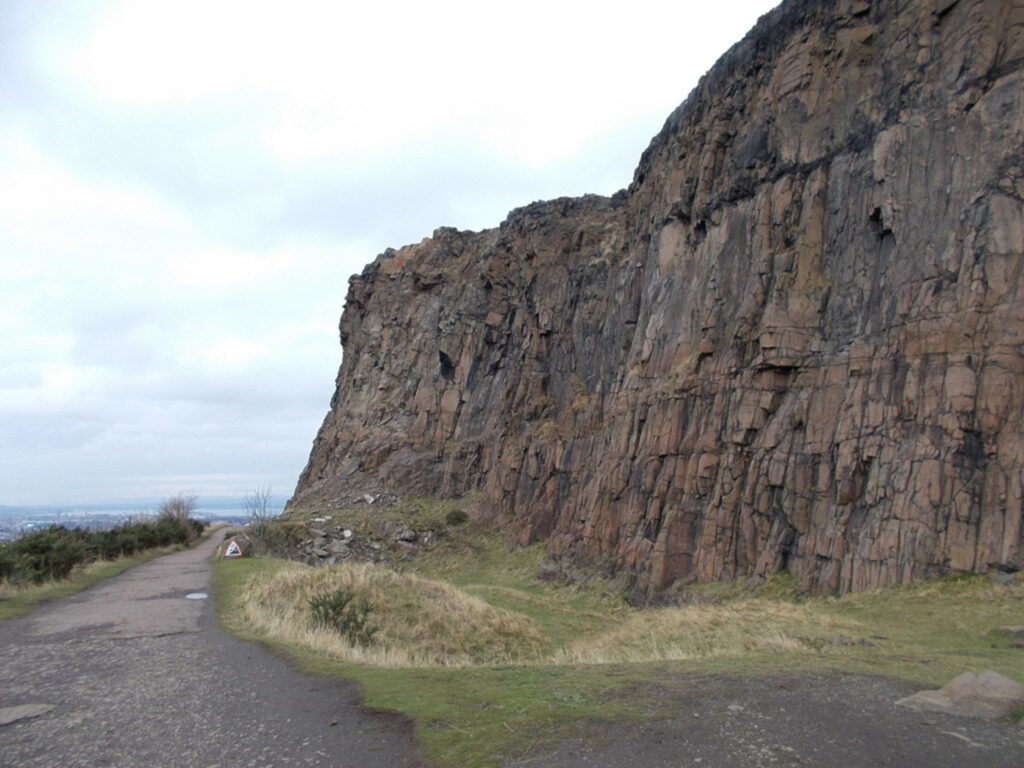
 The Radical Road is aptly named for its stunning vistas and looming cliff faces (C) Iain Russell / Wikimedia Commons
The Radical Road is one of the most famous routes in Edinburgh’s Holyrood Park and the city in general.
The path is set against the cliffs at Salisbury Crags, perched high above the capital, and provides jaw-dropping views of the city below.
The two-century old path was named after the Radical War, also known as the Scottish Insurrection of 1820, a wave of strikes and protests demanding electoral reform in the UK.
Since its closure in 2018, an array of walking groups and locals have campaigned for the paths to be reopened, but HES has said that continued rockfall risk from Salisbury Crags has made this impossible.
Now, signage indicating where rockfall may be most likely, barriers at high-risk points, and fencing is being proposed at two sections along two sections of the path.
Under new plans the section of the road around South Quarry and Hutton’s Rock, which is particularly close to the Salisbury Crags rock slope faces will have mesh panels over two metres tall installed to indicate rockfall risk and protect walkers.
The section of road surrounding Hutton’s Section will have new signage, warning of rockfall risk, installed while 210 metres of chain fencing would be installed to protect the path from rockfall near the Crags.
 Two sections of the Radical Road will see alterations, with a new temporary erected at the South Quarry section (see left) (C) Historic Environment Scotland
A spokesperson for HES said: “Work has taken place throughout 2025 as part of our commitment to reopen part of the Radical Road next year.
“This includes inspection and descaling works, vital rock trajectory modelling and analysis, and necessary ecological surveys and ecological impact assessments.
“The risk of rockfall and the impact of the wildfire in August, as well as unforeseen public safety works to Duddingston Low Road and the High Road have, unfortunately, caused a slight delay in our programme as our limited resources within the park had to be reviewed and diverted.
“Due to the immediate public safety risk, works to enable safe public access to these areas were prioritised, however, work on the Radical Road has continued to progress.”
HES has also assured that the alterations to the path will have minimal ecological or visual impact and will be designed to blend into the surrounding area.
It continued: “Applications for scheduled monument consent and planning permission have been submitted to allow the essential works required to facilitate the partial reopening of the Radical Road to be carried out.
“This includes the relocation and installation of barriers, the installation of interpretation and safety signage, and vegetation management to the path area, and we have been working closely with NatureScot and local stakeholders as part of this process.
“It remains our commitment to partially reopen the Radical Road, from the Hawse to the northern end of the South Quarry, once it is safe to do so next year to allow visitors to access both Hutton’s Section and Hutton’s Rock during the 300th anniversary of James Hutton’s birth in June 2026.
“In the meantime, park users can continue to pre-book ranger guided access to this area.”
 Planned safety measures signage warning of rockfall, a fence separating the cliff face from the path, and a green chain link fence and gate (C) Historic Environment Scotland
Hutton’s Section is named after James Hutton, a Scottish geologist who has been coined the “father of modern geology”.
HES commissioned an ecological assessment of the sections, but due to the small footprint of the features, habitat clearances can be avoided.
Further assessments into the impact on the Arthur’s Seat volcan, a Site of Special Scientific Interest will be carried out, however.
HES did not outline an official start date for works and is awaiting statutory approval from Edinburgh city planners.
The plans were submitted on 3 December by HES and will be decided upon by 11 February next year.
Related