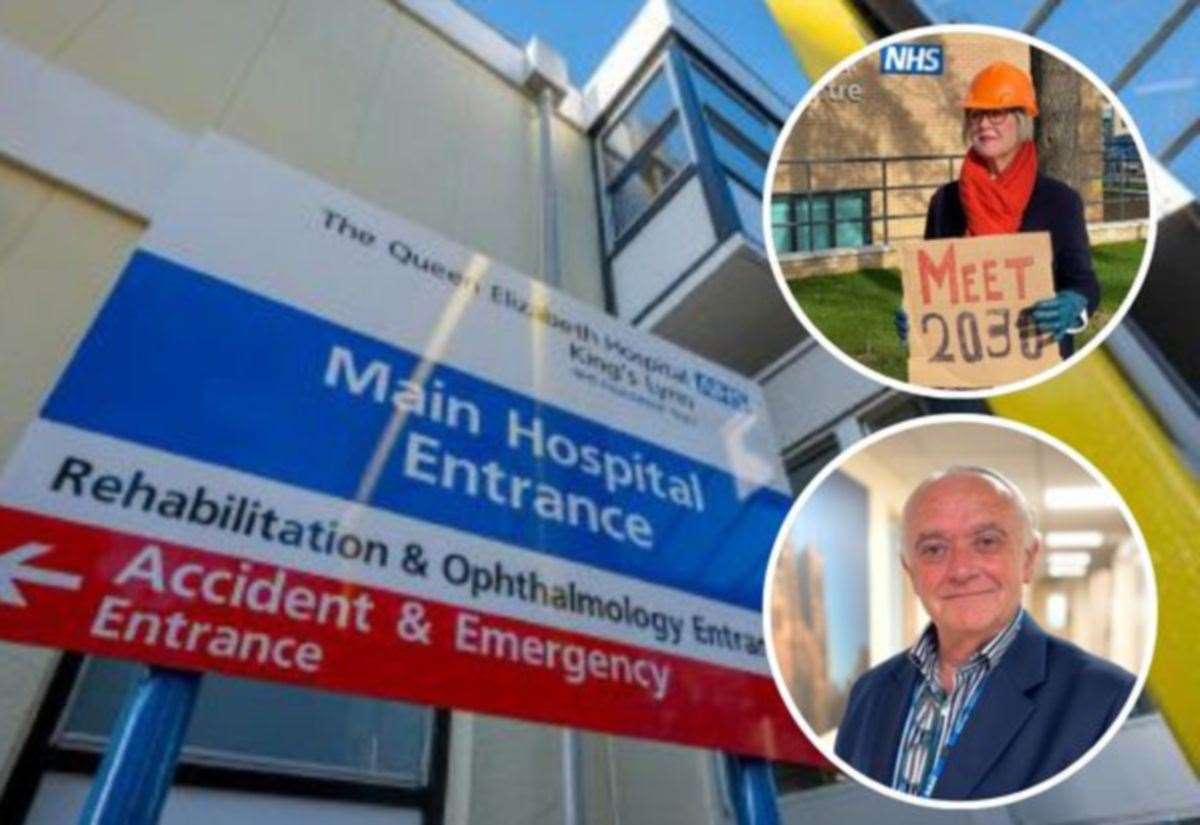
Many with a medical condition are facing an agonising wait to be seen by a doctor at Lynn’s Queen Elizabeth Hospital.
This will not be news for those who have visited their GP and been informed about a lengthy hospital waiting list in certain departments.
Weeks and weeks pass until a letter comes through the door to say that you finally have an appointment, but it may be even longer to wait to have the procedure you have been waiting for.
 The Queen Elizabeth Hospital in Lynn has seen complaints submitted rise in the past year…
Data discovered by the Lynn News reveals that in 92 of 100 cases at the QEH, a patient has been waiting less than 42 weeks to be seen.
The proportion of patients seen within 18 weeks is 55.3%.
This means that patients at the QEH – ranked the worst hospital in the country – could be waiting for up to nine months to be seen.
The QEH is set to be rebuilt by 2032. Picture: QEH
As well as this, we have also discovered via a Freedom of Information (FOI) request that the hospital has received 370 complaints in the past year.
This is 69 more complaints than the previous year.
In this feature, we take a look at the QEH’s wages, waiting times, complaints and rebuild costs in the past year…
Waiting times:
The average nurse in the UK earns a starting wage £31,000. Picture: iStock
Compared to the national average, the QEH performs slightly lower in terms of getting patients seen.
Across the UK at the end of October, 92 out of 100 patients had been waiting less than 41 weeks to start treatment. This is a week shorter than the QEH.
In October, 1,836 people were waiting for a gynaecology appointment at the QEH.
Chris Bown
Nationally, struggles over getting seen by an NHS gynaecologist have been reported, with patients waiting months or even a year for non-urgent care.
For non-urgent, consultant-led care, the NHS aims to start treatment within 18 weeks of referral.
Data shows that just under half of all patients at the QEH are not seen within the 18 weeks.
Ambulances outside the QEH at Kings Lynn.
This is something that the interim executive managing director at the QEH, Chris Bown, admits needs improving.
“While most patients are seen within 42 weeks, we recognise our performance against the 18-week standard, including in gynaecology, is not where it needs to be,” he said.
“Reducing waiting times is a clear priority for the trust and nationally. We continue to work closely with NHS partners to increase capacity, improve flow in our hospital and deliver sustained improvements for patients.”
Complaints:
The QEH in Lynn has had 370 complaints in the past year
Our FOI results revealed that 370 complaints were submitted to the QEH from September 1 last year to September 30 this year.
From October 2023 to October last year, the hospital received 301 complaints.
The hospital’s head of legal services, Sheena Johnson-Banks, confirmed that two people are employed to handle those complaints.
The QEH is set to be rebuilt by 2032. Picture: QEH
The QEH currently does not have an FOI officer in post. We were informed that our request “required inputs from multiple departments”.
In response to the increase, Mr Bown said that this has happened nationally across the NHS.
The hospital has a Patient Advice and Liaison Service (PALS), which can help resolve issues. Patients are advised to make a complaint within 12 months of the incident.
Rob Colwell (left) with David Sayers previously campaigning for a new QEH
A response to the FOI request revealed that the QEH has a 30-day timeframe to respond to complaints, and that this is achieved in 90% of cases.
Mr Bown said: “Complaint numbers have risen nationally across the NHS. We take all patient feedback seriously and welcome complaints as a vital way to learn and improve.”
Meanwhile, Gaywood councillor for West Norfolk and Norfolk County Council, Rob Colwell, advised patients disappointed with their care at the QEH to try and find a way of dealing with it while avoiding submitting an official complaint.
He cited doctors and nurses working in an environment which is in “critical care with props and failsafes” for the reason that complaint numbers have rocketed.
Rob Colwell (left) and Jo Rust (right) are pictured during a Save the QEH campaign back in 2023
“Sadly, with tight NHS budgets and significant workloads, it can often feel like there are not enough staff on duty to meet care, and mistakes can be made,” Cllr Colwell said.
“Doctors and nurses are under huge pressure every day, and we are so grateful for the care they provide, especially in a hospital that itself is in critical care with props and failsafes.
“Whilst the complaint numbers are higher than we would wish at the QEH and appear to have increased on the previous year, my advice to residents would be to try and deal with the matter before requiring a formal complaint.
Cllr Rob Colwell outside the QEH
“Speak to the ward manager to express concern. Do not be afraid to seek a second opinion on a matter under ‘Martha’s Law’ if the matter is urgent.
“Use PALS (Patient Advice and Liaison Service), as the hospital will welcome the feedback and want to improve the patient experience.
“The complaints process is long, and as a solicitor, I know that even if a clinical negligence claim is considered, not all claims can be progressed.”
An illustration of the new hospital, which will have a central communication spine giving access to all parts of the building. Picture: QEH
Bed blocking?
The crumbling QEH has 509 beds.
At the time we submitted our request back in October, 499 of these beds were occupied.
The hospital also had 1,485 outpatients. These are people who receive medical care at a hospital or clinic but don’t need to stay overnight.
Jo Rust, organiser of the Save the QEH group
At the end of last year, it was reported that the QEH had taken 11% of its beds out of use, saying it did not have the funding to pay for them.
This resulted in 60 beds and two wards closing down, but the patients that were in them were fit to go home.
In 2022, it was reported that one-fifth of patients were blocking beds when they were fit to go home.
MP Terry Jermy during a visit to the QEH
Fast forward to now, the hospital says that discharge wait times are reducing thanks to a new programme put in place.
Staff are working in partnership with the Norfolk Community Health and Care NHS Trust, Norfolk County Council, Norfolk and Waveney Integrated Care Board, and private care provider Athena Care Homes to rehabilitate patients.
Through the new service, people can relearn how to do daily activities such as cooking meals and getting dressed, to regain their independence faster.
Campaigner Jo Rust is pictured at a previous Save the QEH protest. Picture: Michael Fysh
Cllr Colwell, who has been part of the Save the QEH campaign group, said he was concerned about the number of beds taken up at the QEH at present.
Before the hospital rebuild was announced, the group held regular protests, waving placards and chanting rhymes to gain the attention of the Government.
“With the current bed occupancy rate running at 99%, I can understand why residents are worried about continued house building in the area and public services at the limit, a concern I share,” Cllr Colwell said.
“In previous years, we have heard of bed closures at the hospital to save money.
Cllr Jo Rust (left) and former QEH chief executive Caroline Shaw during a campaign for new hospital funding in 2023
“I would be interested to know if all wards are or could be opened before patients have to start being transferred to alternative providers. The importance of local care for the patient and to see loved ones through recovery is important.”
‘£3.7m is a difficult pill to swallow’:
FOI data showed that in the past year, millions have been spent on consultancy in the build of the new QEH, which now has a completion deadline of 2032.
The rebuild is scheduled to begin between 2027 and 2028, but no specifics have been confirmed – meaning this could refer to any time from January 2027 to December 2028, nearly two years later.
However, it has recently been reported by the Lynn News that the Government has failed to categorically confirm that the new QEH will be completed by the 2032 deadline.
Since October last year, £3.7million has been spent on paying external consultants as part of the new QEH programme. This is not part of the main hospital spend.
However, while these figures seem shocking, many have said that it is to be expected with such a huge project.
South West Norfolk MP Terry Jermy told the Lynn News that keeping the consultancy cuts as low as possible is important, but the rebuild “requires specialist work and advice”.
We also approached North West Norfolk MP James Wild for comment in relation to this feature, but he did not respond before our deadline.
Cllr Colwell said that “we can only hope” that the huge amount of work done by the hospital’s trust is recognised by the Government.
“That’s an awful lot of money and a difficult pill for local people to swallow when we just see no movement on the ground for the QEH rebuild,” he said.
Borough councillor for Springwood, Jo Rust, who is also a pioneer in running the Save the QEH group, said staff employed at the hospital would not have the “level of experience” in such a big project, and expressed the importance of having external consultants.
“I understand why seeing a figure as high as £3.7million on external consultants seems incredible and astronomical,” she said.
“However, the new build is to new building specifications which haven’t been tried and tested yet. No one has built this type of hospital, although some would have had a closer relationship to other new builds
“I wouldn’t expect staff employed directly by the QEH to have that level of experience, even though they might be professionally qualified elsewhere.
“Consultancy is often seen as a dirty word – I’ve viewed it like that myself.
“But for professionals to maintain their necessary level of qualification, they need to do a certain amount of work every year.”
Cllr Rust added that all hospitals are built using Health Building Notes and Health Technical Memoranda specifications, including the new QEH, but expects there will be further requirements.
“Hospital 2.0 is a new concept, so I do understand that specialists would need to be on board to ensure our hospital was the best that it could be,” she said.
“There is central government money to fund the New Hospital Programme, and my understanding is that it is these central funds which not only pay for the current QEH team responsible for our new building, but also for external consultants who are needed to supplement that team.
“I would expect that the QEH has a responsibility to get the best value for money, and I hope it does, but I imagine there’s a lot of competition out there for a relatively limited number of professionals.”
Cllr Jermy stressed it was “crucial” that the £1.4billion of Government funding is used in an “impactful way” in rebuilding the hospital.
“The rebuild of the Queen Elizabeth Hospital is a once-in-a-generation opportunity to deliver a pioneering, modern hospital for the region,” he said.
“It is crucial that we use this rebuild opportunity and record £1.4 billion of government funding in the most impactful way. An important and responsible part of any rebuild of this scale is to engage with specialist building consultants to ensure every part of the build meets the needs of the people it will serve.
“Keeping these consultancy costs down as much as possible is important, but it must also be recognised that this rebuild requires specialist work and advice.
“The new QEH will be one of the most advanced hospitals in Europe. Already, the QEH is ahead of some of the other RAAC Hospitals in the New Hospitals Programme, with everyone moving at pace to get the new hospital realised.
“I remain determined to ensure West Norfolk gets the first-class hospital it deserves for both patients and staff, and this needs to happen as quickly as it possibly can.”
Cllr Colwell added: “We can only hope the huge amount of work done by the local trust is recognised by the government to release funds as soon as required to make sure the timetable doesn’t slip further. We saw too many delays under the last government.”
What are staff being paid?
We asked the hospital how many members of its staff are earning more than £100,000 a year.
Results showed that 181 people working at the hospital are in that bracket, with eight of these people holding non-clinical roles.
These include the QEH’s medical director, Dr Rebecca Martin, the director of people, John Syson and the new QEH programme director, Peter Cox.
The hospital’s CEO and deputy, as well as its associate director of estates and facilities, are also on high wages.
Other high earners in clinical roles include consultants and specialist doctors.
This may be especially frustrating to some in light of the damning review, which found serious lapses in care for patients during surgery.
Meanwhile, newly qualified nurses are on a starting wage of around £31,049 and junior doctors are paid £38,831 in their foundation year.
Starting wages for healthcare assistants (HCAs) are between £24-26,000.
This is something Cllr Rust does not think is high enough.
“I for one have never considered our health care staff adequately paid, and roles like HCAs really are underpaid, and the service that they provide, vital to support nursing staff, really does deserve to be higher,” she said.
“Strong trade union membership and being active in a trade union support better wages and terms and conditions.”