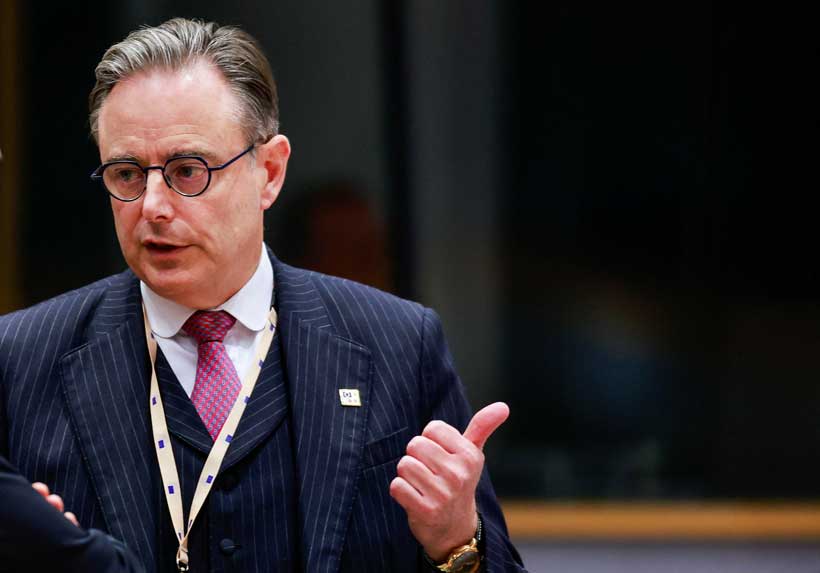
“Had we left Brussels divided today, Europe would have walked away from geopolitical relevance,” Belgian Prime Minister Bart De Wever told reporters. “It would have been a total disaster.”
European governments agreed to provide a €90 billion loan facility to Kiev but failed in an effort to use €210 billion in frozen Russian sovereign assets as the basis for a loan to Ukraine after a 16-hour summit in Brussels—a major setback for German Chancellor Friedrich Merz and European Commission President Ursula von der Leyen.
The attempt to leverage the Russian assets opened a breach within the EU that could not be overcome. As the meeting opened, seven members—Belgium, Italy, Hungary, Slovakia, Czechia, Bulgaria, and Malta—opposed the proposal. Germany, Poland, Sweden, Finland, Denmark, and the three Baltic countries were its primary supporters.
Countries were forced to compromise on an emergency backup plan based on EU joint debt that was pushed for weeks by Belgian Prime Minister Bart De Wever and was deemed not tenable until hours before the agreement was reached. In a further blow to EU unity, three countries—Hungary, Slovakia, and the Czech Republic—all agreed to the loan based on EU borrowing but on the condition it would not impact them financially.
The agreement provides a crucial lifeline to Ukraine’s war-battered economy as it grapples with the risk of a looming cash crunch as early as next spring, with its conflict with Russia grinding on into a fourth year.
Though the accord allows everyone to “claim victory,” this wasn’t the solution that Germany and the Commission had been pushing for in the run-up to the summit.
“Of course, some people did not like it … They want to punish [Russian President Vladimir] Putin by taking his money,” De Wever said, referring to the original plan to use Russia’s assets. But “politics is not an emotional job,” and “rationality has prevailed.”
For weeks, the EU Commission president and the German chancellor have been pressuring member countries to finalize a controversial plan to use the €210 billion in Russian frozen state assets to finance Ukraine. De Wever once again ensured that didn’t happen after previously derailing the Russian assets scheme during an earlier summit in October.
Instead, leaders agreed to jointly borrow €90 billion to fund a loan to Ukraine over two years. This will be underwritten (guaranteed) by the common EU budget.
While this option appealed to southern countries, it was not favored by Germany and its northern European allies, who have traditionally opposed underwriting bonds for their highly indebted peers.
In the end, the urgency of Ukraine’s need for cash and the desperation of EU leaders to show their support (as Donald Trump equivocates) won the day.
In a concession to Germany, leaders opened the door to using the frozen Russian assets to repay the loan to Ukraine. But such an eventuation is in no way assured and is something that would have to be dealt with in the future.
Ukrainian President Volodymyr Zelensky had warned that a failure to provide funding for Ukraine would mean the country would not have enough money to support its domestic and military needs. The government in Kyiv is on the verge of bankruptcy and desperately needs the money by spring to pay for everything from ammunition to infrastructure repairs.
Ukraine would have had a funding gap of $160 billion (€137 billion) over the next two years, according to forecasts by the International Monetary Fund. The EU was looking to meet two-thirds of that, or about $105 billion (€90 billion).
As for the reparations loan, Belgium—which holds a large majority of the immobilized funds—is fearful of future retaliation by Russia or liability if a peace agreement leads to Moscow demanding the return of the funds.
Ahead of the summit, Belgium’s De Wever demanded “binding guarantees” from all EU member states in return for his nation’s approval of the reparations loan.
“Mere oral promises are not enough,” he said at the Belgian parliament Thursday.
Until now, the EU has been using the interest from the Russian assets, which are mostly bonds, to finance some of its support for Kyiv. But as the bonds themselves mature, they are turned into cash, and this is the cash Merz and Von Der Leyen wanted to borrow and lend to Ukraine until Russia pays reparations.
On Monday, the Russian central bank filed a lawsuit seeking billions in damages from Belgium’s Euroclear depository. The bank called the move a preemptive measure against the EU plan to transfer the frozen assets held by Euroclear “to third parties,” according to Russian state news agency TASS.
And on Thursday, the Russian central bank said it would claim damages from European banks in the amount of the frozen assets they hold and lost profits.
US President Donald Trump lashed out at European leaders as “weak” in a recent interview, days after his administration’s new National Security Strategy accused Europe of being “trapped in political crisis” and suffering from a “lack of self-confidence.”
A US-backed, 28-point peace plan that was leaked last month called for investing $100 billion of the Russian central bank assets frozen around the world “in US-led efforts to rebuild and invest in Ukraine,” and for the US to receive profits from those investments. The assets frozen in Europe account for most of Moscow’s immobilized assets globally.
The White House has publicly latched on to Ukraine’s continuing battlefield difficulties or structural weaknesses as leverage to strike a quick peace deal by Christmas.
Talking before the European negotiations concluded, the Ukrainian president said that a funding deal would allay that threat. With that comment and the political and financial backing of Kyiv by Europe and Britain, it seems likely that the war in Ukraine will continue for a further protracted period—at least until another round of financing is needed to further sustain Ukraine domestically and militarily.