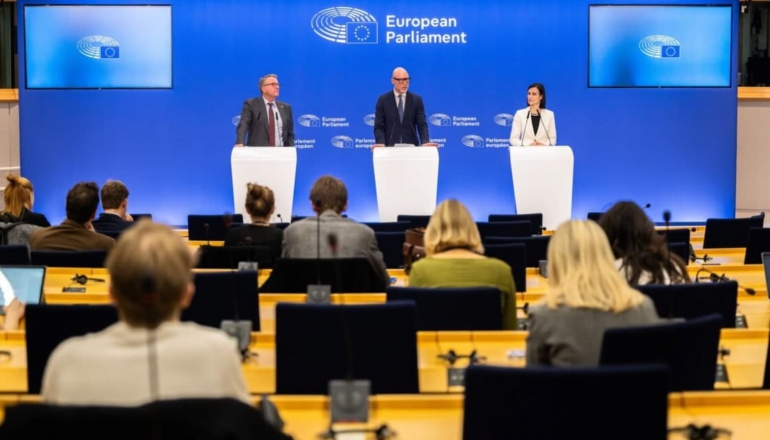
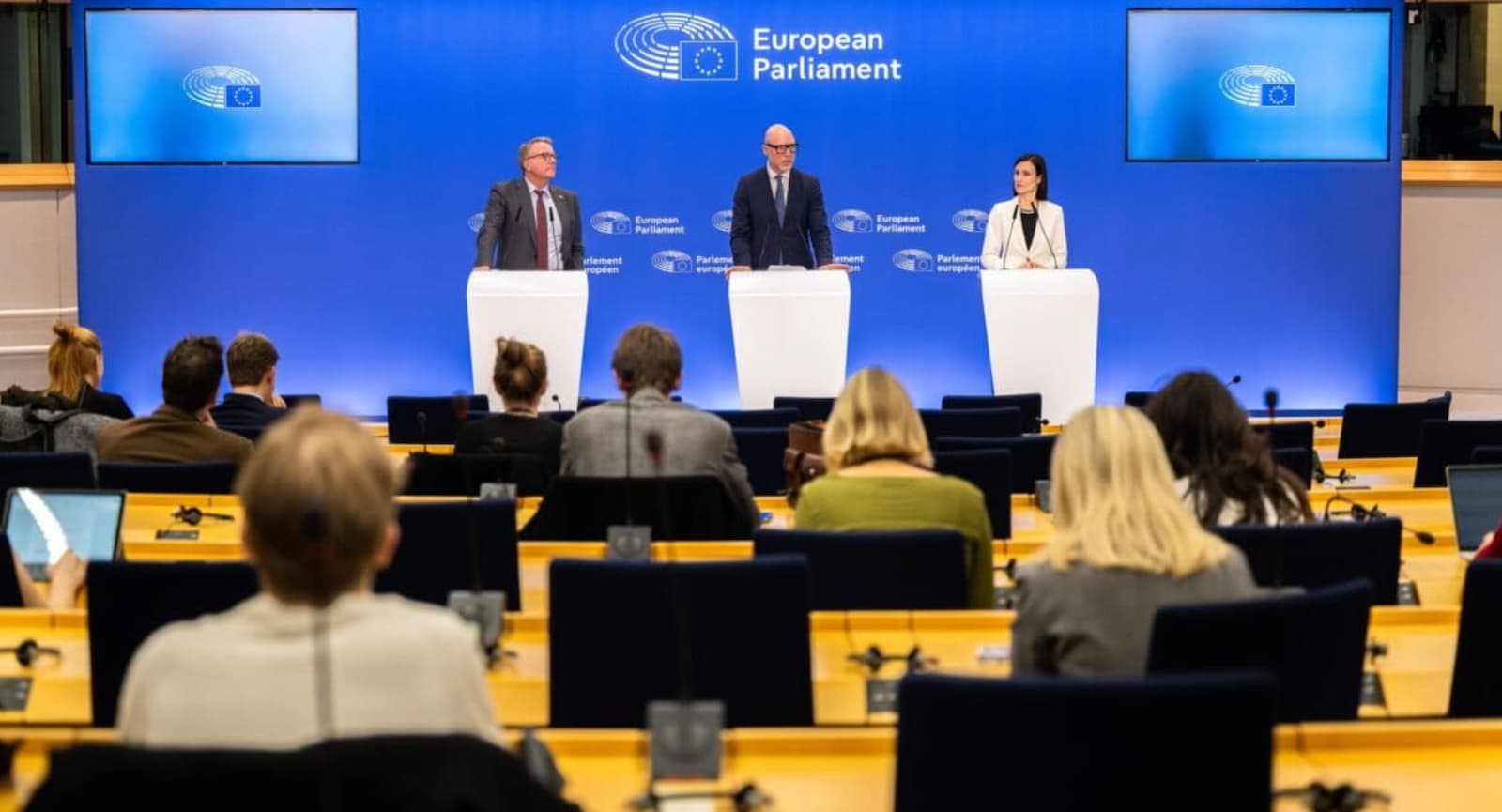
Press conference following the vote to delay the EUDR, again. Image courtesy of Laurie Dieffembacq/European Union.
The European Parliament voted on Dec. 17 to delay a key anti-deforestation regulation that was adopted in 2023 and originally supposed to be implemented at the end of 2024. The implementation was delayed a year to December 2025, and now the EU has voted to delay it yet again by another year.
The European Union Deforestation Regulation (EUDR) requires producers of seven of the key commodities that drive tropical deforestation — beef, cocoa, coffee, palm oil, rubber, soy and timber — to prove that their products are not sourced from land deforested after Dec. 31, 2020.
That requirement includes submitting geolocalized data. But in September, the European Commission cited concerns that its IT system wasn’t ready yet to meet that demand, as a reason for proposing a delay to implementation.
“This is the latest chapter in a farce that’s lasted more than two years, ever since the EUDR was passed with a huge democratic mandate,” Nicole Polsterer, sustainable consumption and production campaigner with the forests and rights nonprofit Fern, wrote Mongabay by email. “[This] decision puts forests on the chopping block and rule-abiding European businesses at a competitive disadvantage.”
The amendment confirms a blanket one-year delay, but small operators will have an additional six months after that, until June 30, 2027, to comply. The decision also introduces the opportunity for additional changes until April 2026 to “assess the law’s impact and administrative burden.”
European lawmakers voted 405 to 242 in favor of the change; eight abstained.
Polsterer criticized the decision to assess the law before it’s even been enacted, saying that without operational experience, there’s no real-world situation to assess. “Agreeing to review the law in April 2026 without this evidence enables anti-EUDR lobbyists to base proposals on what they think might happen rather than actual experience of the law,” she said.
The change also exempts paper used in books, newspapers and other products of the printing industry from the scope of the law — a development the UK Publishers Association celebrated. “It’s a common sense move given the legislation was never designed for our sector,” Dan Conway, the CEO of the Publishers Association, wrote in a statement.
Fern has criticized the pressure from lobbyists for the international pulp and paper industry, going as far back as July 2024, citing the American Forest and Paper Association’s claim that the companies they represent could not prove that their products were deforestation-free.
The recent vote confirms the final text of the amendment but it still needs to be confirmed by the Council of the European Union and published in the EU’s Official Journal before the end of 2025 to apply.
Author: Shanna Hanbury
This article was originally published on Mongabay under the Creative Commons BY NC ND licence. Read the original article.