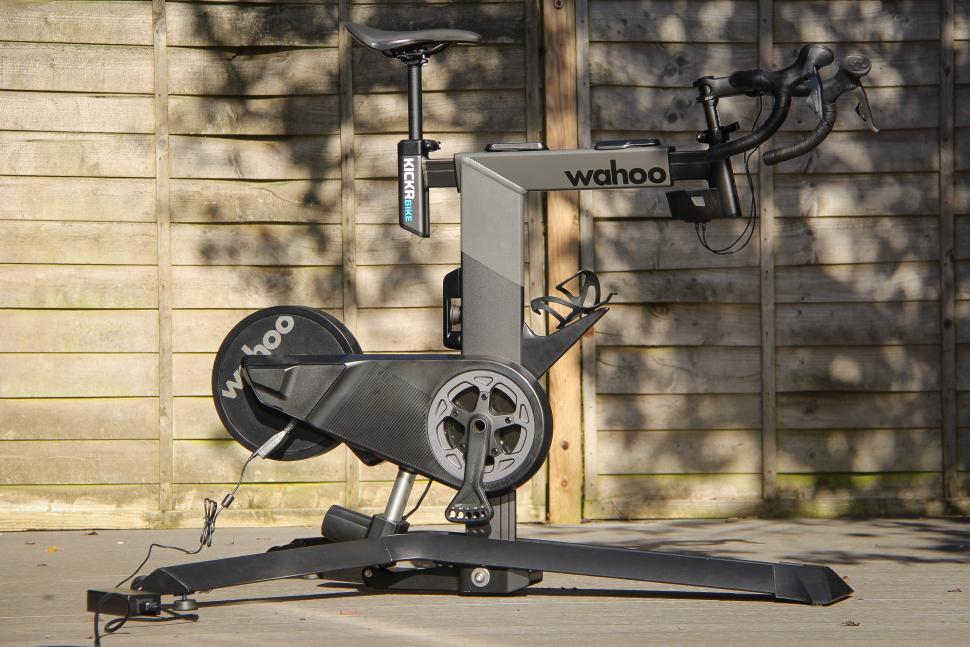
The Wahoo Kickr Bike has had an update, and a name change: with the impressive Kickr Bike Shift joining the line-up, the original bike – with some tweaks – is now the Pro. Some things have been improved, some things haven’t; the Wahoo Kickr Bike Pro is a very impressive bit of kit, but still not without some issues.
The Kickr Bike has been in Wahoo’s line-up for half a decade now, so it’s not new, and the physical bike is more or less the same as it’s been since the start: an alloy frame that’s adjustable at five points, with a belt-driven motor-brake resistance unit and an in-built incline mechanism. The name change to Pro is probably more to differentiate it from the cheaper bike than it is to claim any major step-change from the previous versions.
This is a big, heavy thing and it comes in a big, heavy box that you’ll want to enlist a friend to help you move, but it’s simple enough to assemble: you just bolt the legs on, add the contact points and plug everything in.
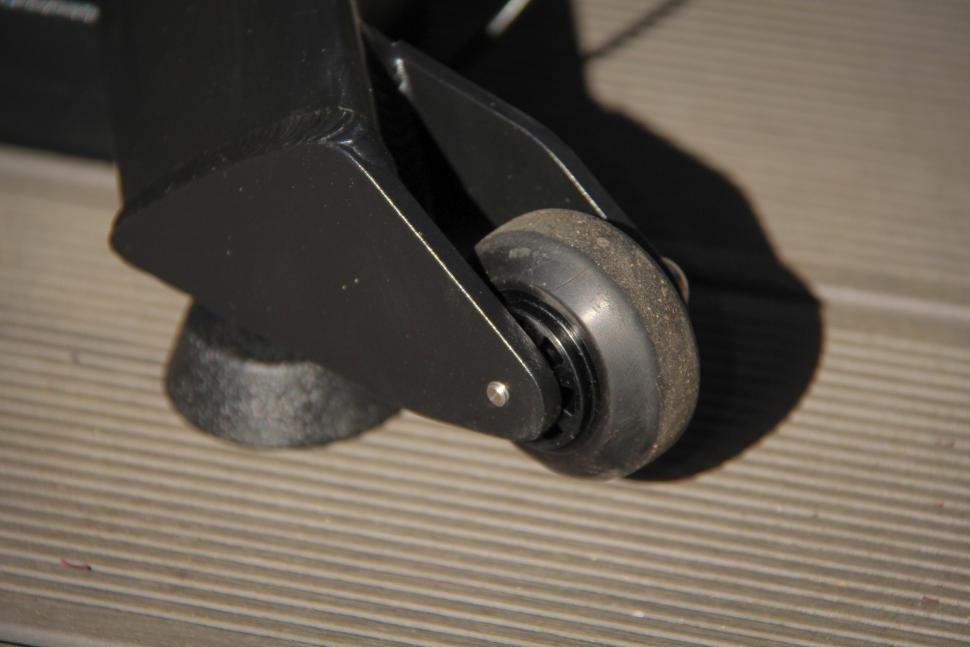 2025 Wahoo KICKR Bike Pro – skate wheel.jpg (credit: road.cc)
Then you’ll need to get it set up so it fits you properly. This can look daunting at first, but once you’ve got the Wahoo app set up on your phone you can enter some very basic information – your inseam, and your preferred riding position – and the app will give you starting points for the five different adjustment points: overall bike height, saddle height, saddle setback, reach and bar height. My fit wasn’t perfect using those settings, but it wasn’t bad either, and it gives you a handy starting point.
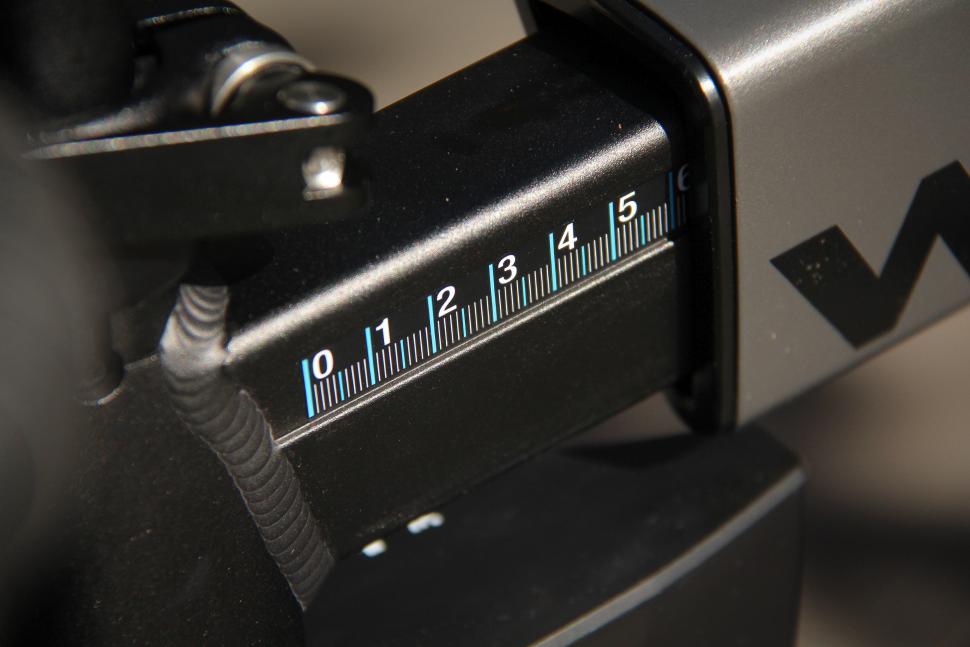 2025 Wahoo KICKR Bike Pro – bar reach adjust.jpg (credit: road.cc)
Once you’ve got it dialled in – from experience this takes a couple of rides – you can make a note of your settings in the app so you can replicate them if someone else has been using the bike. If you’ve had a professional bike fit in the past from a GURU, Retul, or Trek bike fitter then you can enter those numbers to get set up the same as your outdoor bike – if that’s what you want… I tend to ride more upright indoors.
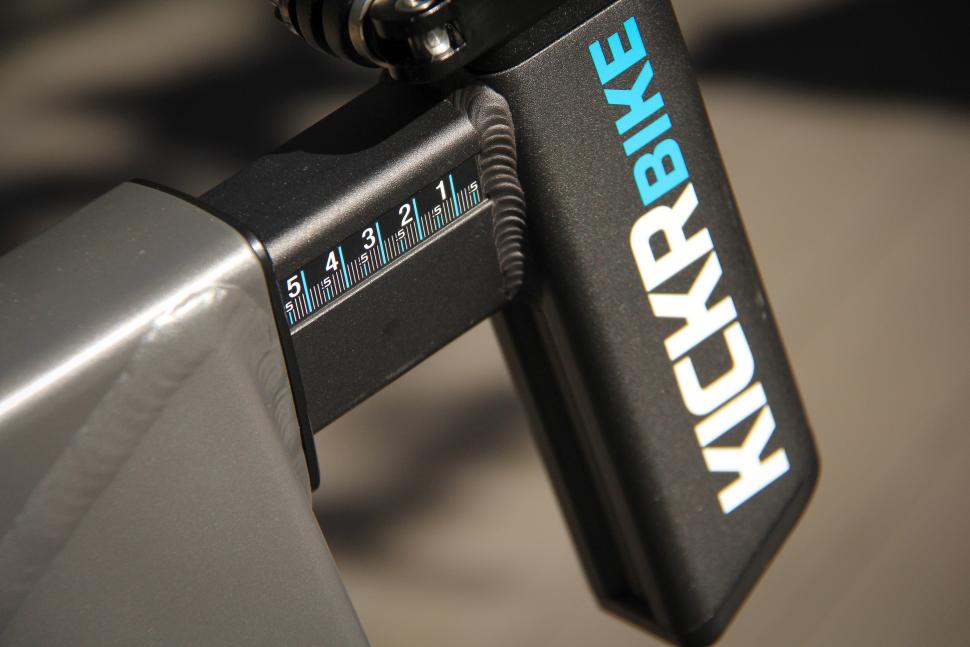 2025 Wahoo KICKR Bike Pro – saddle layback adjust.jpg (credit: road.cc)
In terms of the bones of the trainer, the Kickr Bike Pro is essentially the same as when we reviewed it as the Kickr Bike back in 2020. The motor brake resistance unit has a built-in flywheel; it can generate up to 2,500W of resistance – of which I can personally test a bit less than half – and simulate a slope of up to 20%. The resistance unit can also power itself to keep spinning on the downhills so you don’t have to spin the bike back up at the bottom of a descent.
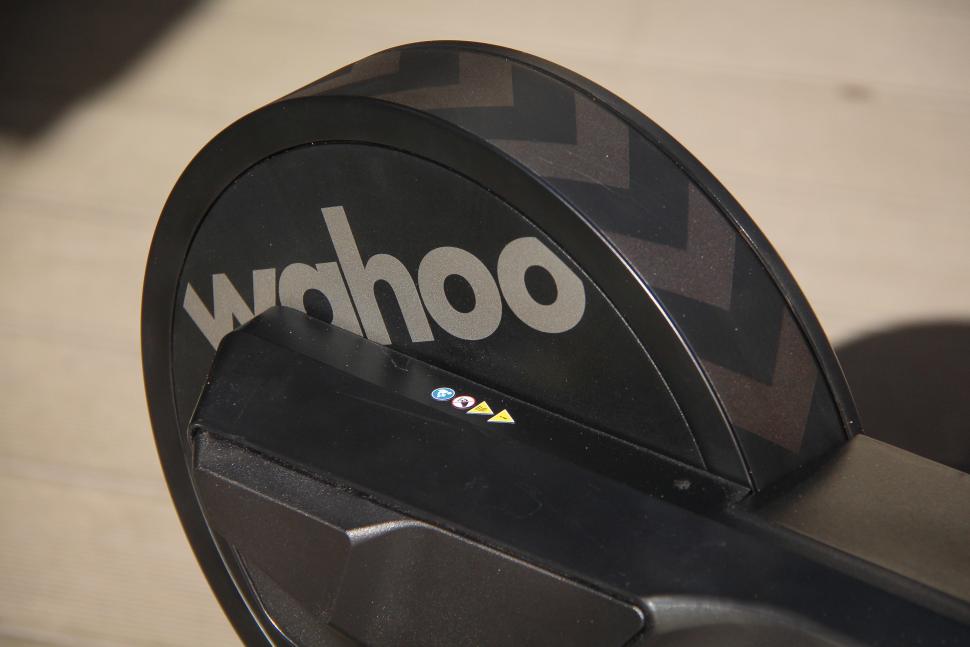 2025 Wahoo KICKR Bike Pro – flywheel.jpg (credit: road.cc)
Resistance changes are more or less instant, so when you’re clicking through the virtual gears you feel the ‘clunk’ of the change a bit like you do with mechanical gears. This is one of the main differences to an electromagnetic resistance unit found on cheaper bikes, including the Kickr Bike Shift – they’re good these days, but the resistance change is always more gradual.
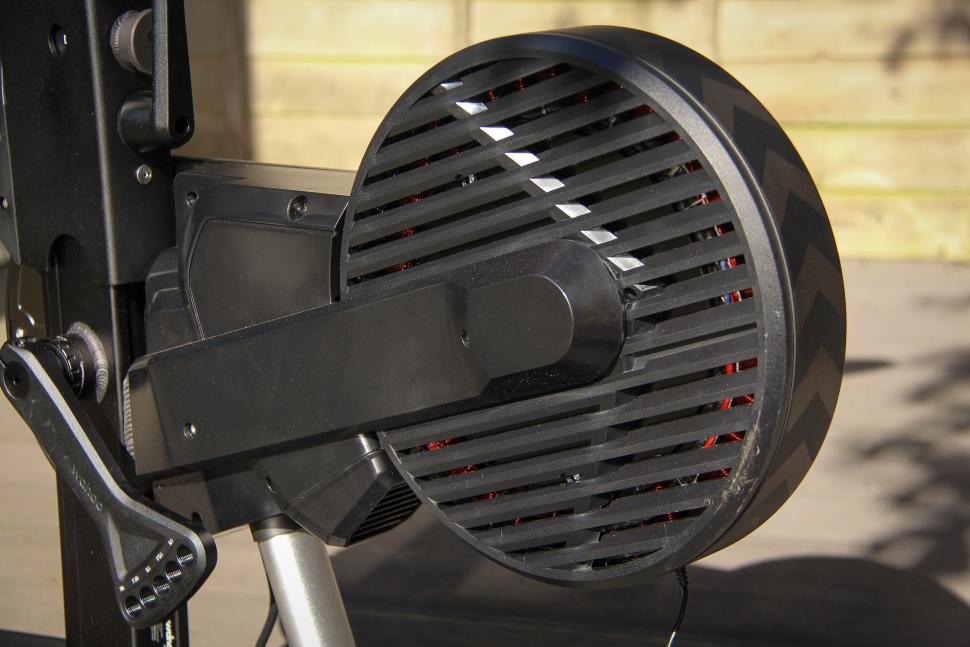 2025 Wahoo KICKR Bike Pro – resistance unit.jpg (credit: road.cc)
I only really like the feel of virtual gears on motor-braked trainers, to be honest; you get used to the feel of any indoor setup, but with the advent of Zwift Cog and more trainers switching to virtual shifting, I miss the tactility of gears. You get a good deal of that back here.
Wahoo Kickr Bike Pro: Grade simulation
That resistance unit is one of the main things you’re paying a premium for. Another is the built-in grade simulation which tilts the bike up or down depending on what’s happening on screen. This makes the experience of riding round the Zwift worlds a lot more immersive, and also means you’re in a more familiar position on the climbs: with the bike tilted up you have less pressure on your hands, and standing up feels more like climbing, and less like sprinting.
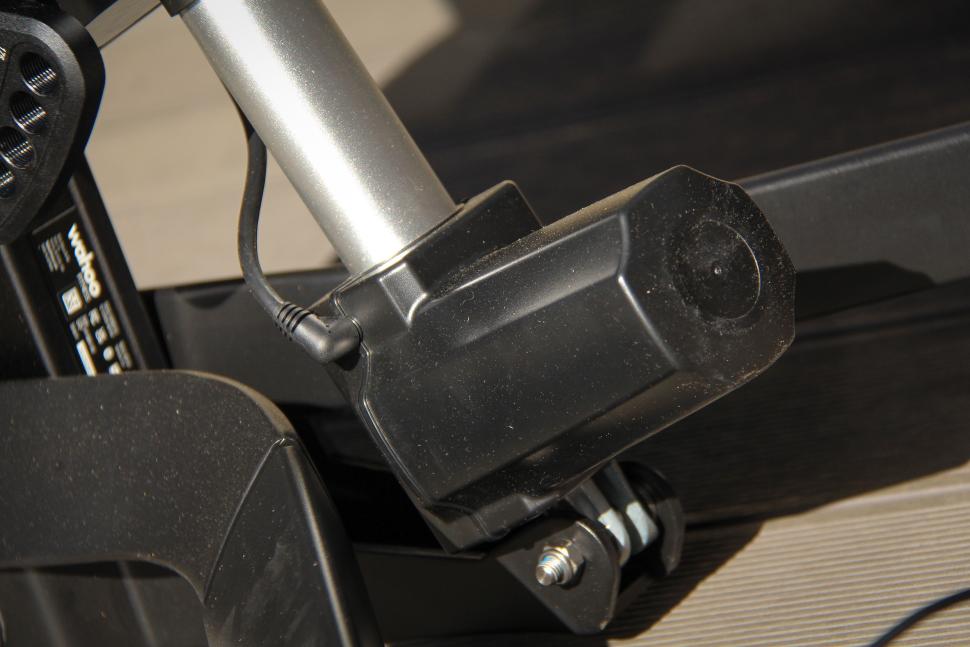 2025 Wahoo KICKR Bike Pro – incline motor.jpg (credit: road.cc)
It works well, although one drawback is that it’s tied in Zwift to your trainer difficulty setting, so you only get full movement when you have difficulty set to maximum. I’m assuming this is because Zwift doesn’t (or can’t) independently send gradient information for setting resistance, and for setting the bike incline: you just get one parameter sent, and on lower difficulty settings it’s scaled down. If you tend to use 100% difficulty that’s not going to be an issue, but I never do, so it’s a trade-off between getting the movement and using the setting I prefer.
Overall I’d say the incline is a fun thing to have rather than a necessity. It adds a bit of interest and I quite like the position it puts you into for climbing, but I don’t necessarily miss it on other trainers.
While some things stay the same, others change. Mostly the stuff that’s changed is how you contact and interact with the bike. The saddle has been upgraded to a Fizik Aliante R5, and that’s paired with Fizik Solocush bar tape on a new ergonomic handlebar that’s a little bit more flared and I found to be very comfortable for indoor riding.
The levers have changed significantly, too: now you get a full cursor/four-button setup on the hoods that mimics the Zwift Play/Click controllers. That means you can navigate through most of Zwift without ever having to reach for your keyboard or your iPad. There are steering buttons on the inside of the levers; that’s where they were before and I found I pressed them a lot by accident, but the new levers are better so Wahoo has clearly tweaked the placement.
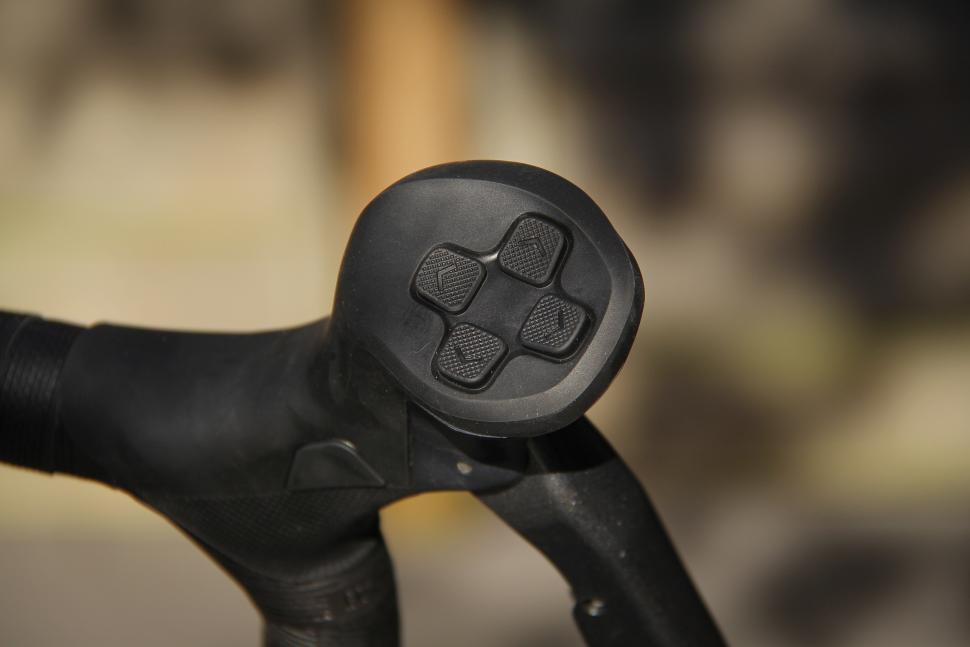 2025 Wahoo KICKR Bike Pro – cursor buttons.jpg (credit: road.cc)
Braking is also still supported on the bike – pulling the lever brakes the flywheel – but not really required in apps at the moment.
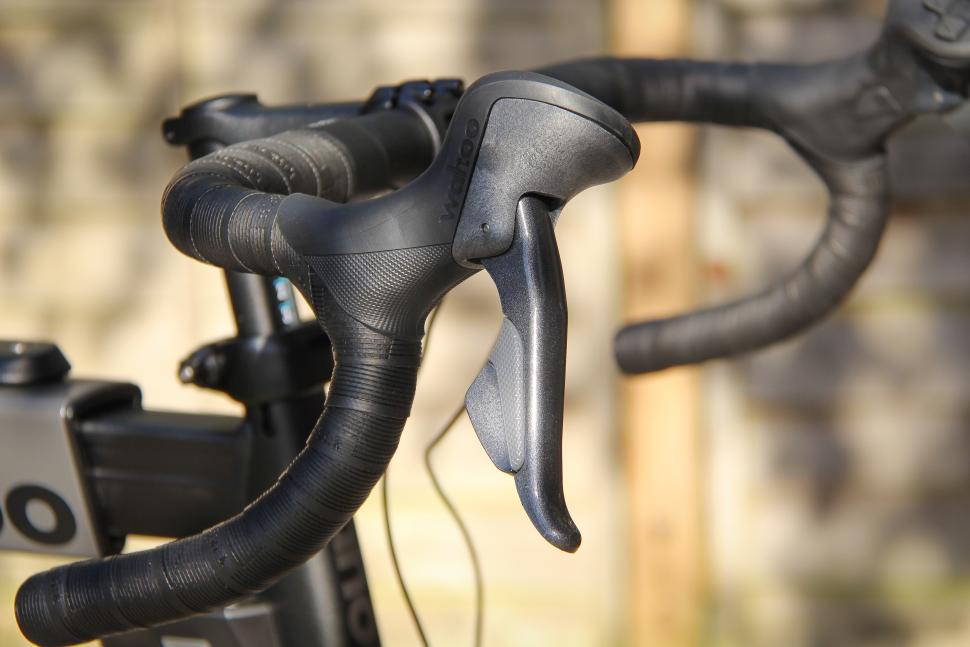 2025 Wahoo KICKR Bike Pro – lever.jpg (credit: road.cc)
For moving between gears you get two paddles behind the brake lever similar to a Shimano lever. By default they work like Shimano levers too, with the right lever handling the rear sprockets and the left changing between front rings. But using the Wahoo app you can replicate pretty much any setup you like from any of the big groupset manufacturers, or make yourself a custom setup if you prefer.
The gear display is where it was before: to the right of the down tube, tucked away. It wasn’t a highlight of the bike when it first appeared and it’s still not; it’s okay unless you put a sweat catcher or a towel on your bars, which will immediately obscure it. There’s a button on the display to lock and release the incline motor, too.
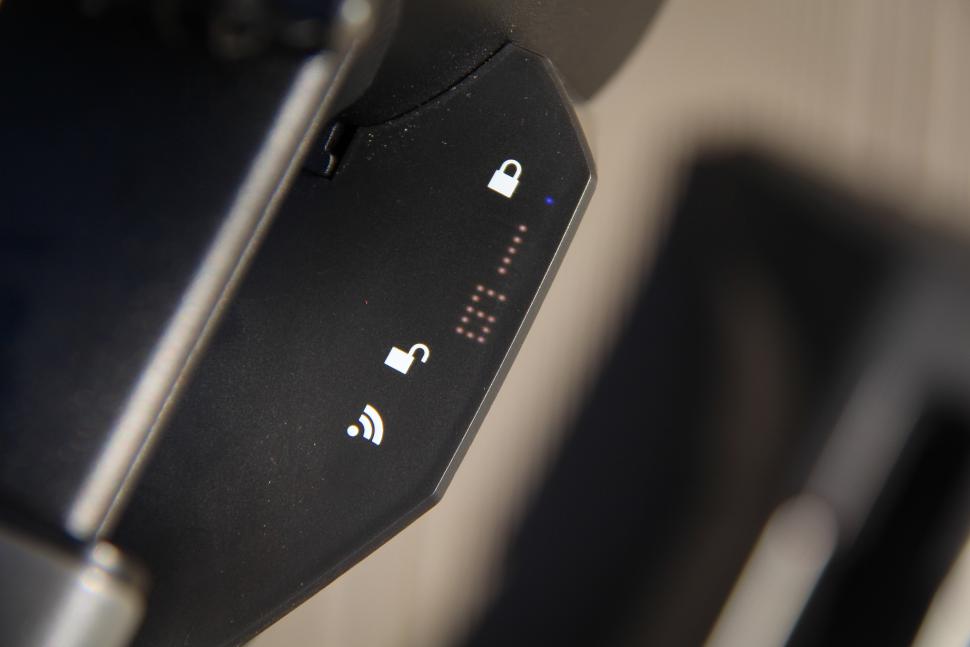 2025 Wahoo KICKR Bike Pro – display.jpg (credit: road.cc)
The only other thing to note down there is a USB port underneath, which you can use to charge your phone or iPad while you’re riding.
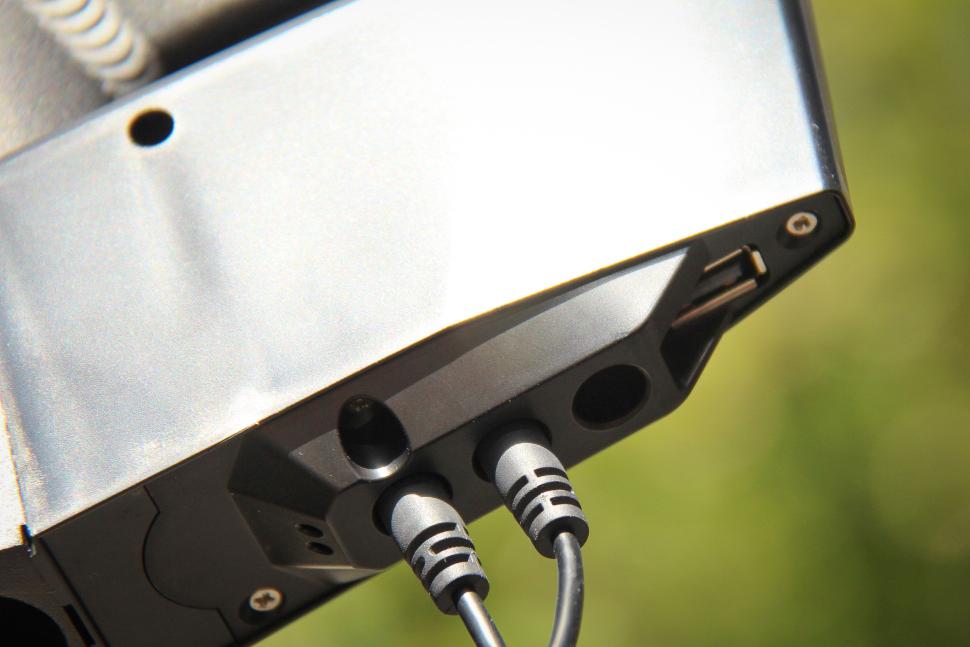 2025 Wahoo KICKR Bike Pro – USB port.jpg (credit: road.cc)
Wahoo Kickr Bike Pro: Power accuracy
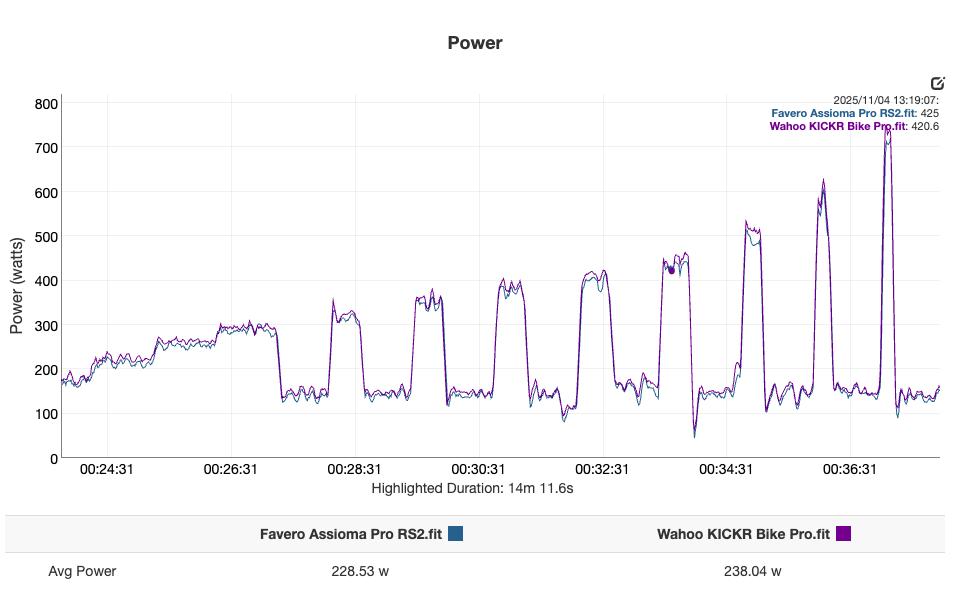
I benchmarked the Kickr Bike Pro against the Favero Assioma Pro RS2 pedals, which I’ve generally found to be accurate. Here’s the trace of the pedals versus the bike across my standard benchmarking workout:
 Wahoo Kickr Bike Pro – power – ERG intervals.png (credit: road.cc)
As you can see, the two track each other extremely well, and the bike is reading slightly over the pedals. Across the testing I did, it was always about 4% higher and that’s the case here. Is one right and the other wrong, or are they both wrong? I don’t have anything I can empirically benchmark against but I’ve generally found the pedals to be where I’d expect against other power meters. They read slightly above the Wattbike Atom and the Muov bike (still in testing) which is more what you’d expect, as there are losses between the pedals and the power meter of most smart bikes, measuring from the resistance unit.
So on balance I’d say the Kickr Bike Pro’s numbers are slightly high. Good news for Zwift racing, then, but otherwise not really an issue: the numbers are repeatable and reliable, and if you’re spending winter aboard the bike you’ll be able to see the trends in your fitness easily.
Below is a free ride, with a couple of sprints thrown in. It’s the same deal here: the bike is slightly above in a repeatable way. The most obvious gap is at the top of the sprints – there’s about a 40-50W gap up there, but it’s the same percentage.
 Wahoo Kickr Bike Pro – power – free ride.png (credit: road.cc)
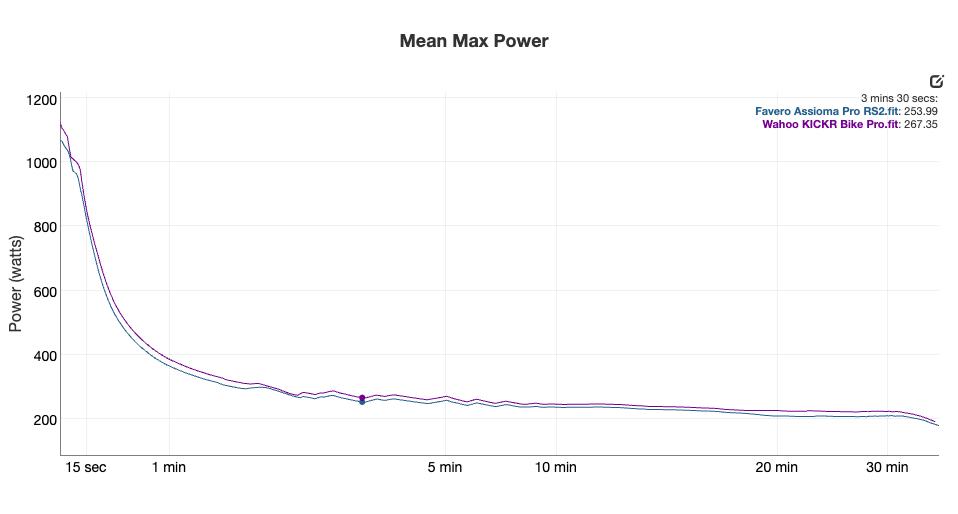
The mean max power graph confirms this: there’s a pretty consistent gap all the way along the line between the two.
 Wahoo Kickr Bike Pro – power – Mean max.png (credit: road.cc)
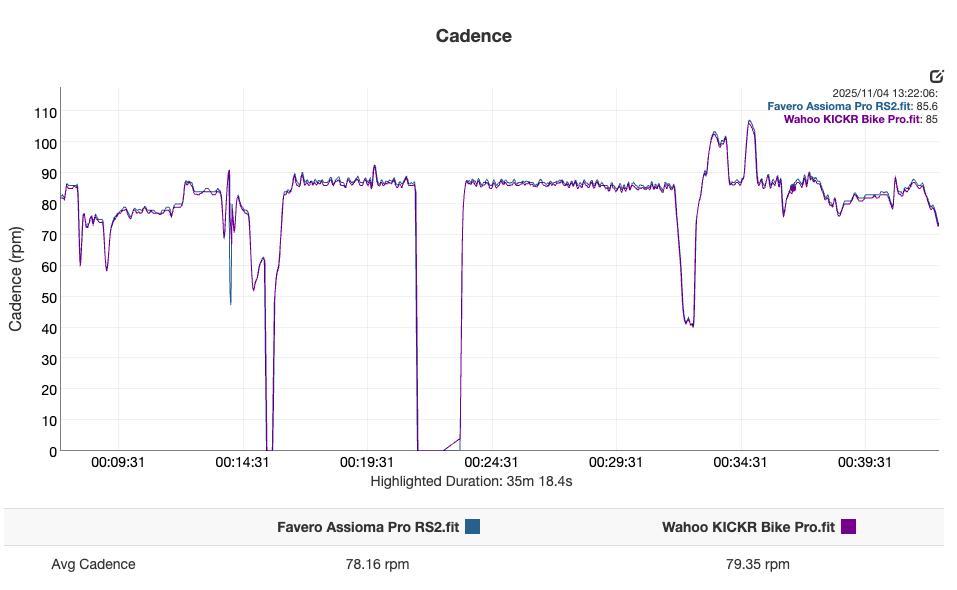
The cadence graph shows that the bike and the pedals track each other very closely, which isn’t a surprise. There’s about a 0.8rpm difference between the two, for whatever reason; I’m assuming the pedals are correct because they are directly measuring revolutions. The Kickr Bike Pro kind of is too, in the sense that it measures at the flywheel and has a single-speed belt drive transmission that has a defined ratio, but maybe the calculation is very slightly out, I’m not sure. There are some bits where the two don’t pick up stopping and starting in the same way, but for the most part there’s not much between them.
 Wahoo Kickr Bike Pro – power – Cadence.png (credit: road.cc)
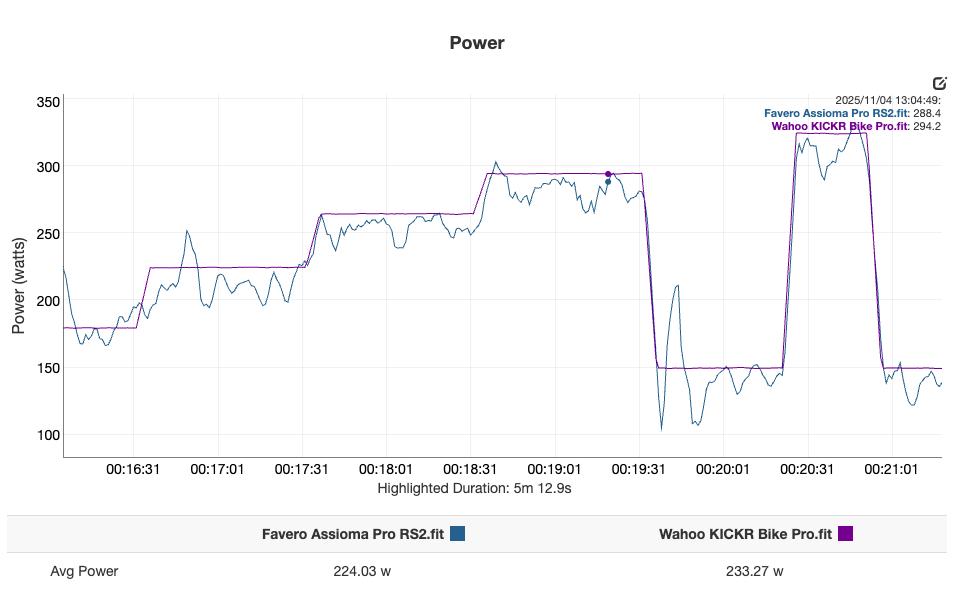
The Kickr Bike has an option for ERG smoothing, so the line on the ERG graph is consistent and doesn’t jump up and down. It doesn’t actually affect the reported power, the difference here is just the same. If you like a straight line on your power graph, you can turn it on. I can’t personally see the point, but you do you.
 Wahoo Kickr Bike Pro – power – ERG smoothing.png (credit: road.cc)
While we’re on the subject of ERG, it wasn’t necessarily the highlight of the original bike – there were some issues with accuracy of the intervals and the power sticking at the end of an interval. That’s all been worked through and ironed out, and I’d say that now the Kickr Bike Pro is among the best I’ve tried for ERG feel. It doesn’t tend to spike at the start of high power intervals, and it keeps an even power across a wide range of cadences, even down to 40-50rpm for climbing intervals, without dropping into a spiral of doom where the power ramps up round the pedal stroke. Accuracy was also good across different cadences. It’s gone from being a bit of a weakness to a strong point, so if you do a lot of interval training it’s good to know you’re well served here.
Wahoo Kickr Bike Pro: Apps
The Kickr Bike Pro comes with a 90-day full subscription to Wahoo’s apps. There’s the general Wahoo app which you can use to set up the bike, update the firmware, change the gearing setup, turn ERG smoothing on and off, and other useful stuff like that. Then there’s Systm, which is the evolution of The Sufferfest, which Wahoo acquired in 2019. And there’s also an Elemnt app, which isn’t really relevant here.
Currently I’d say the whole Wahoo app situation is pretty confusing. Systm sort of stands alone, but you need the Wahoo app to configure your bike, and also there’s workout information on there, and even seemingly some Systm content. And you can do routes in the Wahoo app, but also in the Elemnt app, which (I think) you’ll need to actually sync them to your device. The paid sub gives you Systm, but also some features on the Wahoo app. I feel like the whole thing could do with a bit of a consolidation, really. It’s not intuitive at all.
All that being said, Systm is a full training platform with lots to do. The cycling aspect is built around The Sufferfest’s 4DP measurement, which tracks your power at 5 seconds, 1 minute, 5 minutes and 20 minutes, and tailors your workouts accordingly. It’s a solid system, and you might have noticed that Zwift does a similar thing these days, although in Zwift the intensity of any block in a workout is still tied just to your FTP.
There are a lot of video workouts and they’re good fun, inasmuch as an indoor workout can be: they tend to tell a story and guide you through the intervals with video and sound. Some of the vids from the catalogue are getting a little dated now but there are new ones coming online too. As well as cycling there are running and swimming sections, plus mental strength, yoga, and strength and mobility. There’s a lot in there, and if you’re just going to commit to one training sub then at £12.50 a month if you pay annually, it’s decent value too. If you’re planning just to train through the winter, then it’s £14.99 a month on a rolling contract, so you’re getting about 50 quid’s worth of training with the bike, which is kind of like a 1.5% discount…
Wahoo Kickr Bike Pro: Conclusion
Is the Kickr Bike Pro ‘the pinnacle of indoor riding technology’ like Wahoo says it is? Well, it’s really good, and you get some tech – the incline system mostly – that you’re not going to find anywhere else. The ERG mode is hugely improved, the bike is whisper-quiet and solid in use, and Wahoo has upgraded your contact points considerably. You’re stuck with that display that feels like a bit of an afterthought, and it’s a pity the incline system doesn’t work independently of the trainer difficulty setting in Zwift.
At £3,499 this is an expensive bit of hardware and you’re going to be fully committed to indoor training (or just rich) to drop that kind of money on a static bike, but it is really good. It’s easy to set up, has a great ride feel and offers something that other bikes don’t. At RRP it’s the same price as the Tacx Neo Bike Plus which for me probably has the edge on virtual shifting realism and has a better screen, but I think I prefer the more general ride feel of the Kickr.
You can spend more – it’s currently sitting in the shed next to the £4,995 MUOV bike – but you can also get really excellent bikes for much, much less: the Wattbike Proton costs half what the Kickr Bike Pro does. Is it as good? No, but it’s good enough for lots of people.
If you’re making the jump to something like the Kickr Bike Pro it’s probably for the realism of the gears, and the incline system, and the general quality of the bike and the resistance system, and you do get plenty for your money here.
Verdict
Top-quality indoor trainer with a high-quality resistance unit and unique incline tech
Make and model: Wahoo Kickr Bike Pro
Tell us what the product is for and who it’s aimed at. What do the manufacturers say about it? How does that compare to your own feelings about it?
From Wahoo:
KICKR BIKE PRO: For those who want to experience an even better version of the highly acclaimed KICKR BIKE, the new KICKR BIKE PRO is Wahoo’s flagship indoor cycling experience. Combining unmatched realism with onboard grade simulation, gear shifting, and real-time responsiveness, BIKE PRO is perfect for riders who crave premium performance and total immersion. Whether it’s a multi-user household or a rider who refuses to compromise, KICKR BIKE PRO is the pinnacle of indoor riding technology.
NEW: Intuitive New Shifter Controls for Seamless In-Ride Interaction: KICKR BIKE PRO debuts redesigned, ergonomic shifters that put total control at your fingertips. Inspired by modern virtual cycling trends, the new interface offers a natural, responsive feel and easy access to in-app features on Zwift, without ever leaving the bars. This update enhances rider immersion and places KICKR BIKE PRO as the most integrated indoor training solution available.
NEW: Premium Touchpoints for a Premium Ride: The KICKR BIKE PRO introduces notable improvements to rider comfort and feel with an all-new set of premium touchpoints:
Fi’zi:k Aliante R5 Saddle
Fi’zi:k Solocush Handlebar Tape
New Ergonomic Handlebar, specifically designed for indoor riding
Revolutionising Realism and Control: Building on its reputation as the ultimate indoor riding simulator, KICKR BIKE PRO offers next-level realism with integrated incline simulation, a precision flywheel with motor and downhill simulation, and KICKR Race Mode for near instantaneous power response. The easily adjustable five-point fit system ensures perfect ergonomics, while virtual shifting offers seamless, customizable gear changes to replicate real-world riding.
Unmatched Ride Feel
KICKR BIKE PRO combines controlled resistance with built-in grade simulation to replicate the sensation and body position of riding outdoors – including downhill simulation to maintain speed on virtual descents.
Reality Shift
Virtual shifting and custom gearing allows you to match the gear ratios of your outdoor bike, replicating the major groupsets from Shimano, SRAM and Campagnolo to create a personalized ride experience.
True Fit
Guided by an intuitive set-up app, KICKR BIKE PRO’s 5-point adjustment system lets you easily adjust frame, setback and reach dimensions to optimize overall bike fit for comfort and performance.
Premium Touchpoints
Fi’zi:k Aliante R5 saddle, Fi’zi:k Solocush Handlebar Tape, and a new ergonomic handlebar redefine indoor comfort. These premium components deliver a more comfortable and supportive ride.
Legendary Ride Realism
KICKR BIKE PRO combines KICKR’s legendary resistance and grade simulation technologies to replicate the sensation of riding outdoors – including downhill simulation that allows you to maintain speed on virtual descents.
Physical Grade Changes
With integrated tilt, this indoor smart bike simulates grade changes in real-time by not only providing changes in resistance, but also physically raising and lowering the smart bike to match ascents up to 20% and descents as steep as -15%.
Intuitive Control System
Completely redesigned shifter controls deliver increased comfort and greater in-ride control over the app experience. Integrated commands for Zwift keep hands on the bars and focus on the effort, not the interface.
Premium Saddle
KICKR BIKE PRO comes equipped with the iconic Fi’zi:k Aliante saddle. Designed for endurance, it delivers pro-level support to match the most demanding indoor rides.
Ergonomic Bars
KICKR BIKE PRO features Fi’zi:k Solocush handlebar tape and a new ergonomic handlebar to support longer sessions and harder efforts with greater comfort .
Programmable Virtual Shifting
Customize the KICKR BIKE PRO’s shifting controls to match shifters from the leading manufacturers – SRAM, Shimano, and Campagnolo.
Programmable Gearing
Replicate your outdoor bike down to the exact gearing configuration by selecting the number of speeds and cassette tooth count.
Adjustable Fit
Adjust the fit of your smart bike to match your outdoor bike’s geometry across 5 points – stack, reach, setback, saddle height, and frame height.
Multi-Sensor Simplicity
Integrated KICKR BRIDGE removes ANT+ and BLE device limitations by relaying Heart Rate and other compatible sensors onto your home network through your KICKR BIKE PRO, making sensor pairing quick and easy.
Seamless Connectivity
Offering a robust 2.4 GHz Wi-Fi connection, up to 3 Bluetooth Connections, a direct connect port and ANT+/ANT+FE-C compatibility, KICKR BIKE PRO smart bike pairs to most devices and applications so you have the most control over your training and ride data.
KICKR Race Mode
Built for the demands of virtual racing, KICKR Race Mode streams power data up to 10x faster for real-time responsiveness during sprints, surges, and breakaways.
Wahoo Ecosystem
The Wahoo ecosystem offers cyclists the tools to get faster, fitter, and have more fun while chasing their goals. From sensors and smart devices to pedals and mounts, every accessory is engineered for precision, comfort, and performance.
Tell us some more about the technical aspects of the product?
From Wahoo:
Specifications
Dimensions
60x30x46″ / 153x76x117 cm [LxWxH]
Rider Height Range
5′ (152 cm) to 6’4″ (193 cm)
Maximum Rider Weight
250 lb / 113 kg
Crank Arm Lengths
165 mm, 167.5 mm, 170 mm, 172.5 mm, and 175 mm
What’s in the Box
KICKR BIKE PRO Smart Bike
AC Power Adapter
Allen Wrenches (4mm and 5mm)
Handlebar Assembly
Seatpost and Saddle Assembly
Does not include pedals
Setup
Setup Instructions
Supported Devices
iPhone / iPad: iOS 16 or newer
Android: Please visit our support site to check for Android compatibility.
MacOS: Bluetooth enabled or pair with ANT+ dongle
Windows PC: Bluetooth enabled or pair with ANT+ dongle
Rate the product for quality of construction:
9/10
Rate the product for performance:
8/10
Rate the product for durability:
9/10
Rate the product for weight (if applicable)
9/10
Rate the product for comfort (if applicable)
7/10
Good, and the improved saddle and tape help.
Rate the product for value:
5/10
Tell us how the product performed overall when used for its designed purpose
Very well.
Tell us what you particularly liked about the product
The ride feel, and the ease of adjustment.
Tell us what you particularly disliked about the product
The display is still poor.
How does the price compare to that of similar products in the market, including ones recently tested on road.cc?
£3,499 is at the top end of the market but you can spend more; the Tacx bike is the same at RRP.
Did you enjoy using the product? Yes
Would you consider buying the product? Yes if I was more flush than I am.
Would you recommend the product to a friend? Yes, a wealthy friend.
Use this box to explain your overall score
It’s very good overall: a high-quality trainer with a great resistance unit and a highly configurable fit. The incline unit adds something, but I’m not sure if it’s something I’d personally pay for.
Age: 52 Height: 189cm Weight: 99kg
I usually ride: whatever I’m testing… My best bike is: Lauf Úthald, Kinesis Tripster ATR, Dward Design fixed
I’ve been riding for: Over 20 years I ride: Every day I would class myself as: Expert
I regularly do the following types of riding: commuting, touring, club rides, general fitness riding, fixed/singlespeed, Mountain Bike Bog Snorkelling, track