RESEARCHERS from Heriot-Watt University have confirmed the key causes behind the devastation caused by the 2011 Japan earthquake and tsunami.
The study, part of an international research team, “provides the clearest evidence yet that a thin, clay-rich layer just beneath the seabed at the Japan Trench played a central role in allowing the magnitude 9.0 earthquake to rupture all the way to the surface”.
It is now understood that the shallow slip of the clay layer displaced vast areas of the seafloor, generating the tsunami that caused over 20,000 casualties.
Taking place on 11 March 2011, the earthquake struck off the coast near the city of Sendai in the country’s T?hoku region.
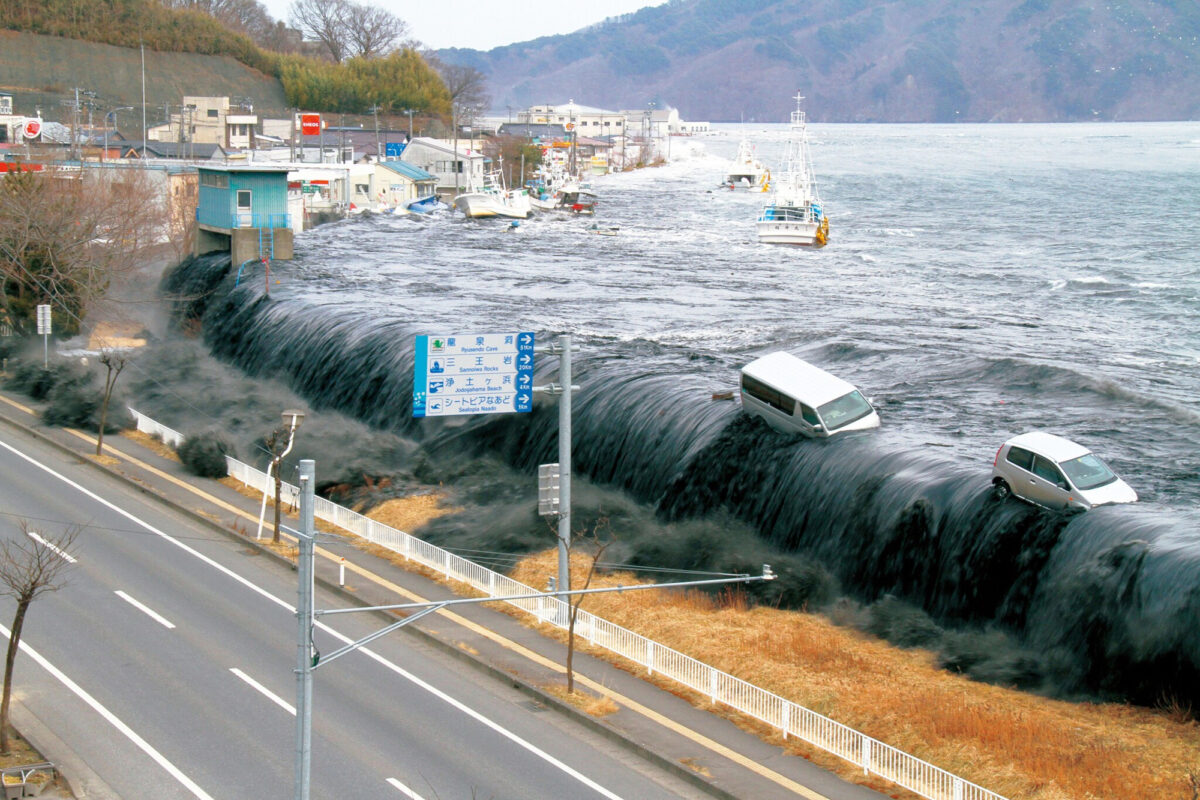
The resulting tsunami swept through the coastline, destroying homes, vehicles, and infrastructure in its wake.
 The earthquake caused smaller shocks around the world.
The tsunami also resulted in the explosion of three reactors at the Fukushima Daiichi nuclear power plant.
Over 19,000 people were killed, while over 2,500 remain missing to this day.
Patrick Fulton, co-author of the study and based at Cornell University in the USA, said: “This work helps explain why the 2011 earthquake behaved so differently from what many of our models predicted.
“By seeing exactly how the fault zone is constructed, we can better understand where slip is likely to concentrate and how much tsunami potential a given subduction zone might have.”
The results are based on data collected during International Ocean Discovery Program Expedition 405, known as JTRACK, which in 2024 drilled directly through the plate boundary fault.
Reaching almost eight kilometres beneath the sea surface, the expedition is the deepest scientific ocean drilling ever completed.
Amy Gough, a sedimentologist from Heriot-Watt‘s School of Energy, Geoscience, Infrastructure and Society, participated in the expedition.
She said: “From a sedimentological perspective, this is a unique recipe for localising deformation.
“The fault is not spread out over tens or hundreds of metres. It is concentrated into a very thin zone that makes it much easier for large earthquakes to keep going all the way to the seabed.”
Dr Uisdean Nicholson, also a sedimentary geologist in Heriot-Watt said: “We knew from earlier studies that there was weak clay near the fault zone, but previous drilling records were patchy, with limited core recovery.
“The exceptional results from this expedition, with complete cores and geophysical data from multiple drilling sites, let us see exactly what the relationship is between that material and the fault.
“What we find is an exceptionally weak layer that contains direct evidence of extreme shearing at the main plate boundary.
“The clay, which has very little frictional resistance, allows the rupture to propagate all the way to the seabed rather than the energy dissipating below the surface.
“That led to this enormous amount of movement of the seabed, which pushed the water up in turn, resulting in this devastating tsunami.”
The new findings confirm that it is “precisely the weakness of this thin clay layer” that enables such extreme motion.
The findings will not help in predicting future earthquakes, but the researchers say they represent an important step towards more realistic models of how megathrust faults behave.
Fulton added: “Ultimately, our goal is to translate this kind of detailed fault zone knowledge into better assessments of earthquake and tsunami hazards for coastal communities around the world.”
Related