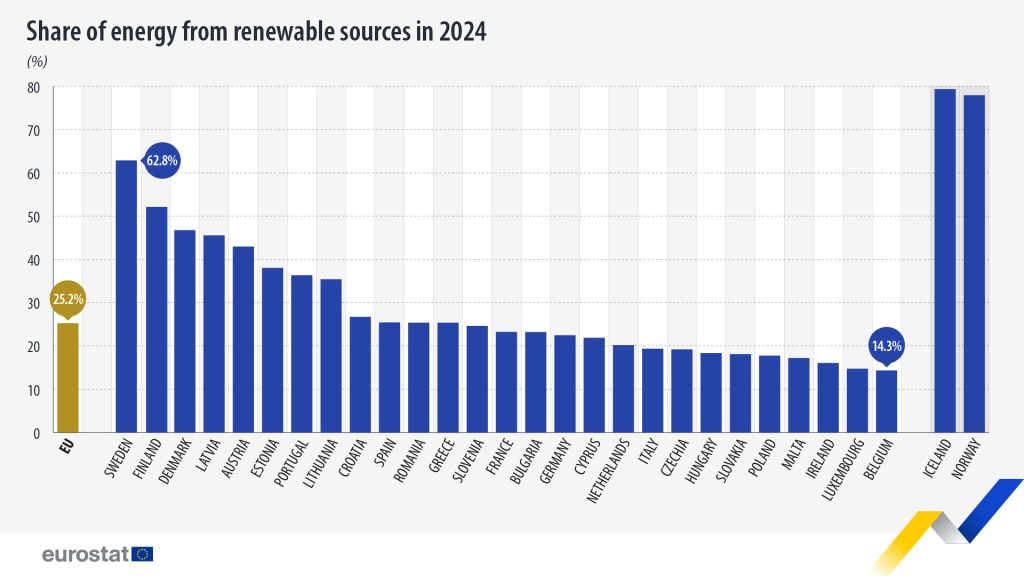
Some 25.2% of the EU’s gross final energy consumption came from renewable sources in 2024, a 0.7-percentage-point rise on the previous year, new data from Eurostat has shown.
While the growth in renewables is welcome, the EU is still 17.3 percentage points short of meeting its 2030 target (42.5%), which will necessitate an annual average increase of 2.9 percentage points between now and the end of the decade.
Sweden leads the way
Sweden leads the way when it comes to energy consumption from renewable sources, with 62.8% of its energy generated in this way, largely from solid biomass, hydro and wind.
Finland took second place, with a renewable share of 52.1%, again largely driven by solid biomass, wind and hydro, with Denmark placing third (46.5%), relying mainly on solid biomass, wind and biogas.
Other countries to report a notable percentage of energy generation from renewables included Latvia (45.5%), Austria (43%), Estonia (38%) and Portugal (36.3%).
At the other end of the scale, Belgium recorded a renewable share of 14.3%, Luxembourg followed with 14.7%, and Ireland reported 16.1%, with Malta (17.2%) and Poland (17.8%), not far behind.
Two non-EU countries lead the way for renewable energy generation in Europe, however with Iceland generating 79.3% of its energy from renewable sources, and Norway generating 77.9%, Eurostat‘s data showed. Read more here.
Share of energy from renewable sources, 2024 (%)
Share of energy from renewable sources, 2024 (%)
Value (%)
Like this:
Like Loading…
Related