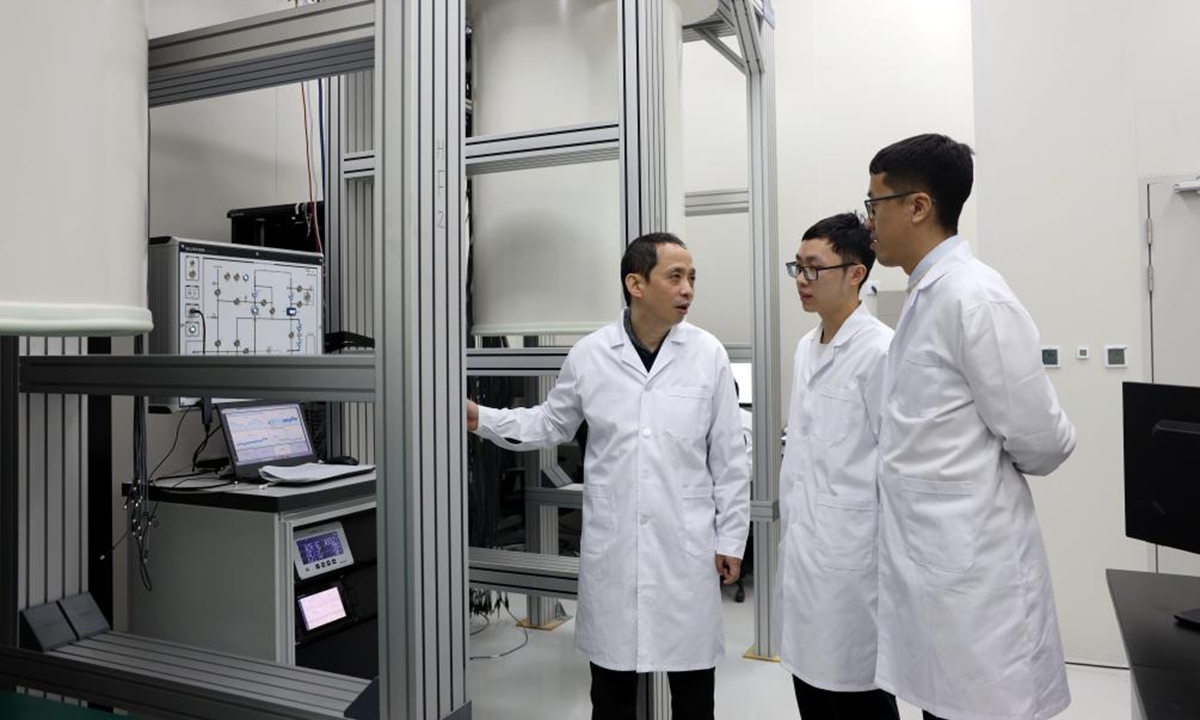
Zhu Xiaobo (first from left), professor at the University of Science and Technology of China and chief scientist of the “Zu Chongzhi” quantum computer, discusses experimental results with his students on March 3, 2025. Photo: Xinhua
China has made a new breakthrough in quantum computing, as its superconducting quantum computing prototype “Zuchongzhi 3.2” achieved quantum error correction below the fault-tolerance threshold on a surface code with a code distance of seven, according to a report by Science and Technology Daily.
The breakthrough demonstrated that logical error rates drop significantly as code distance increases, marking a key milestone for China in achieving quantum error correction that improves once the threshold is crossed.
It also opens a new, more efficient “all-microwave control” pathway compared with approaches pursued by Google, laying a crucial technical foundation for large-scale fault-tolerant quantum computing.
The findings, carried out by researchers from the University of Science and Technology of China, including Pan Jianwei, Zhu Xiaobo and Peng Chengzhi, along with associate professor Chen Fusheng, were published on Monday as a cover paper and an Editors’ Suggestion in Physical Review Letters, according to the Science and Technology Daily.
How to push overall system control precision beyond the stringent error-correction threshold, thereby realizing increasingly effective quantum error correction, is widely seen as a critical dividing line between laboratory prototypes and practical quantum computing systems.
Building on earlier research, the USTC team proposed and successfully implemented a novel “all-microwave quantum state leakage suppression architecture” on the 107-qubit Zuchongzhi 3.2 quantum processor. Using this architecture, the researchers realized a surface-code logical qubit with a code distance of seven.
Experimental results showed that the logical error rate decreased markedly as the code distance increased, with an error-suppression factor reaching 1.4. This confirmed that the system is operating below the error-correction threshold and has achieved the goal of increasingly effective error correction, the report said.
Quantum computing is widely regarded as a key technology for the next generation of the information revolution.
In March this year, the same team, including Pan from the University of Science and Technology of China, successfully built the 105-qubit superconducting quantum computing prototype “Zuchongzhi 3.0,” once again breaking the world record for quantum computational advantage in the superconducting system, Xinhua News Agency reported.
Global Times