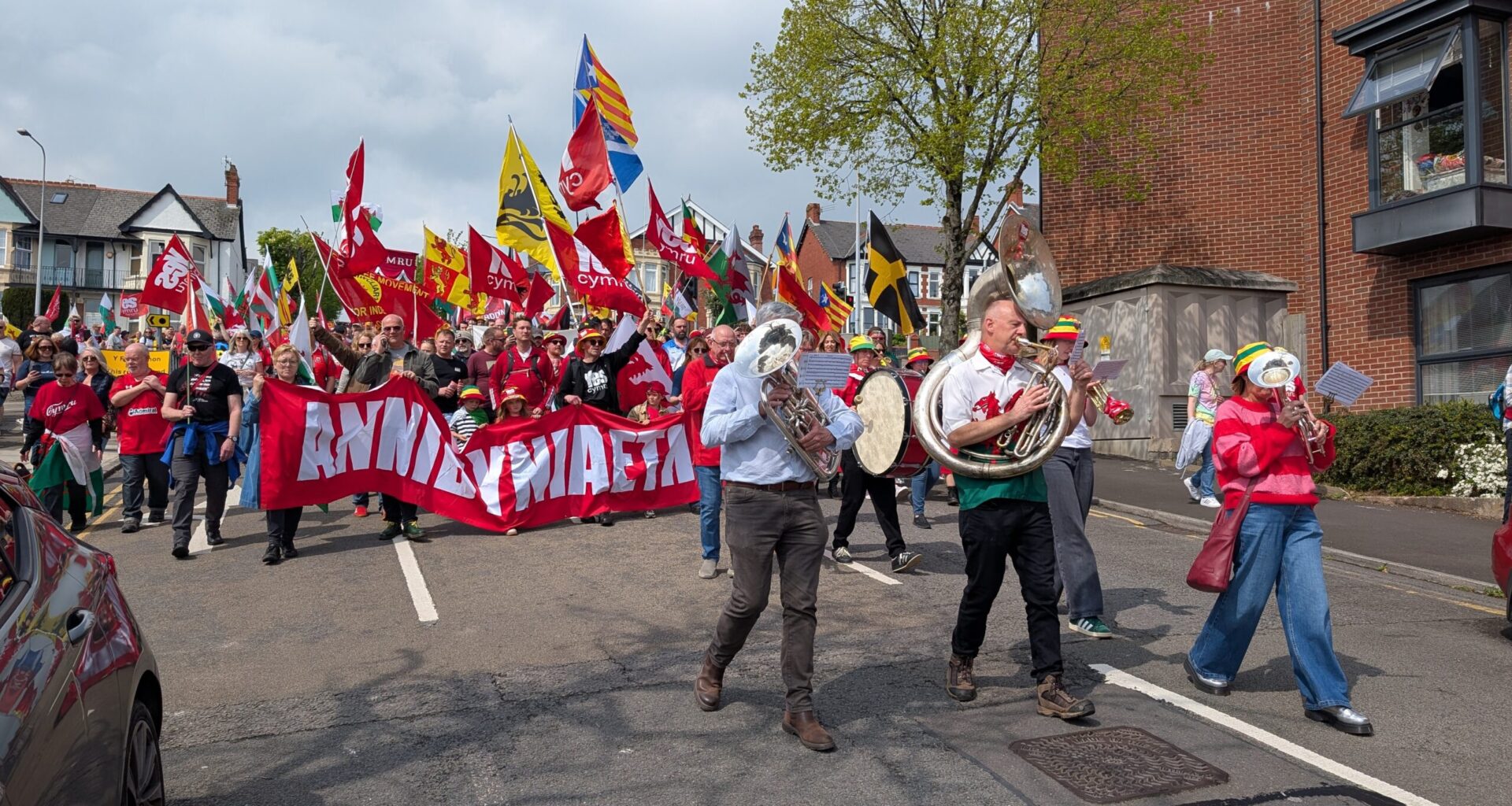
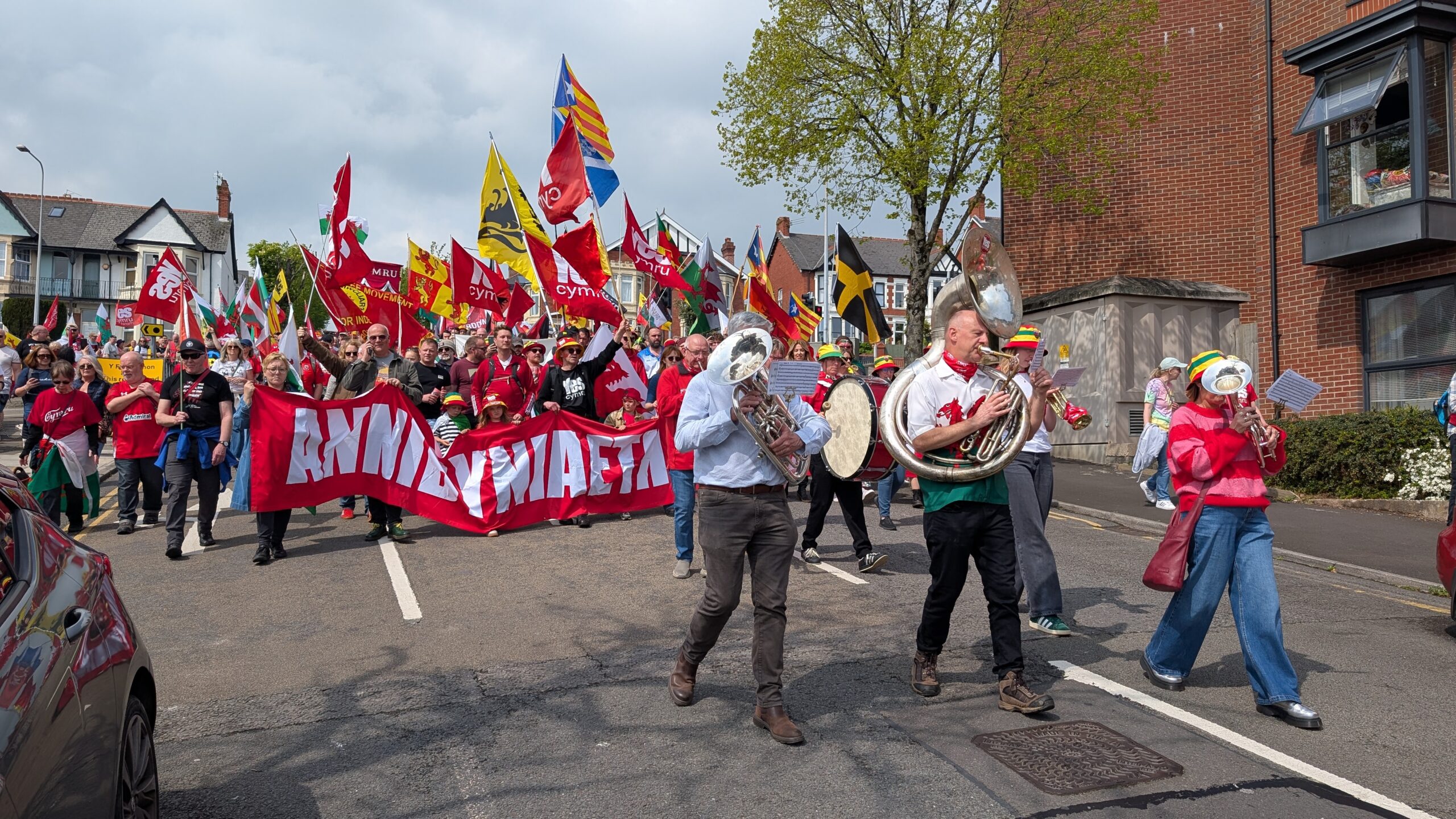
 Marchers supporting Welsh independence in Barry
Mike Hedges – MS for Swansea East
Plaid Cymru’s policy is one of salami slicing to independence. Summed up by devolve, devolve, and devolve until there is nothing left to devolve.
Adam Price when leader of Plaid Cymru said: “Plaid Cymru has a simple answer to the challenge posed by Westminster, and that is independence.”
Please ignore that Wales is financially a net beneficiary of the union. We know that because David Phillips of the IFS has estimated Wales is a net beneficiary of the union by between 12 and 15 billion pounds a year.
If Wales keeps its revenues, funds its own public spending, and then makes a population-based contribution to the UK-wide situation, at least as it stands, that would lead to a large fiscal deficit for Wales.
Also, according to David Phillips of the IFS, the most recent estimates from the ONS suggest that public expenditure in Wales is about 10 per cent higher than it is across the UK as whole. This despite raising substantially less money per person.
We also know small countries do not have the economic strength to weather financial storms. For example in Iceland between 2008 and 2010 a catastrophic financial crash occurred.
It involved the default of all three of the country’s major privately owned commercial banks in late 2008, following problems in refinancing their short-term debt and a run on deposits.
Relative to the size of its economy, Iceland’s systemic banking collapse was the largest of any country in economic history. The crisis led to a severe recession.
The Conservative policy is this is the end of the devolution journey. Even opposing the devolution of policing that has already been devolved to some English mayors as well as Scotland and Northern Ireland.
This is written by someone who believes in devolution but not in Welsh independence. We have had several devolution settlements for Wales, and we are no closer to a long-term settlement than we were before the first.
Responsibilities
In the UK, we have seen different devolution settlements for Wales, Scotland, and Northern Ireland, as well as different responsibilities devolved to London and some of the larger city regions of England.
We have what is meant to be a reserved powers model in Wales, following the most recent settlement, but the host of reservations within supposedly devolved areas makes a mockery of such a definition.
Since leaving the European Union, there is now a new battle to get devolved to Wales those powers repatriated to Britain in wholly devolved areas.
If the settlement had been a comprehensive reserved powers model, then this would not have arisen as nothing being repatriated would be on the current reserved list.
There are the obvious areas that need to be held centrally within a devolved structure such as defence, foreign affairs, national security, currency, interest rates, overseas aid, immigration, driver and car licensing, central bank, and National Insurance numbers.
Discussion
If those areas are devolved, it is called independence rather than devolution. But there are those areas that are worthy of discussion over whether they should be devolved or set centrally, including:
*State pension age and amount. Should we have one for the UK or should each jurisdiction set its own? How would that work with movement between England, Wales, Scotland, and Northern Ireland?
*Should we have one unified social security system, or should each jurisdiction be able to set their own contribution levels and payments? Same issues as above.
*Should alcohol and tobacco duty be the same to avoid cross-border movement? Should there be UK taxes to pay for the centrally funded items, with all other taxes devolved and collected locally? Similar to state and national taxes in the USA. How will financial support from the wealthier to the poorer regions be organised and maintained?
Not everything needs to be devolved to Wales, Scotland and Northern Ireland or the English city regions at the same time. What we should have, is a list of items that are available to be devolved with each parliament and mayoral area needing at least two thirds of members voting in favour before the area is devolved. This is what happened in Northern Ireland when policing was devolved.
‘Big bang’
This approach avoids “big bang” devolution, where control of everything is passed on one day, while still allowing for matters to be devolved as the parliaments are ready for them and funding is agreed.
The advantage of this is that it sets an end point of the devolution journey outside of creating new countries and allows each to move at a pace it is comfortable with but with a common endpoint. Asymmetrical devolution has not worked.
Other countries such as Germany and the USA have the same powers devolved. Each US state has the same powers and responsibilities no matter its size and the same with each German Lander.
Devolution in Wales does not have to end in Cardiff. Devolution within Wales is possible to the four regions of Wales and councils.
Which powers would be better devolved to local authorities also needs to be discussed and decided. The 20th century was almost a one-way movement of control away from local councils including water, further education, and policing. The question surely should be where the best decisions will be taken for the local population.
Devolution in Wales is a journey, but it must not be a journey that only ends in Cardiff. For true devolution, powers will also need to be devolved to the regions and councils of Wales.
Support our Nation today
For the price of a cup of coffee a month you can help us create an
independent, not-for-profit, national news service for the people of Wales, by
the people of Wales.