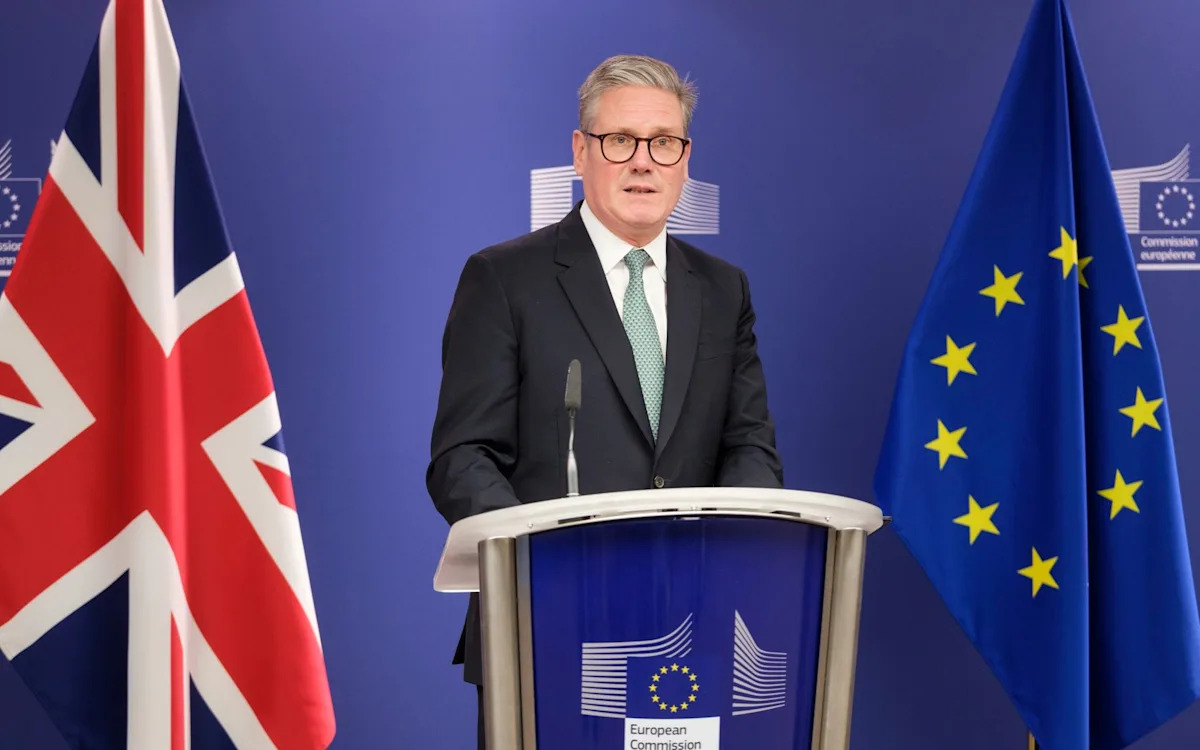
Wes Streeting’s insistence this weekend that Keir Starmer must go further in undoing Brexit merely says aloud what has long been implicit. It took Britain a decade to get into Europe and four torturous and divisive years to extricate itself half a century later. Yet here we are again.
Freed from European control, Britain has struck trade deals around the world – though too much of Brussels’s regulatory dead hand remains, constraining business and diluting the independence Brexit was meant to secure. But now, under unreconstructed Eurozealot Keir Starmer, direct rule from Brussels is creeping back onto the agenda.
And why wouldn’t it? The Prime Minister made his name on this issue. Having only entered the political fray in 2015, he rose from relative obscurity under Corbyn to the last Remaining hope, prompting speculation as early as 2016 that he might one day lead Labour.
During the long-drawn-out renegotiations, Starmer argued for a second referendum. Like many, he repeated the line that the British electorate had somehow been duped by snake-oil Leave campaigners.
So it was likely that, once in office, Starmer would cosy up to Europe. With his approval rating plunging to -48 and his party polling at around 20 per cent, the direction of travel is now clear.
A “youth mobility” scheme is being advanced and Nick Thomas-Symonds, who once held Theresa May’s government in contempt over Brexit, has been elevated to the cabinet. At a handsome £570m a year – though even this may be an underestimate – Britain will rejoin the Erasmus student programme. Senior party figures, implausibly, talk of the customs union as the key to an economic recovery already compromised by excessive taxation and regulation, which would only grow if we rejoined.
Remainers still cling onto a number of conceits. First, that membership of the customs union and single market – or “closer alignment”, as Starmer euphemistically puts it – will shake us from our economic torpor. People like Wes Streeting, who is now pushing Starmer to go further, see salvation in Europe.
Yet its supposed powerhouses are hardly thriving. Germany’s economy contracted in 2024, France’s unemployment rate is 7 per cent, Italy’s GDP per capita has barely increased in a decade. These economies are trapped under the weight of their welfare states, mass migration, disastrous energy policy and suffocating regulation. Seeking rescue from them is like trying to tow yourself to shore whilst chained to a sinking ship. Eventually, the waters will close over you.
In any case, Brexit was never primarily about money, it was about sovereignty, democracy, “taking back control” – the idea that politicians must listen to voters and decisions should be made by elected representatives accountable to the public – not EU bureaucrats with questionable legitimacy. It’s going to be difficult for Labour to now argue that overturning what voters wanted is not just more of the same old.
Second, that in some unspecified way rejoining would make it possible to control the never-ending flow of illegal migrants, which act as Reform’s main recruiter. We are clearly incapable of doing anything ourselves, seems to be the assumption.
Third, that closer ties won’t only save the country, but the Party, too. Some Labour strategists now consider a pro-Remain position essential to stopping the slippage of young, cosmopolitan, globalist voters to the Greens and Liberal Democrats. If the story of the Right has in 2025 been Reform; on the Left it is the astonishing surge in support for the Green Party, now polling at around 17 per cent.
Surveys suggest a third of Labour supporters want to rejoin the EU completely – seemingly oblivious to the fact we would be guaranteed to do so on worse terms at great cost. Nearly 40 per cent want to rejoin the customs union and single market.
A plan to pledge this in Labour’s 2029 manifesto could be Starmer’s last roll of the dice. “He’s facing the same problem the Tories had in the last Parliament – a deeply divided electoral coalition,” says historian Stephen Davies.
“Starmer has no choice but to upset one half and hope a Left-wing stance on economics will be enough to keep the other onside.” This will confirm Labour as the metropolitan party of the graduates, the public sector – the new “working” class.
But it hinges on Starmer surviving to 2029. Already, the sharks are circling, with around two thirds of the Parliamentary Labour Party convinced he cannot survive past May’s elections.
Red Wall MPs representing Leave-majority constituencies, who would rather like to hang onto their seats, will fiercely resist abandoning the Party’s base. Senior figures in Blue Labour – the conservative wing to which Starmer’s chief of staff Morgan McSweeney is closely aligned – say they would be “appalled and disgusted” at the betrayal. The PM’s authority is already fragile; another rebellion on the scale of the welfare revolt could be terminal.
Decades after Charles de Gaulle brusquely vetoed Britain’s accession talks to the European Economic Community, we are still – just about – an independent nation rather than a continental appendage.
Yet now we are run by a haughty human rights lawyer who distrusts public opinion and believes in the supremacy of international law and technocratic globalism. It seems unlikely that, even if it somehow sneaks into the manifesto, a commitment to turning the clock back to 2016 will prove a winning ploy for this discredited Government.