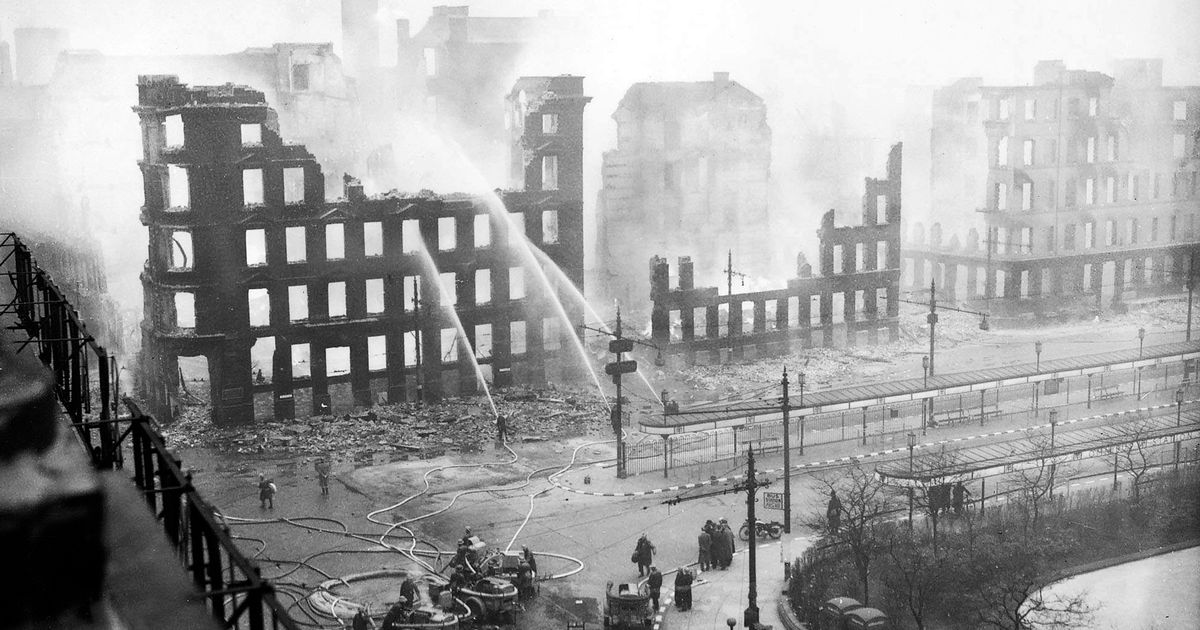
It’s been 85 years since the Christmas Blitz rained terror down on Greater Manchester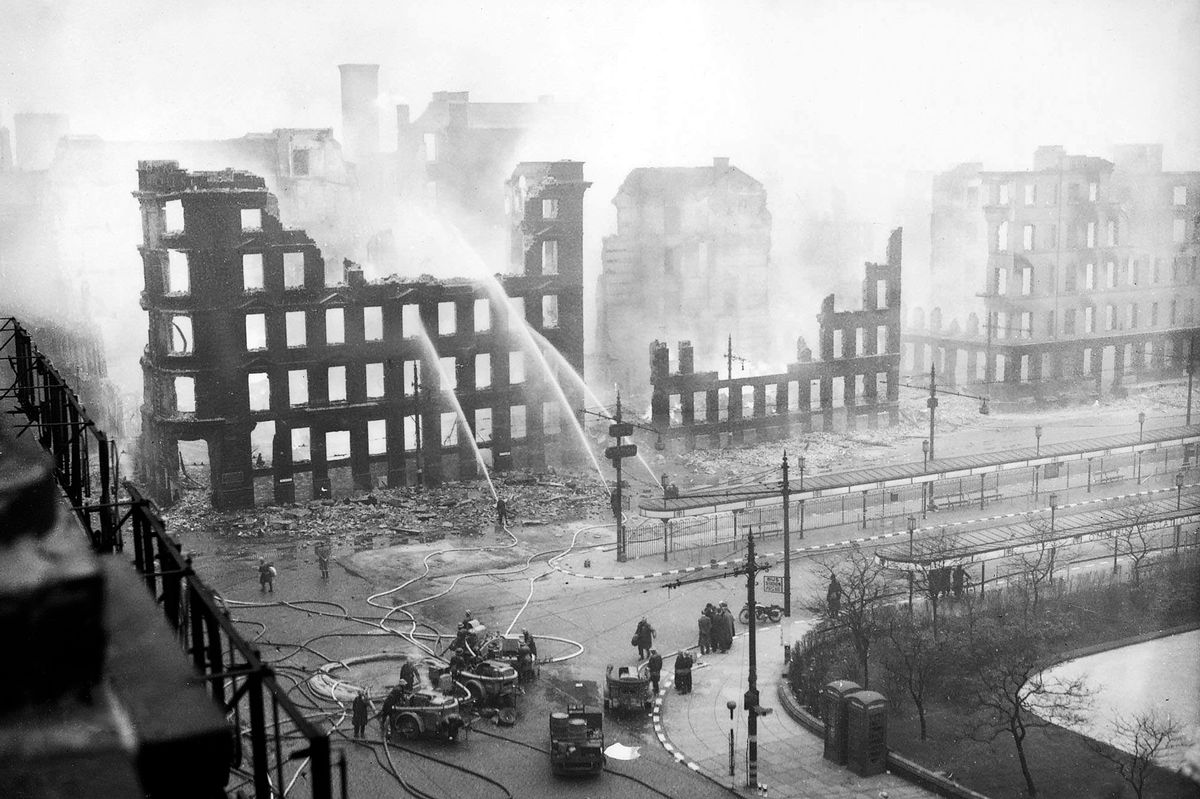 Firemen spray water on to the smouldering remains in the centre following the Christmas Blitz bombing raids in December 1940
It’s hard to imagine Greater Manchester residents barricading themselves and rushing to bomb shelters at a siren’s wail. Unlike other parts of mainland Europe now, it’s been 85 years since the region faced such terror.
The Christmas Blitz that came to Manchester and Salford on December 22-24, 1940, remains one of the darkest periods in our history. Nazi bomber raids killed hundreds of people and reduced large parts of the city centre to rubble.
Over those two nights, fires raged citywide as the city was decimated by bombs and incendiaries. Manchester, as an important inland port and Industrial city, and Trafford Park, being a major centre of war production, made the region a prime target for German bombers.
Following the sirens minutes earlier, the first incendiary bombs landed in Albert Square at 6:48pm on December 22. Soon after, the Royal Exchange was ablaze. Fires then raged across Manchester, Salford, and Stretford.
Fire crews swarmed the city, dousing flames. Local residents formed amateur crews, using hand pumps to battle fires on their own streets.
Shortly after 7pm that same night, part of Victoria Buildings collapsed into Deansgate while the Exchange Hotel burned fiercely.
In Eccles, a huge bomb exploded on Gilda Brook Road, close to a house where the air personnel were hosting a Christmas party. 12 died, and 31 were injured. A husband and wife and their three children who lived in the house next door were killed by the same bomb.
In Monton Road, another massive bomb fell on a house and killed three children aged 16, 12, and six. A sailor home on leave from the battleship Queen Elizabeth died at the same house.
The bombs continued to fall into the morning, relentlessly killing and maiming with each passing hour. Just before the skies fell quiet near 6:30am on December 23, Manchester Cathedral took a direct hit.
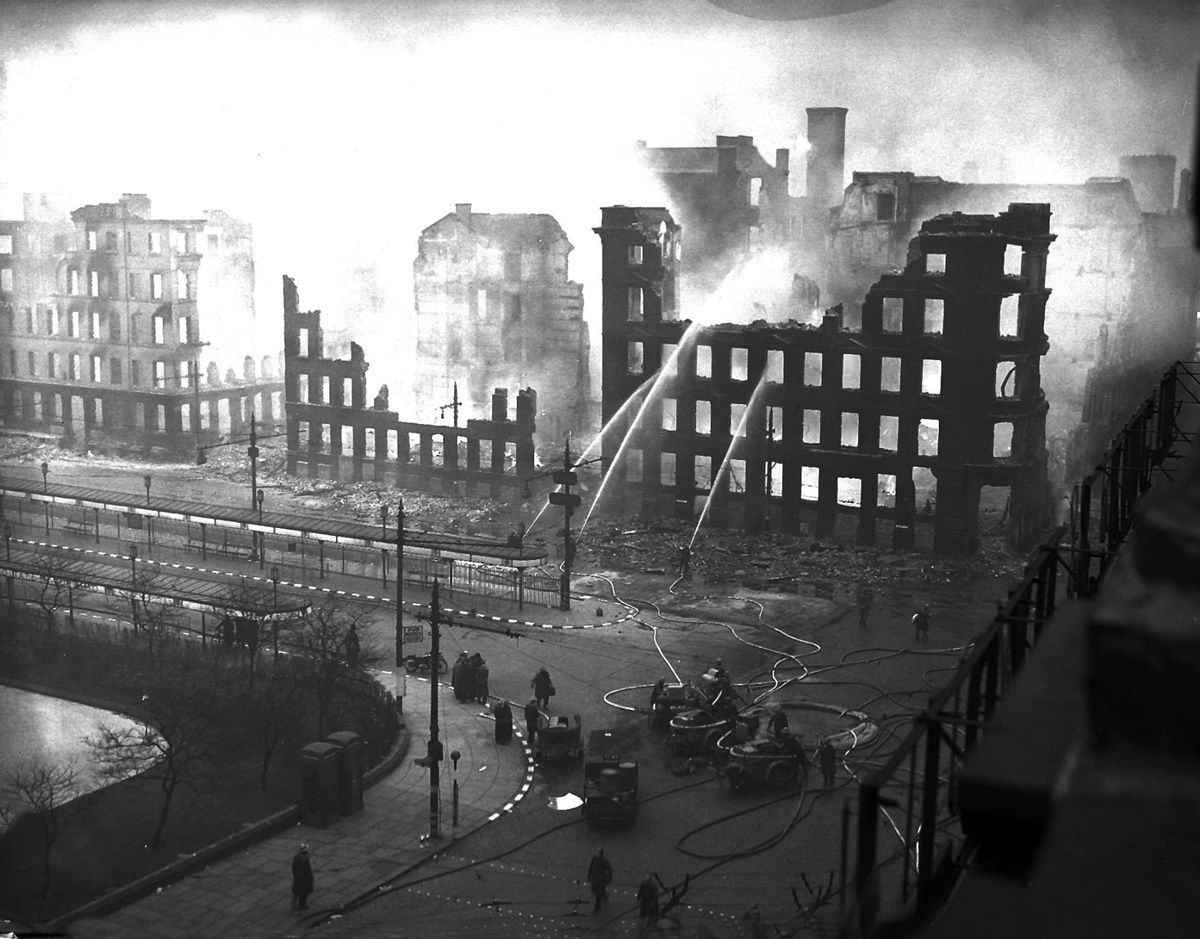 Buildings ablaze in the Manchester Blitz, December 1940(Image: Mirrorpix)
By 11:30am, all fires had been brought under control as extra police were drafted into the city. The public was said to have conducted itself remarkably well in circumstances where fury, grief and the numbness of shock might well have been the only sane response.
Yet there was little time to grasp what had happened, as just after 7pm, the skies darkened, and the hum of engines returned once more. The Luftwaffe had returned.
Shattering salvoes of ‘ack-ack’ guns fired blindly into the sky, hunting the sound of bombers soaring overhead. Waves of bombs and incendiaries fell on Stretford, Stockport and Salford.
In Salford, hundreds of houses were left without electricity as fires flickered in the darkness.
At a wedding party at the Manley Arms pub in Hulme, 14 people were killed in a huge bomb blast. Another bomb made a direct hit on Manchester Royal Eye Hospital, killing a doctor and a nurse.
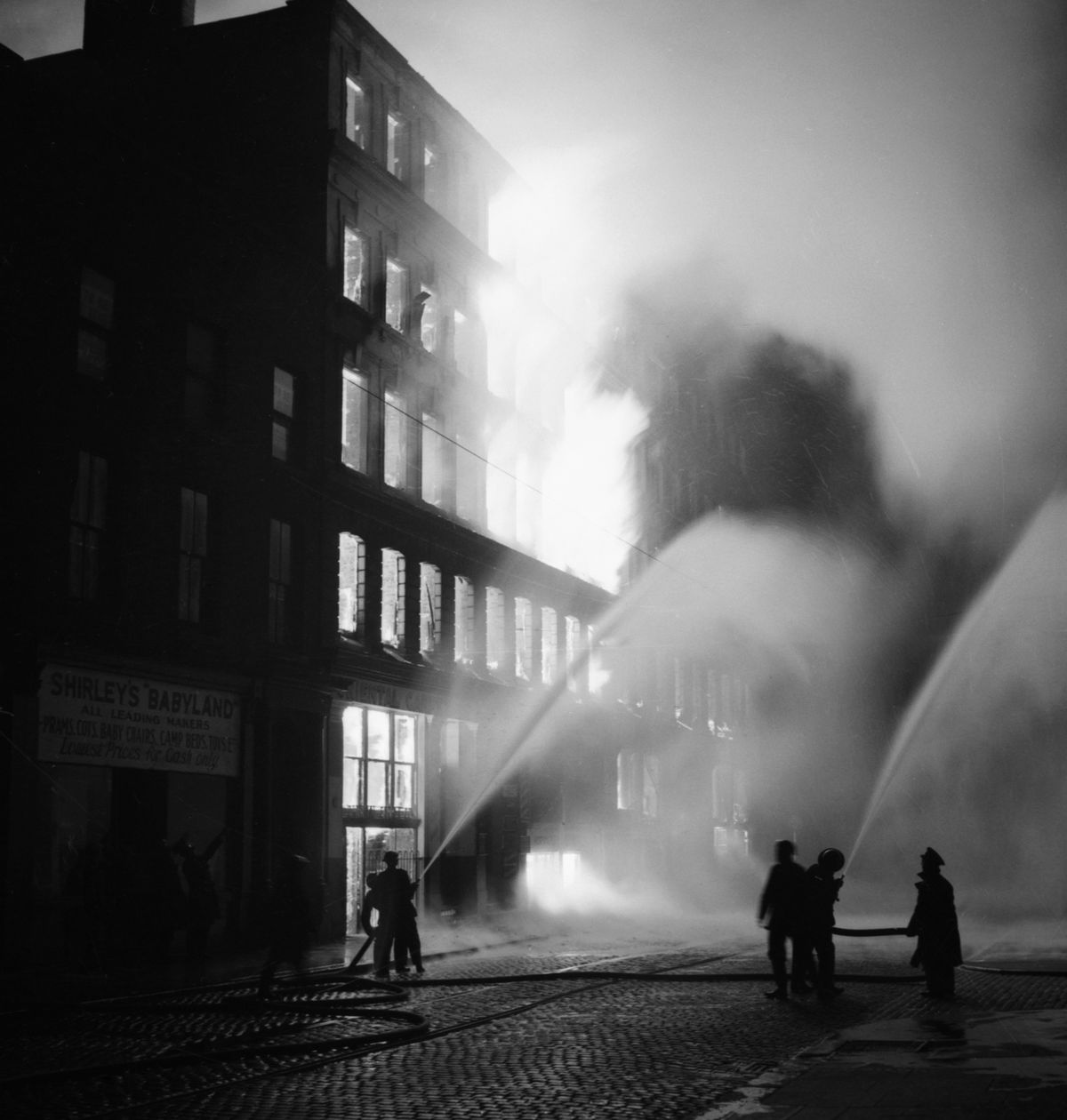 The Manchester Blitz, Buildings burning in Manchester after a German air raid in December 1940
As the bombs fell, hospital staff across the city continued to work through the bombardment. The horror continued until just after midnight on Christmas Eve when air-raid sirens signalled the all clear. The bombers had left, but in the aftermath, strong winds fuelled the firestorm raging across the region.
This may all seem like a long time ago, but the Christmas Blitz remained a very real memory for many years after.
The International War Museum (IWM) sound archives reveal many personal accounts of the Christmas Blitz. Robert John Alexander was only a teenager when he witnessed the German Air Force attacks on Trafford Park in 1940.
Robert vividly recalled: “We all had shelters… We had a shelter built in the back yard, about 2ft x 6ft and an escape part of it 3ft square tapered to the outside so you could push it out if you were buried in. Right in the backyard.”
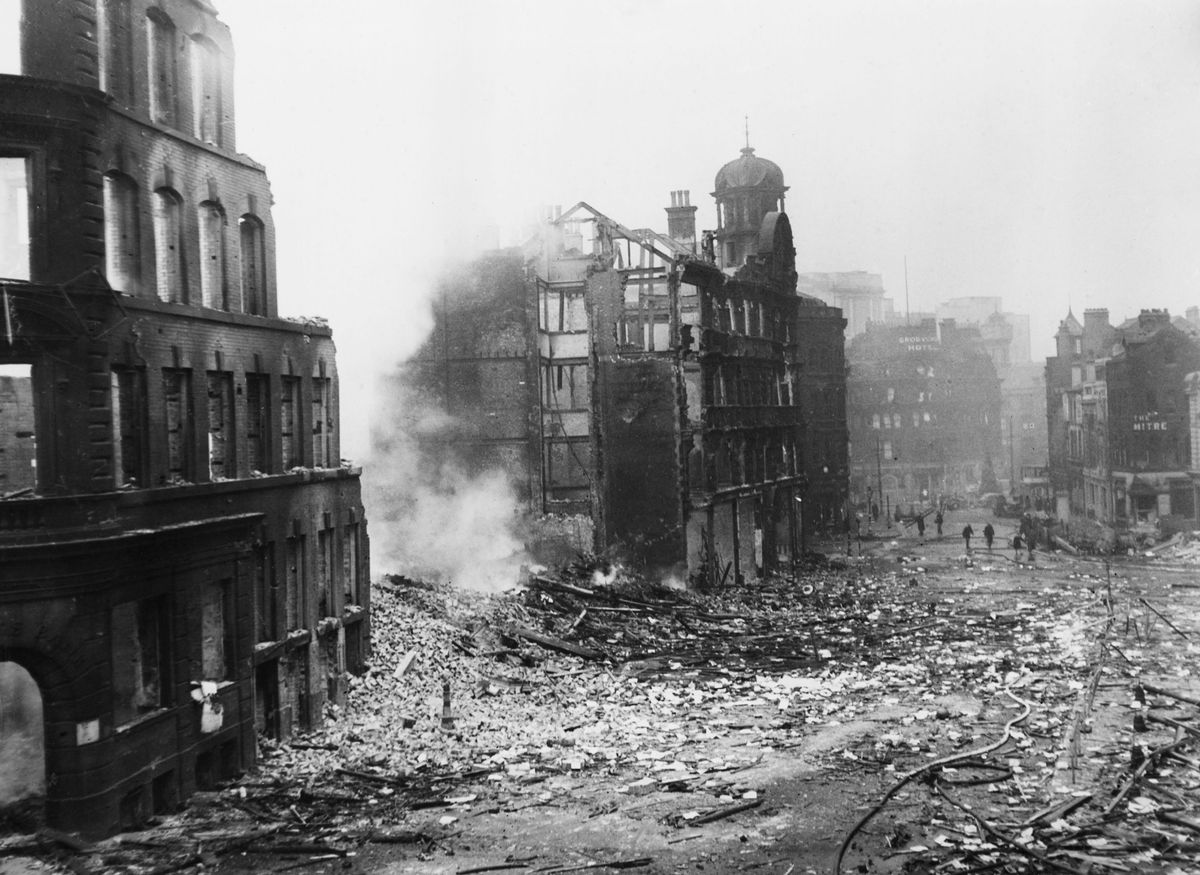 The aftermath on Cannon Street in Manchester.
24th December 1940
Having previously been evacuated to Knutsford, a more rural area deemed safer and less of a target for German bombers, Robert was soon returned home to Trafford. This was just in time to witness the bombing of one of Europe’s largest industrial areas and a key target of the German campaign, which, if successful, could bring the production of arms and munitions to a significant halt.
He said: “First time the Blitz was incendiaries, you’d never seen fires like it. They couldn’t train them to fight fires like that, and they’d never seen fires like that.”
Robert continued: “During the night, this incendiary fell on our house. It burnt itself out in the backyard. We doused it out with the sand. Everyone had to have a bucket of sand in their house for this very reason. I kept it for this very reason, and I’m trying to think what made me keep it.”
Incendiary bombs were designed to start fires and light the way for bombers to drop heavier explosives.
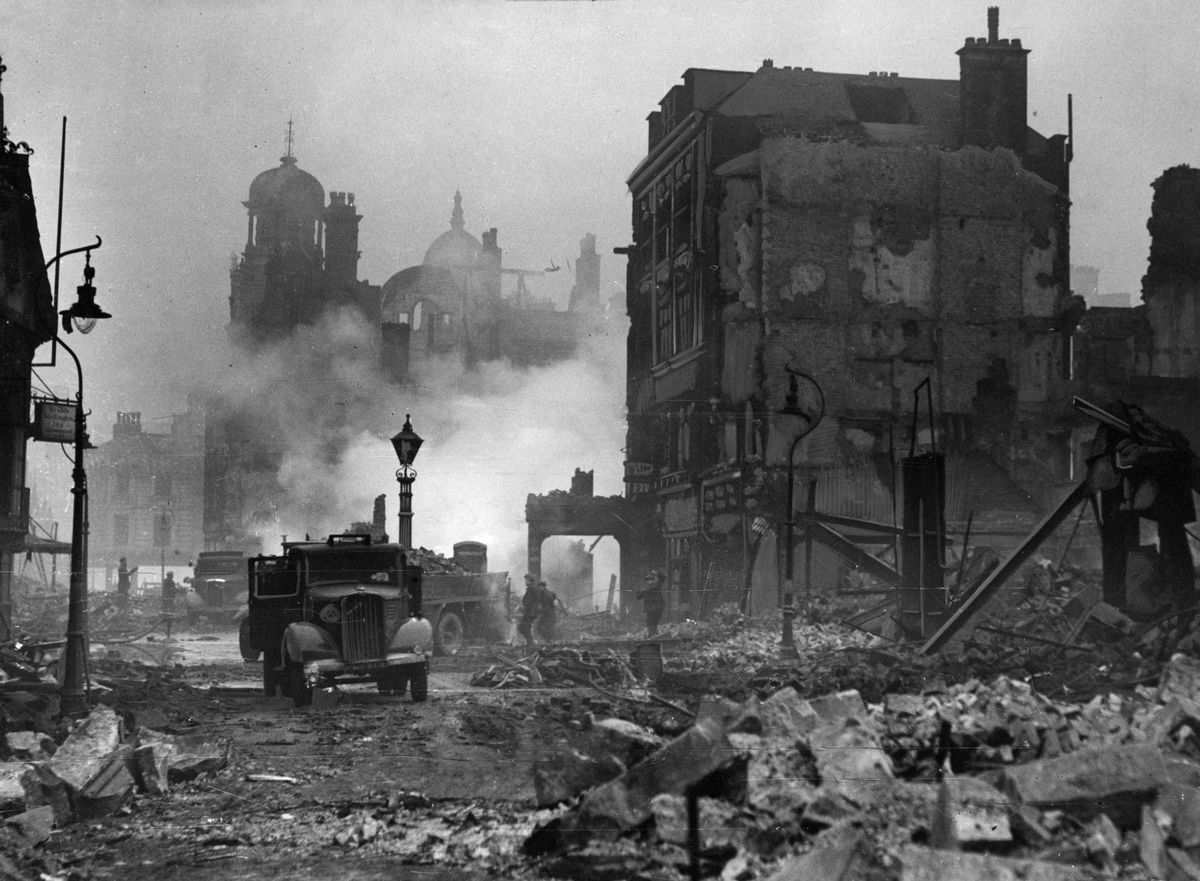 Devastation in Manchester after the raid. 24th December 1940
Robert added: “The first night we reckoned was the fire bomb night when everything was burning. You could read a newspaper at midnight. You could read yer paper.
“And all the shelters were full of people. They had some good shelters, they would never withstand a direct hit. But they were to protect you from any blast or anything like that. We were in the shelters the second night, and mum said I’d like a fresh cup of tea. So me dad said I’ll go and make one.
“Well you were supposed to douse the fire if there was an air raid but we hadn’t done. The blast came down the chimney, there was a shower of smoke and sparks all over the place.
“They’d bombed the Trafford Park Hotel. The bomb actually dropped on the bowling green of the Trafford Park Hotel, and we found one of the bowls in our front room, you know the bowls from the bowling green. And we were right in line with the blast.”
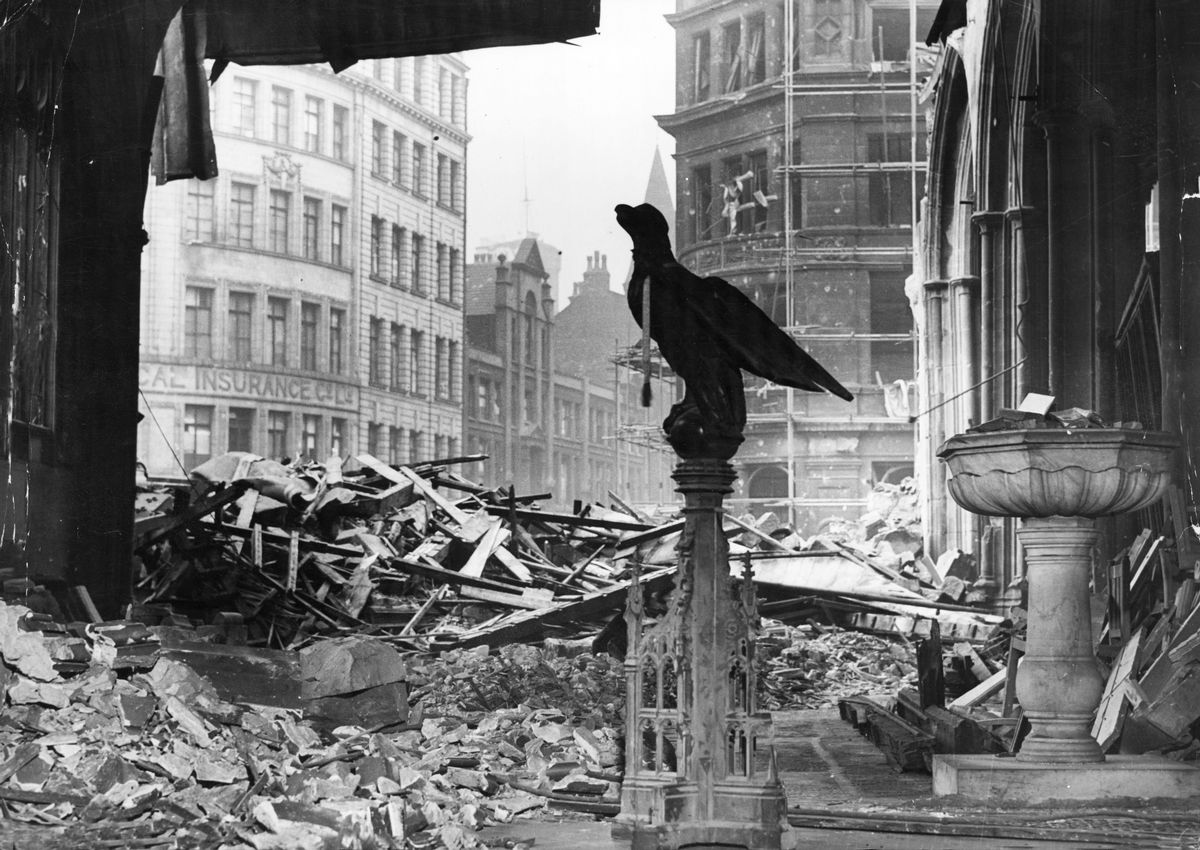 Rubble, and stone work from a church is seen amongst the ruins in Manchester. Picture taken 23rd December 1940’Whole families had been killed’
May Coombs is another who vividly remembered the terrors of the Christmas Blitz. She was just seven years old and staying with her grandparents, Mary and Arthur Travis, at their flat on the Langworthy Estate on Eccles New Road.
Speaking to the M.E.N. back in 2015, May said: “There were more raids through the war but this was the worst. My dad, James, was an engineer at the munitions factory in Eccles, but he was in the Home Guard so he was out on an air raid patrol that night.
“I could see bombs lighting up the whole area and distinctly remember the noise from the bombs and the planes. So many bombs were falling.
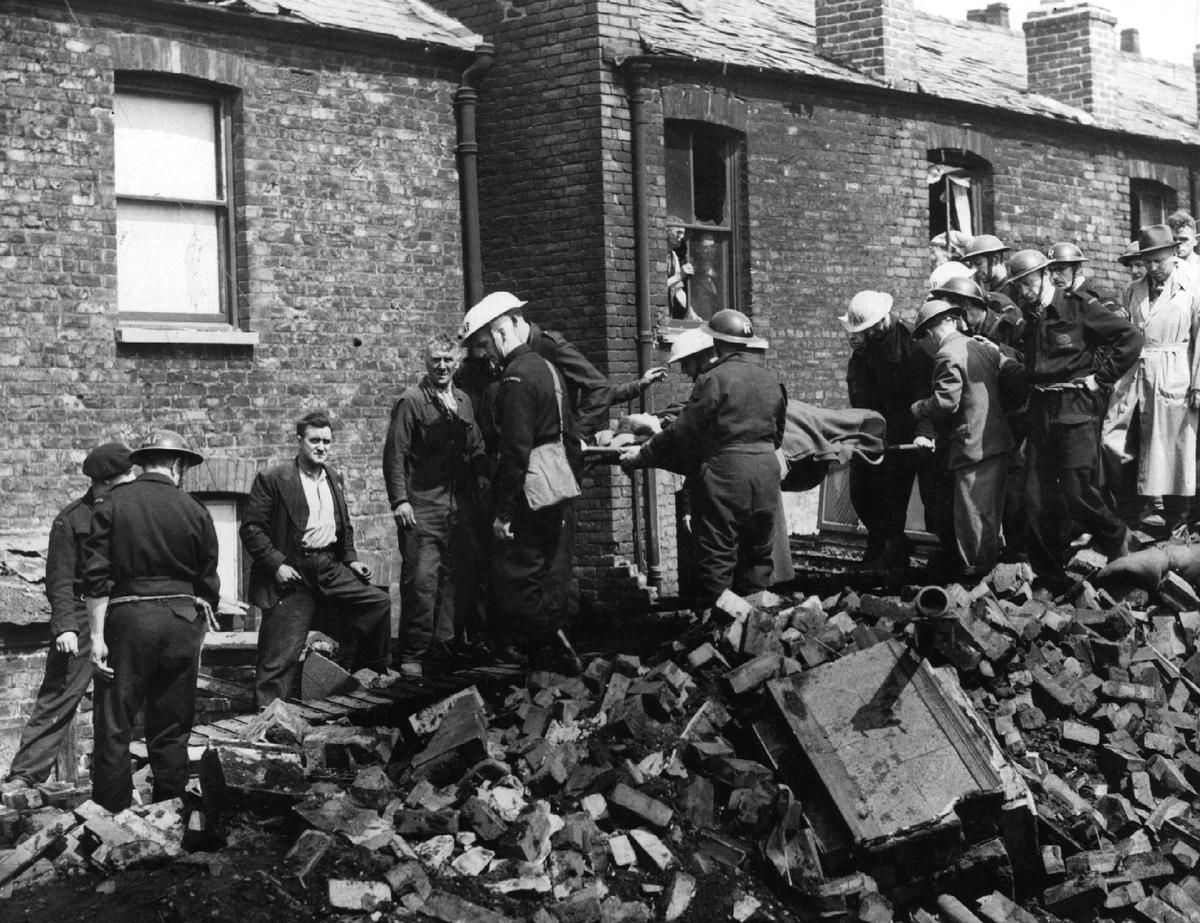 Manchester Blitz bomb damage on a residential street
“My nana and I couldn’t get across to the air raid shelter because so many bombs were falling so we stayed in the stairwell and she put me under her shawl.
“Eventually, we did get across and spent all night in the shelter, which was in the square in the middle of the flats.
“In the morning, we heard rumours about the extent of the damage so walked down to my parents’ home. My uncle Billy came up and said he and my aunt Lily had been bombed out but they weren’t sure about my mum and sister.
“We walked to the end of the street, which was cordoned off, and there was just a huge crater where Bigland Street had been. Our terraced house was in the middle of the row.”
 2nd January 1941: The ruins of Manchester Cathedral after a German bombing raid
May’s mother, Hilda Travis, 28, and 18-month-old sister, Jean, died in their home close to the docks when it took a direct hit. They were among 215 who died in Salford that night.
“I don’t know why my mum and sister didn’t get to the air raid shelter that night. They were hiding under the stairs and the house took a direct hit,” said May.
“I remember the mass funeral – all the coffins laid out in rows. They all had a Union Jack over them and the Mayor of Salford was there.
“Whole families had been killed.”
One person who was part of the Auxiliary Fire Service (AFS) tasked with putting out the fires on those nights was Archibald Howitt Warren. In the sound archives at the IWM, Archibald recalls how the Christmas Blitz really brought the horrors of the war home to people in the region, and the public scepticism for those who had chosen to join the fire service.
He said: “The public generally were not happy with us, especially those whose husbands and that had gone to the war…they thought we’d joined the fire service in preference to going in the armed forces, which wasn’t true. We were directed there and had to stay there.”
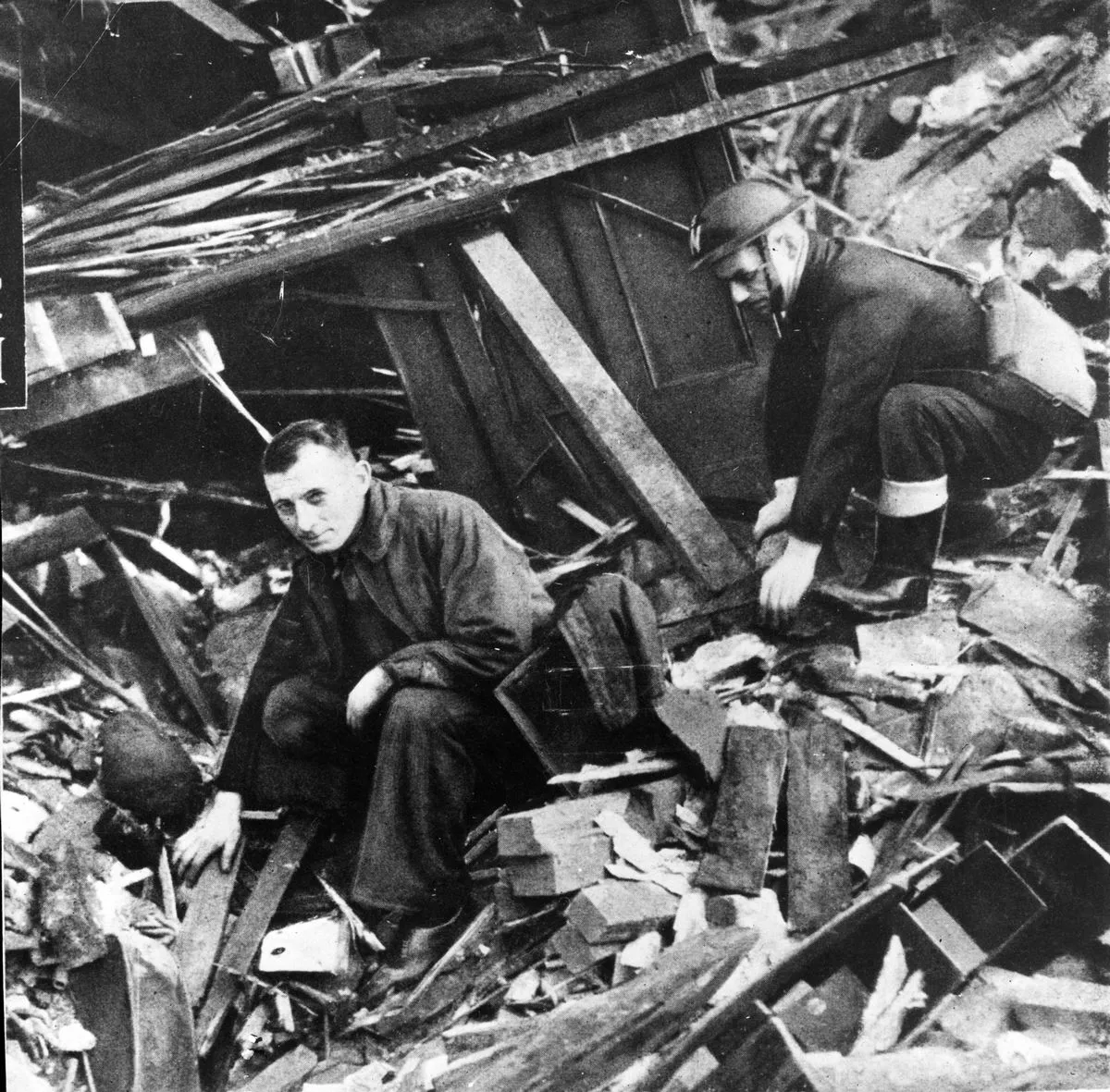 Two members of the emergency services sift through the rubble following the Christmas Blitz
Born in Manchester, Archibald worked in his father’s hairdressing shops in Manchester and Merseyside as a young man. He signed up to become an Auxiliary Fireman in 1938, just before the outbreak of war, and was called up full-time from September 1939.
On the home front, as Britain braced itself for an all-out German air attack, its civil defence plans were put into effect. Air raid precautions were rigorously imposed, but although the much-feared danger of aerial attack did not immediately materialise, people still had to abide by a host of government restrictions.
“When the raids started…we were glad of the action. It was dangerous, of course, and it was very sad to see people’s homes destroyed.
“By this time the public’s attitude to us had changed completely and we were generally well received.”
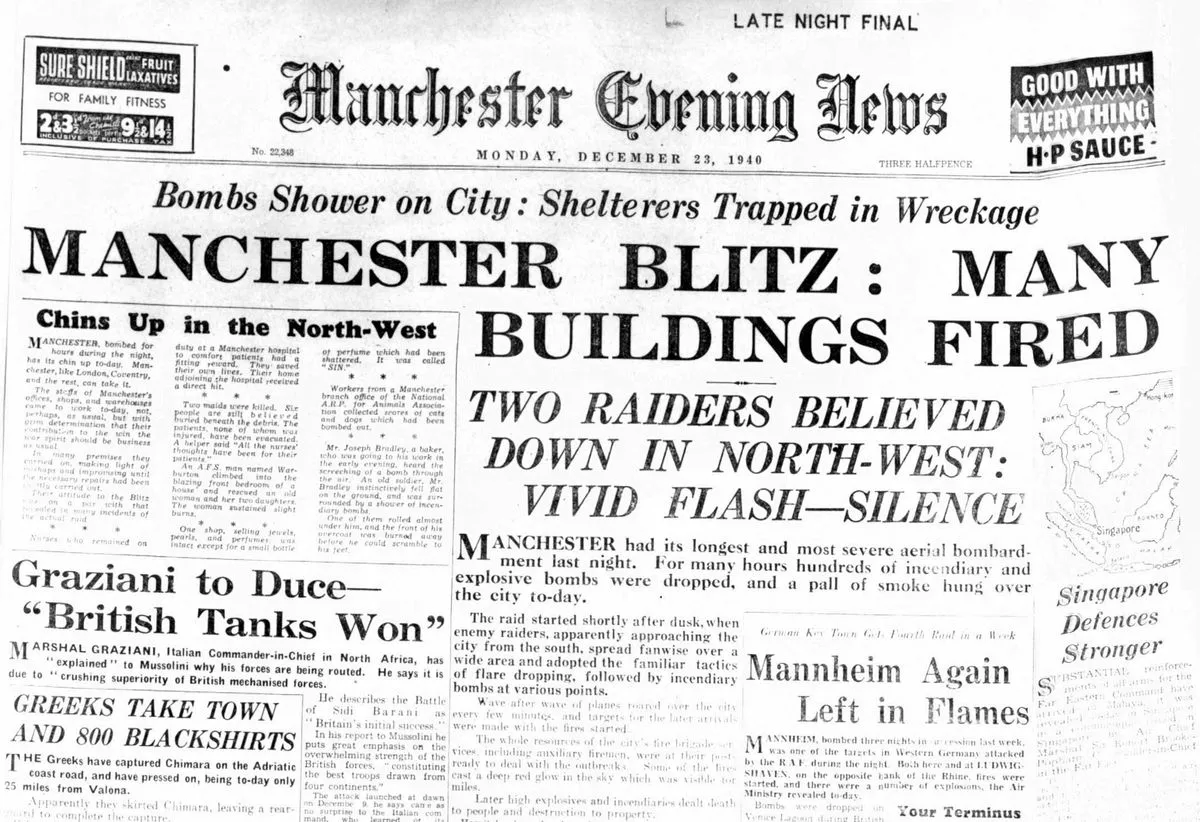 Manchester Evening News front page
Archibald vividly remembers working to exhaustion when the city centre was bombed during what became known as the Manchester Christmas Blitz.
“Two things spring to mind about Manchester in the 1940 blitz. I was with others in St Ann’s Square… and it’s not very well known… we took some bombs off the roof of St Ann’s church.
“I remember very well we worked very hard all night and were completely exhausted, and we were trying to scrounge food from cafes… and I remember a very elderly gentleman coming running towards us, crying. He was saying, ‘Can you do something with the Cotton Exchange, the roof is on fire and I’ve been a member for 40 years.’
“He was really shaken and distressed, but we couldn’t get up to it, our ladders wouldn’t reach.”
The Manchester Blitz brought the war to the doorsteps of people living in the region, and it was the heaviest targeted bombing on civilians until that point in history.
Over 650 people were killed, over 2,000 were injured, and 50,000 homes were damaged as 467 tonnes of high explosives and thousands of incendiary cannisters were dropped by the Luftwaffe in just two nights.