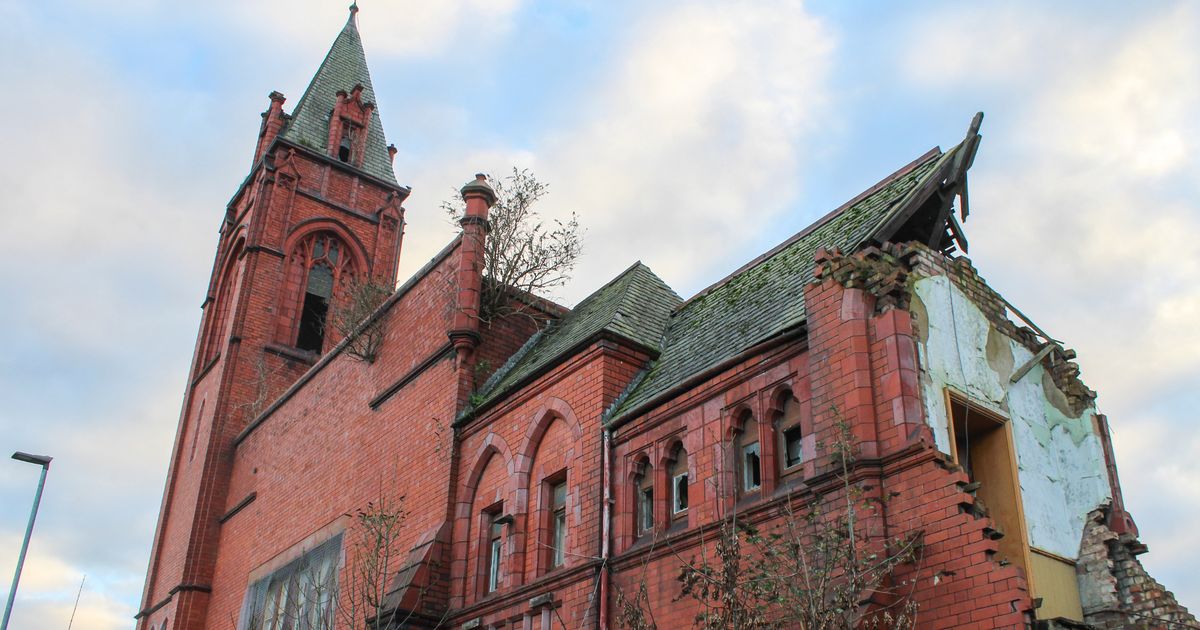
Once the beating hearts of their communities, many of Manchester’s historic churches now stand empty, decaying or half-demolished. We explore the decline of worship and the architectural treasures left in its wake. Greta Simpson reports.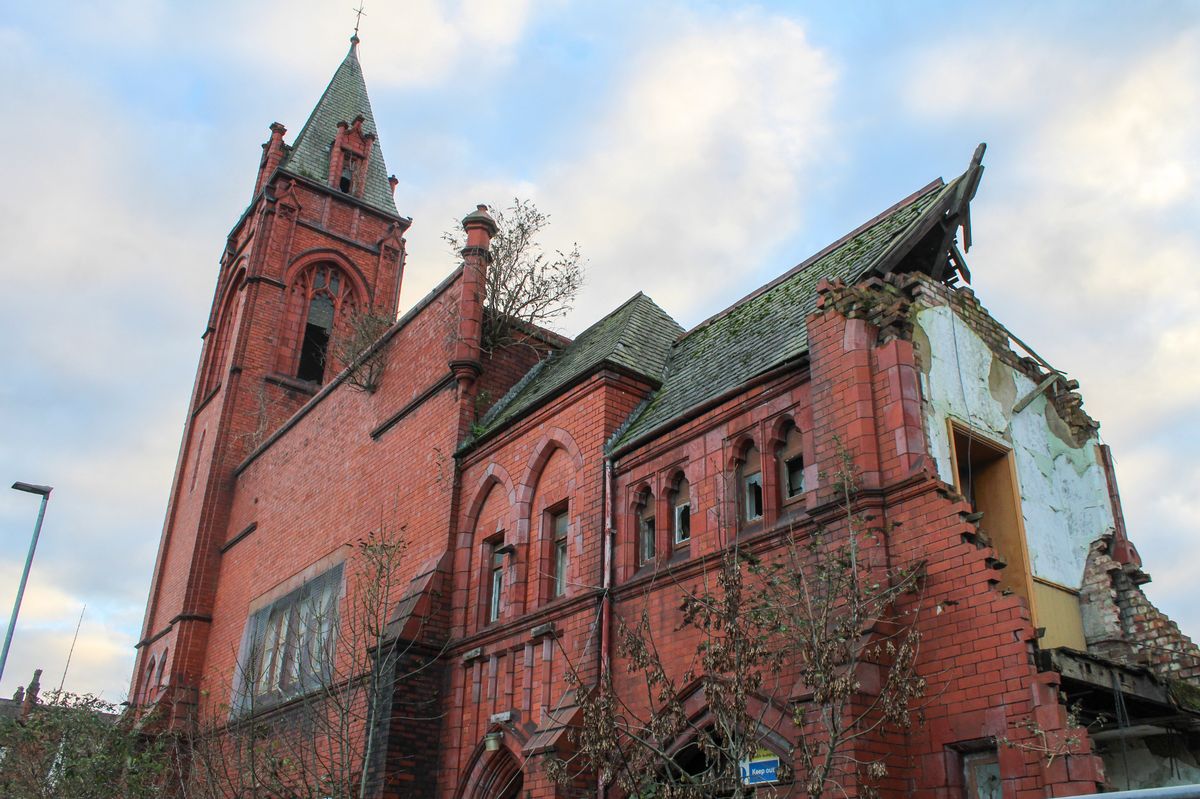 The former Moss Side Unitarian Church on Shrewsbury Street. (Image: Manchester Evening News)
It’s no secret that churches in this country are having a hard time of it. You might think this a modern phenomenon – might shake your fists at the youth of today with their TikToks and crystals – but church attendance has been dwindling since the second world war.
The data is a bit woolly, gathered as it was by disparate groups with various vested interests. But a Mass-Observation survey conducted in 1948 found that 15pc of Brits attended church. That dropped to 12pc in 1979; 10pc in 1989; and 7.5pc in 1998.
In the 2021 census, for the first time, less than half the UK population described themselves as Christian. 27.5 million people ticked that box, representing a 13.1 percentage point drop compared with 2011.
This is despite the fact that ‘Christian’ was still the most common response to the ‘religion’ question – though closely followed by ‘no religion’, a category that had risen 12 percentage points on the previous decade.
A much trumpeted YouGov poll earlier this year found that belief in God among young people had ‘doubled’ over the past four years. 37pc of 18 to 24-year-olds said they believed in a god, which is up from just 16pc in 2021 – but the question was a general one and made no reference to Christianity.
But if congregations are dwindling across the country, what do we do with the relics they leave behind? As well as the cultural hallmarks that hundreds of years of Christianity has given us – Christmas, Easter eggs, excellent hymns, Tesco closing annoyingly early on a Sunday – there are thousands of physical ones.
The UK has 20,000 listed churches. What do we do with these Gothic masterpieces, their delicate stonework, their lofty spires? Some have found new, modern uses, like flats, offices and climbing walls.
Some have been converted to other religions and now serve a new congregation as a mosque, temple or synagogue. But many have not been so lucky – and are waiting quietly to learn of their fate.
Moss Side Unitarian Church, Shrewsbury Street, Old Trafford
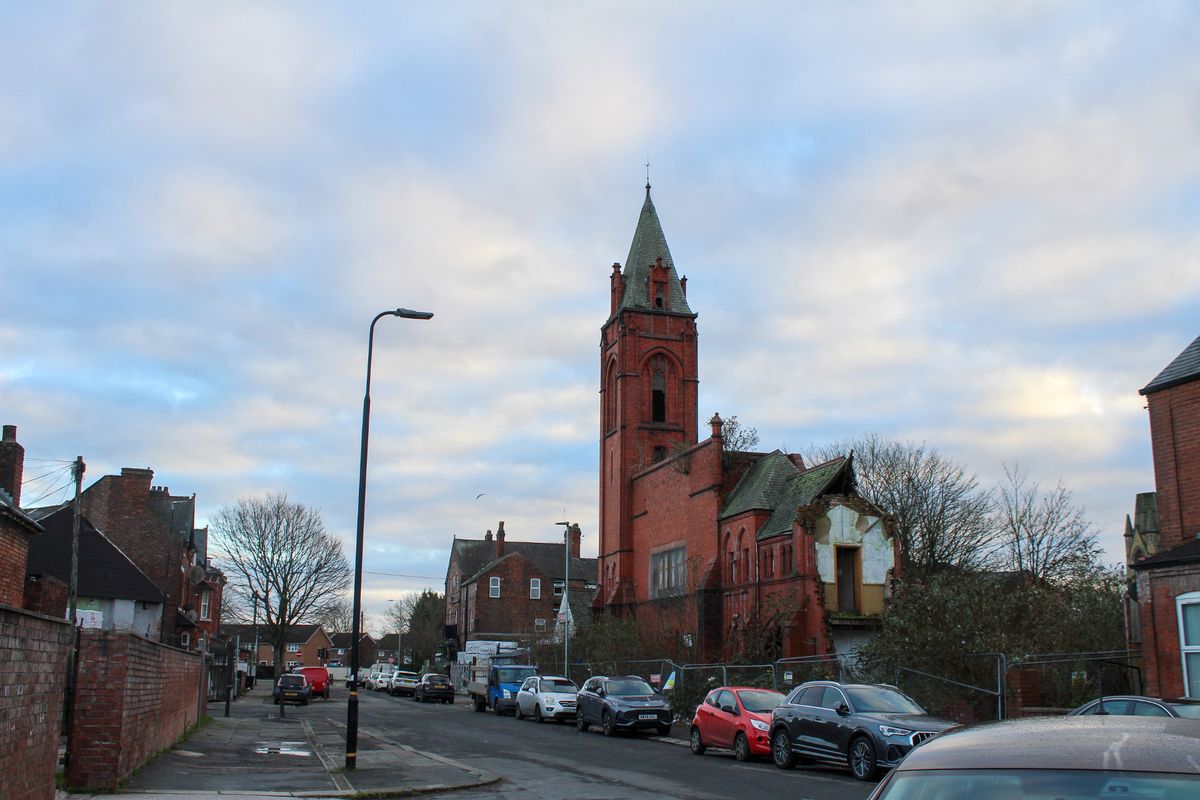 The view up Shrewsbury Street. (Image: Manchester Evening News)
This fine red brick church was built in 1901 and first opened its doors in October that year, to serve a local congregation which was established 14 years previously. It is said to have been damaged by enemy bombing in 1940, after which services were held in the school chapel.
It was designed by JW and RF Beaumont, a prominent local firm who designed the Whitworth Art Gallery. It was largely funded by an 1899 bequest from William Roberts, a member of the congregation, who also funded the statue of William Gladstone in Albert Square.
The church closed in 1947, but was given a new lease of life when it became a club for Polish ex-servicemen new to Manchester. It was marked as a ruin on the 1955 Ordnance Survey map, but was still used as a warehouse and social club until the early 2000s.
 The building now stands half-demolished (Image: Manchester Evening News)
SAVE estimated in 2022 that the building had been vacant for almost 20 years and was ‘rapidly deteriorating’. That same year, local residents had to be evacuated as the church’s roof suffered a dramatic and sudden collapse, falling through almost entirely.
At the time, SAVE said the building was ‘well-detailed throughout. “A large centrally sited gable with Gothic window and terracotta tracery served a large school room at first floor. It is a distinctive local landmark and a typical feature of many Unitarian chapels in the second half of the 19th century.”
Trafford Council received a Prior Notification to demolish the building in late 2020. The council then submitted an application to list it, but this was refused by Historic England, who said the building was ‘too altered’.
As of June 2022, Trafford Council had refused the Prior Notification, but demolition work appears to have begun by October that year. It has then since stalled, with no further work taking place.
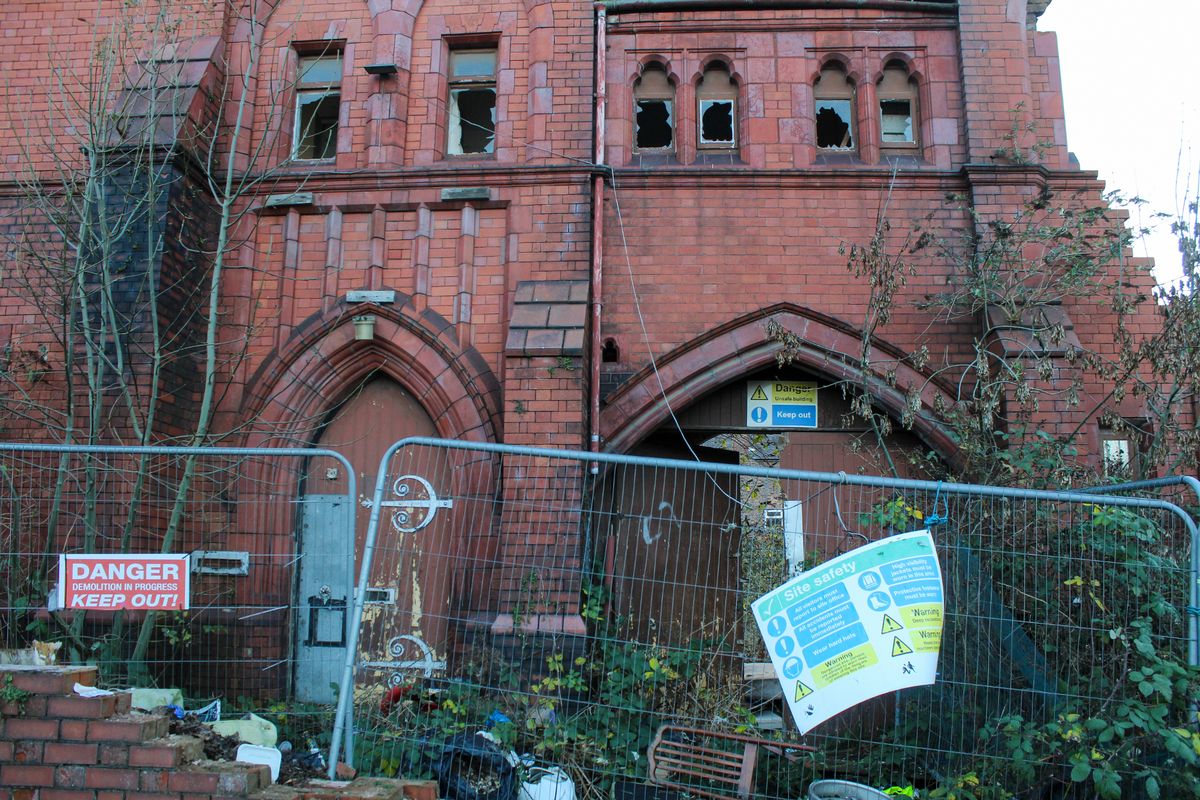
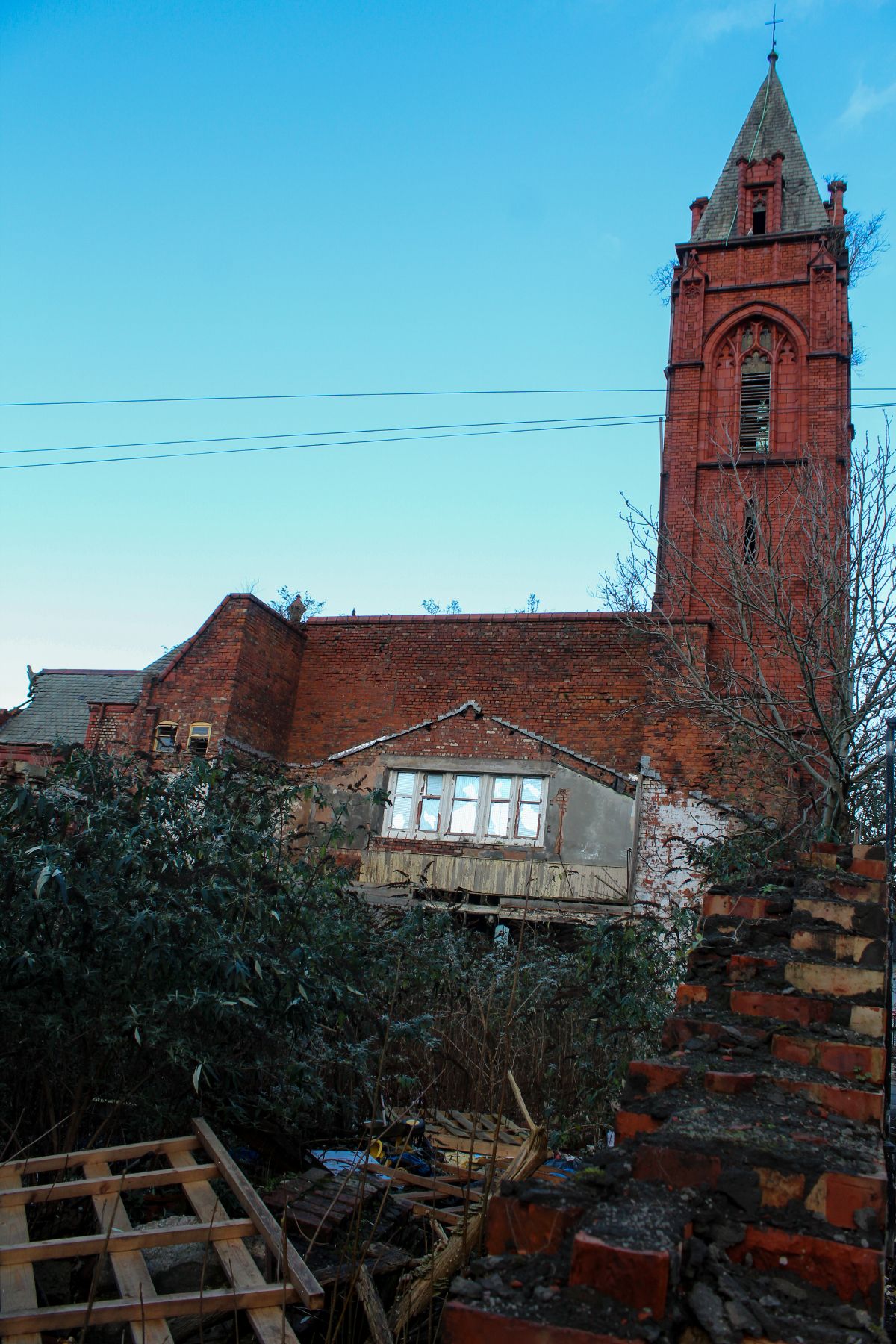 What is left of the church, viewed from the rear. (Image: Manchester Evening News)
This has left the church a half-demolished wreck, an undeniable eyesore with every window shattered, surrounded by collapsing metal fencing, its rear yard full of rubbish and waste.
It’s a sad fate for such a beautiful building which has stood proudly as a prominent local landmark for more than 100 years, with such a rich and storied connection to its local community.
Church of All Souls, Every Street, Ancoats
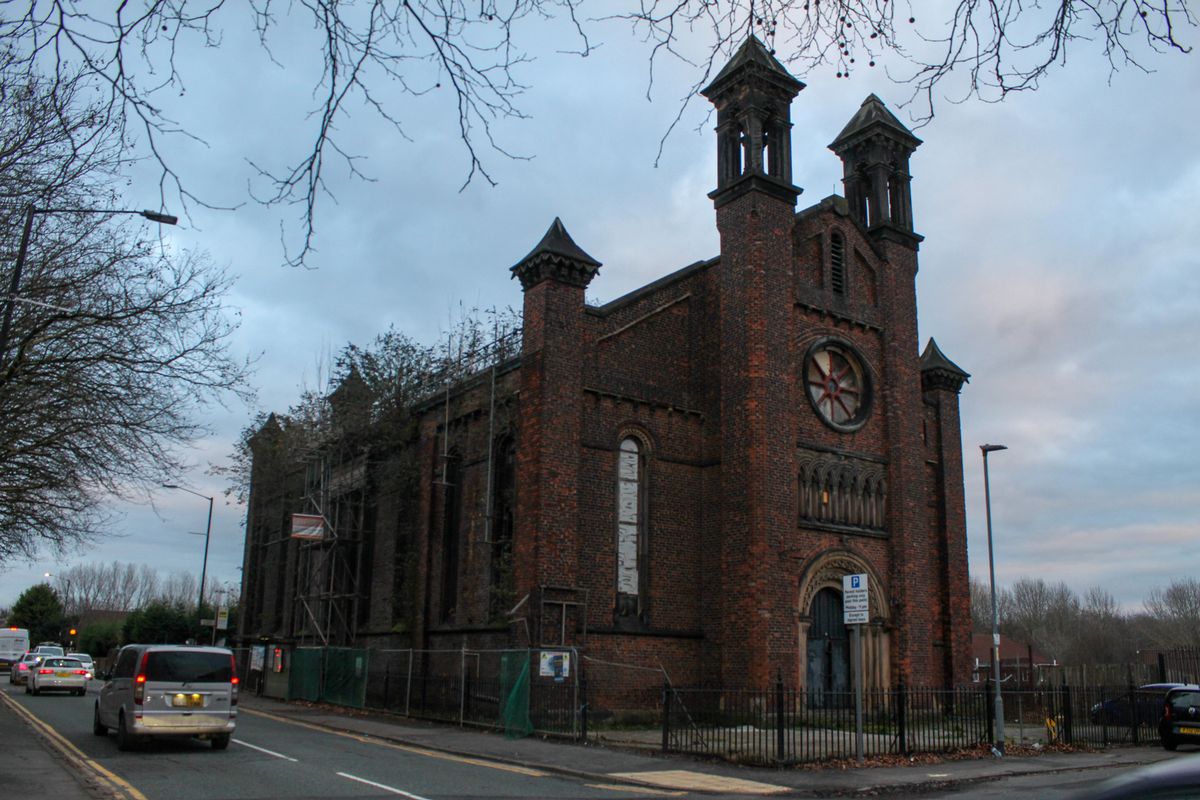 Church of All Souls in Ancoats. (Image: Manchester Evening News)
This unusual-looking Gothic church is the oldest on this list. It was onstructed between 1839 and 1840, and has stood imposingly on Every Street in Ancoats ever since.
Old Trafford was mostly still fields at that time, but Ancoats was already a built-up area in its own right, with the church built among mills and terraces.
It was built for a Samual Warren, a Wesleyan Methodist minister who was expelled from the church and formed his own faction of ‘Warrenites’.
The church served this ‘slum parish’ (as one Methodist website called it when Warren was minister) for over 140 years, watching on as, street by street, the terraces surrounding it were cleared and built over with modern housing.
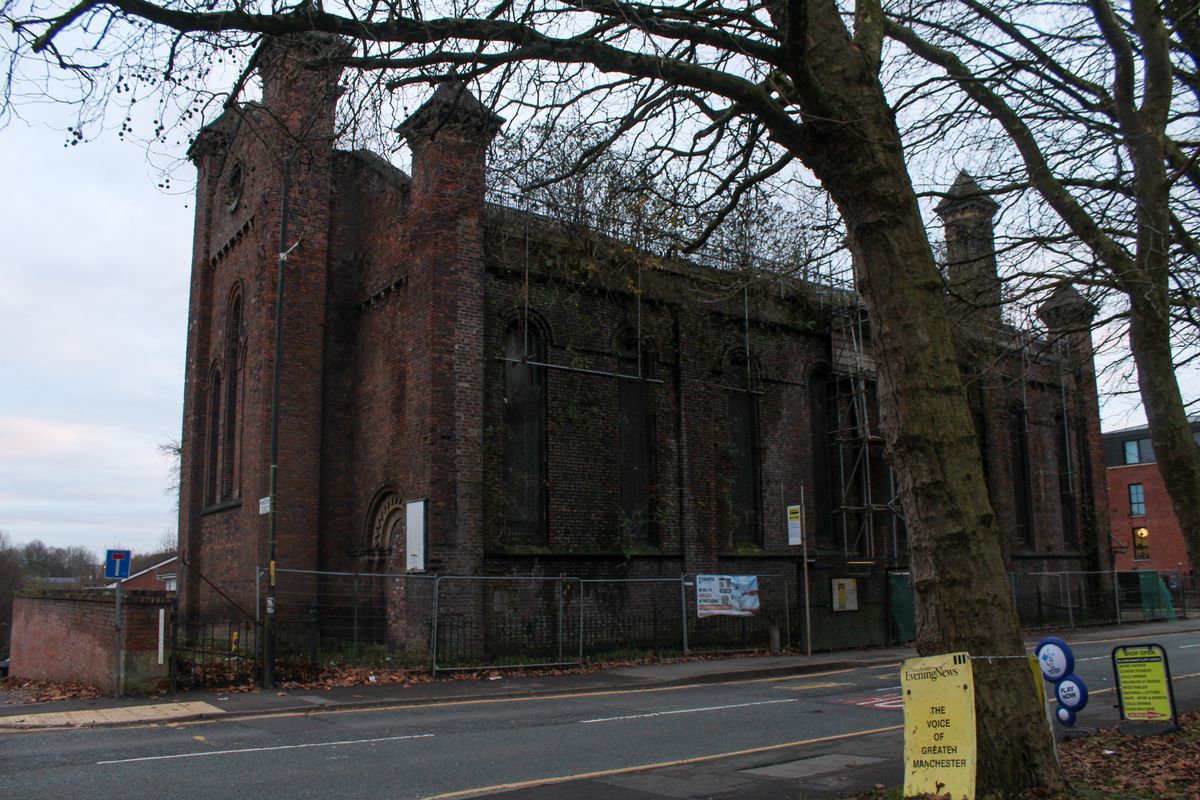 Church of All Souls in Ancoats. (Image: Manchester Evening News)
All Souls’ finally closed its doors in October 1984, but not before becoming a Grade II listed building – which might account for this prime piece of real estate on the edge of Manchester city centre, and close to the Etihad, never having been redeveloped since.
The church is now held up by scaffolding, with several windows smashed and vegetation growing out of the walls. Some of the stained glass and tiled windows are being held up by netting.
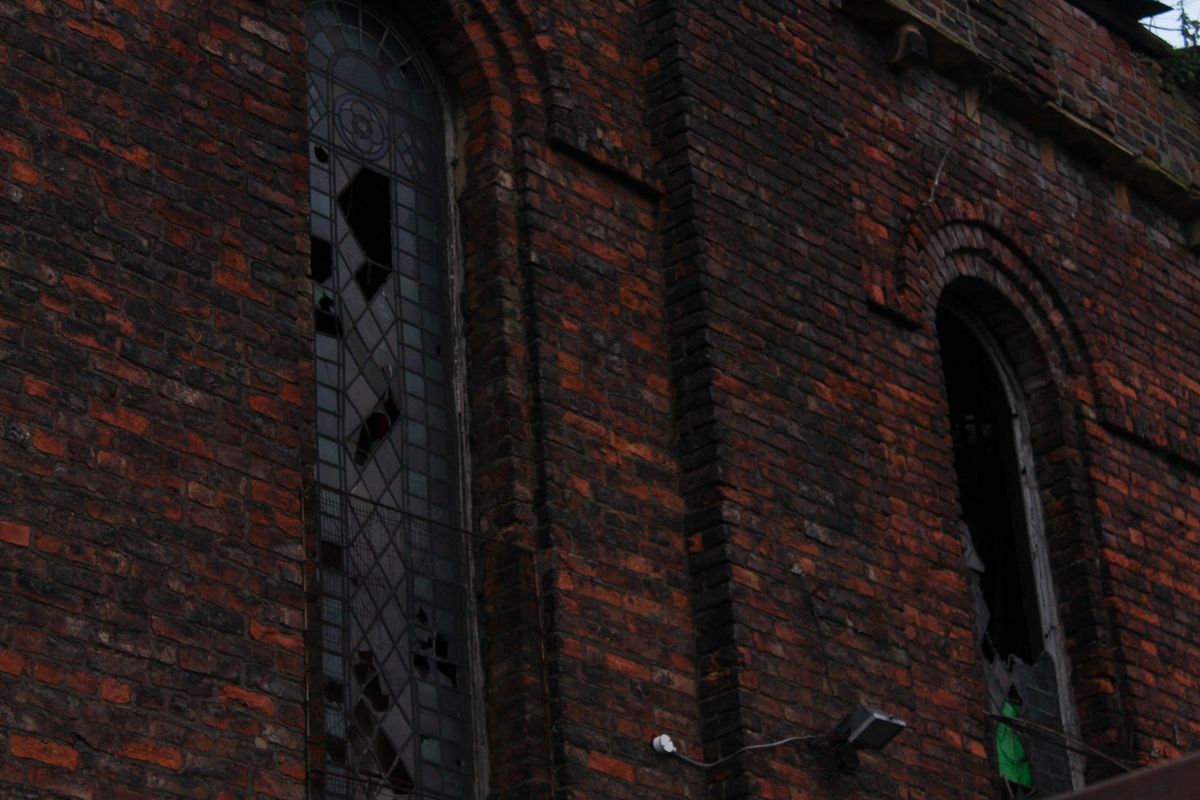 Damage to the tiled windows (Image: Manchester Evening News)
It was put up for auction in December last year for the reasonable price of £450,000, but doesn’t appear to have yet found a buyer, as the listing is still active.
You would think it could make for some characterful apartments, or a trendy art studio, but for now it will continue to loom over Ancoats as a lonely, boarded-up and potent reminder of its industrial past – and the ‘slum parish’ it used to serve.
Primitive Methodist Church, Ardwick
What looks like a stately and beautiful church survives in only one photo on Manchester City Council’s archives.
The Primitive Methodist Church, which stood on the corner of Higher Ardwick, had a 120ft tower with neighbouring school rooms, lecture hall and a two storey, three bedroom house for the minister.
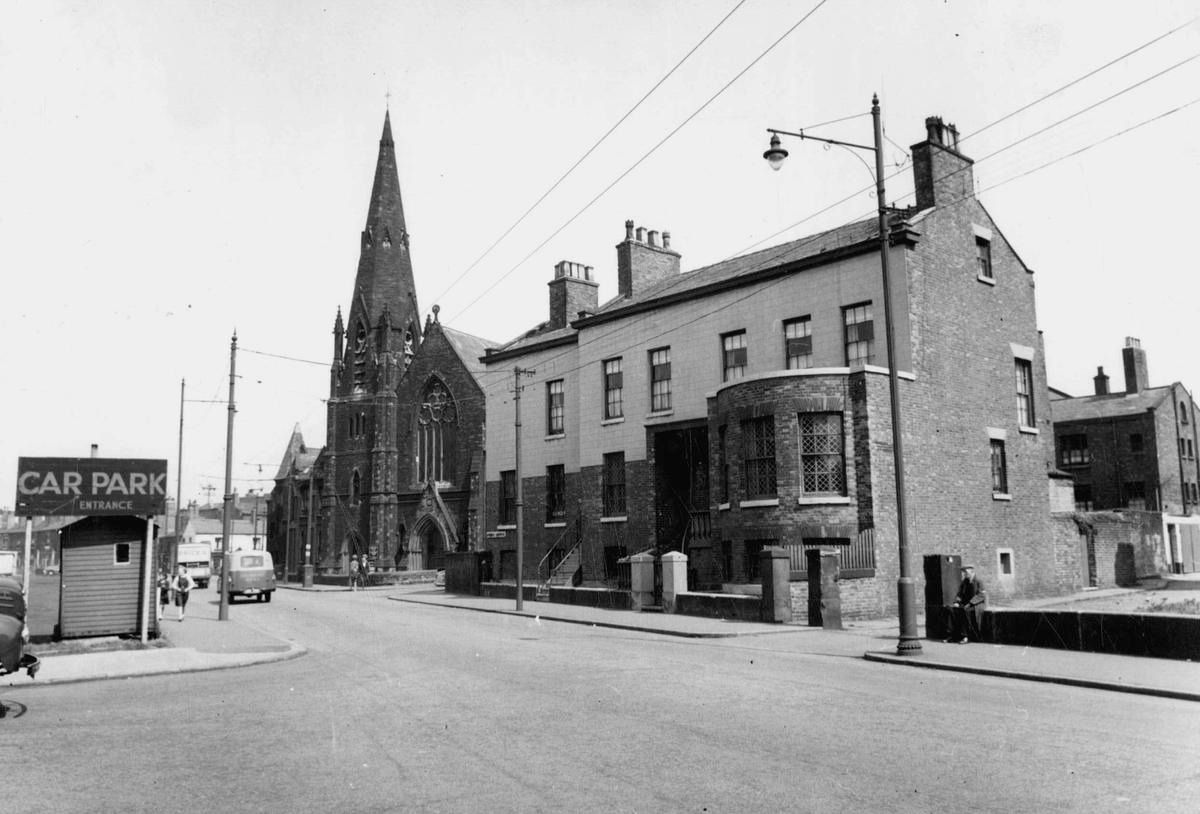 A view of Higher Ardwick in 1958. (Image: Courtesy of Manchester Libraries)
The frontage, which faced Higher Ardwick Road and looked towards Ardwick Green, featured a large stained-glass window and detailed decorative stonework.
The foundational and memorial stones were laid in July 1874 ‘in the presence of a large number of spectators’ and it took four years to complete. Sadly, the church would not reach its centenary, as it closed its doors for good in 1964.
The planners don’t appear to have cooled their heels, as a council archive photo shows the main part of the church to have gone by 1969. In typical 60s fashion – whose planners never saw a beautiful building that they didn’t want to replace with a car park – the resulting land has remained empty ever since.
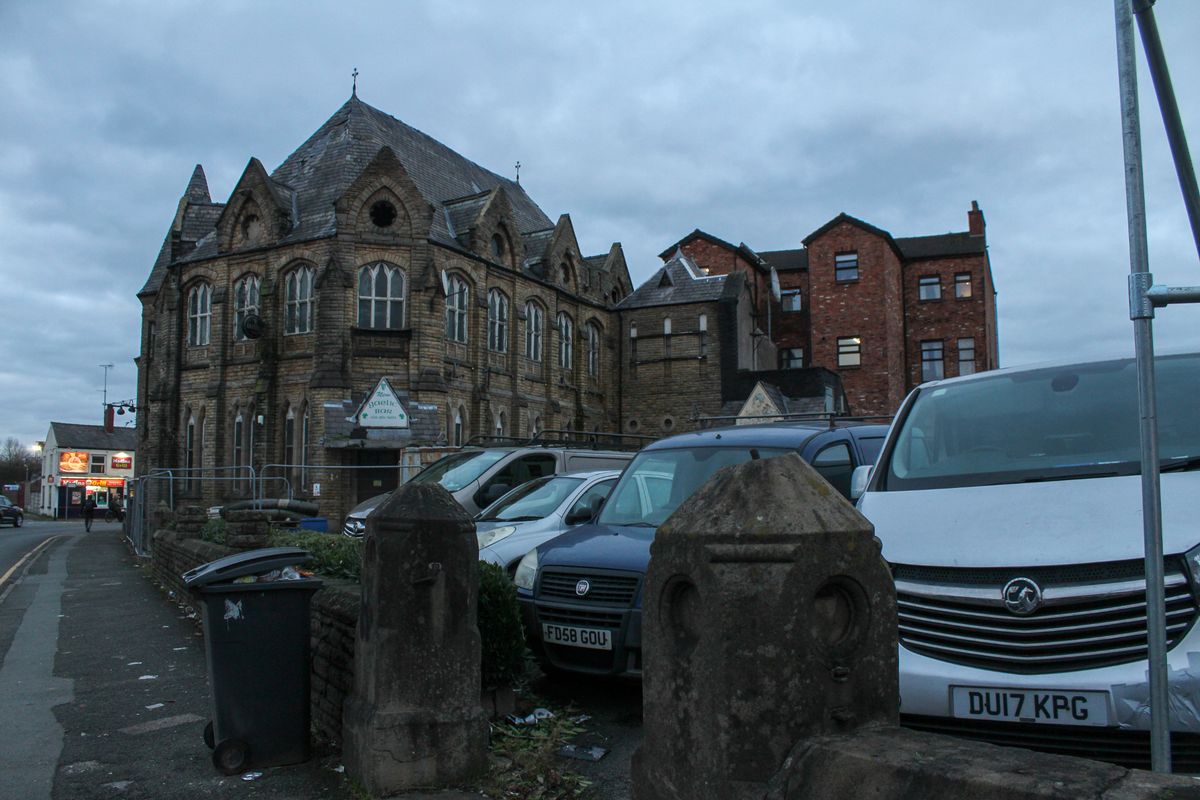 A view of the site today. (Image: Manchester Evening News)
It leaves this once imposing site in a sad state, with its grand remaining buildings – the Sunday school and minister’s house, in their sandstone, collegiate style – strangely denuded and truncated.
The Sunday school has housed a succession of Irish bars: first, the beloved 32 Club, and then a Gaelic bar, but this now appears to be defunct as well. The minister’s house now appears to be private housing.
 What is left of the church buildings (Image: Manchester Evening News)
You can’t exactly argue that the conversion has been done sympathetically either. The thick, worn stone wall surrounding the site is now the only clue you might have of what was once there.
Philips Park Cemetery Chapel
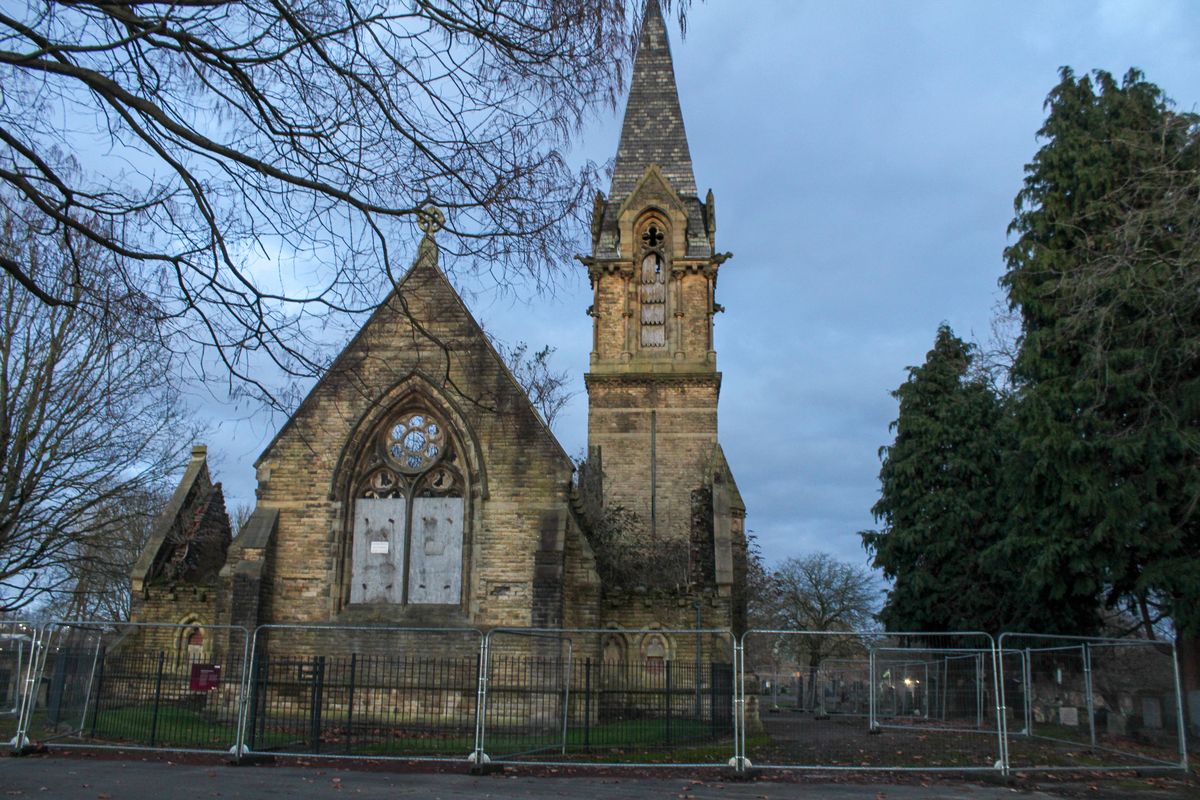 Philips Park Cemetery chapel today. (Image: Manchester Evening News)
Philips Park Cemetery opened in 1866 and was the first municipal cemetery to open in Manchester. At the time, it had four separate mortuary chapels serving different denominations and faiths, but today, only the Anglican church remains, and it is in a sorry state.
A post on the urban explorers forum 28 Days Later in 2018 shows detailed brick and plasterwork inside, held up by classical columns and vaulted pillars covered in colourful tiles. It has been Grade II listed since 1988.
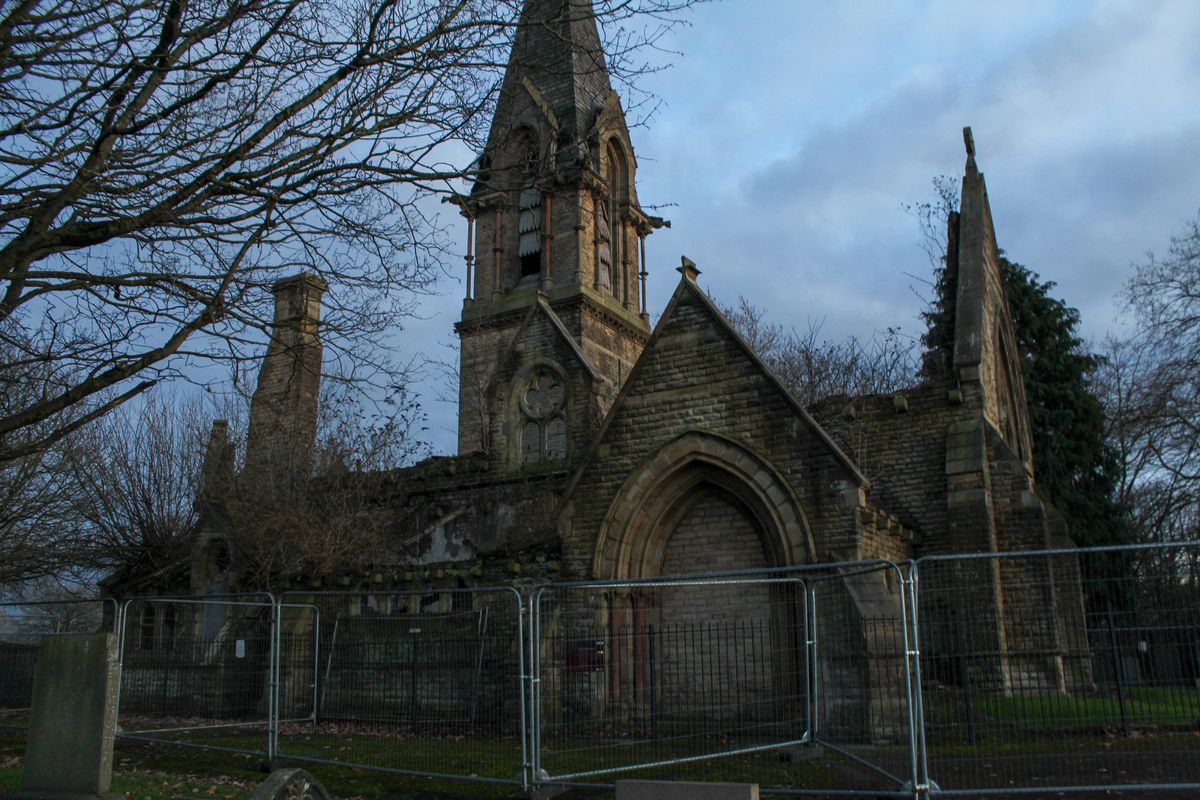 The church’s roof has collapsed (Image: Manchester Evening News)
But now, the building is now not much more than a shell. The roof has almost entirely fallen in, its windows smashed or boarded up and a veritable forest of undergrowth has sprung up inside.
Now surrounded by ugly metal fencing and ‘DANGEROUS BUILDING’ signs, a sign on the fencing indicates that the building has been vacant for 25 years.
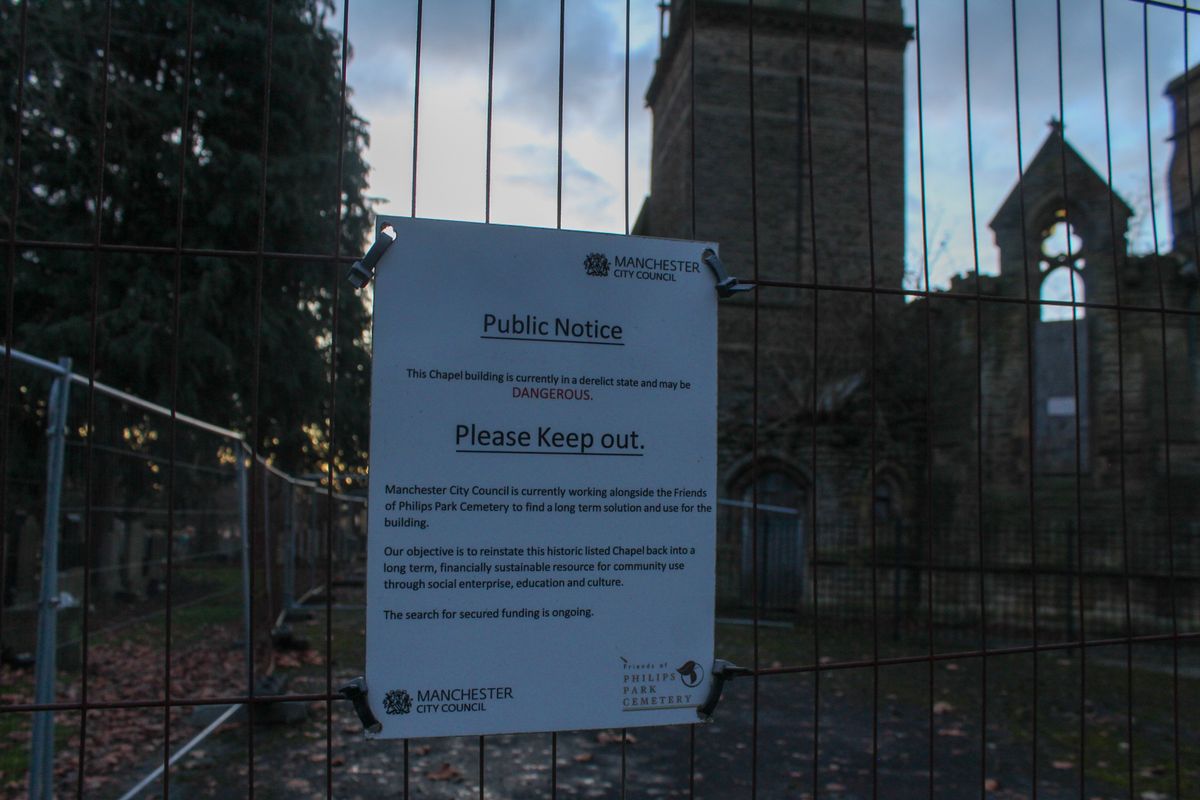 A sign on barriers surrounding the church (Image: Manchester Evening News)
“Manchester City Council is currently exploring options for the chapel, but its current state presents significant challenges,” it reads.
A campaign group, Friends of Philips Park Cemetery, received lottery money in 2014 to convert the building into a heritage visitor centre, but subsequent bids were said to be unsuccessful.