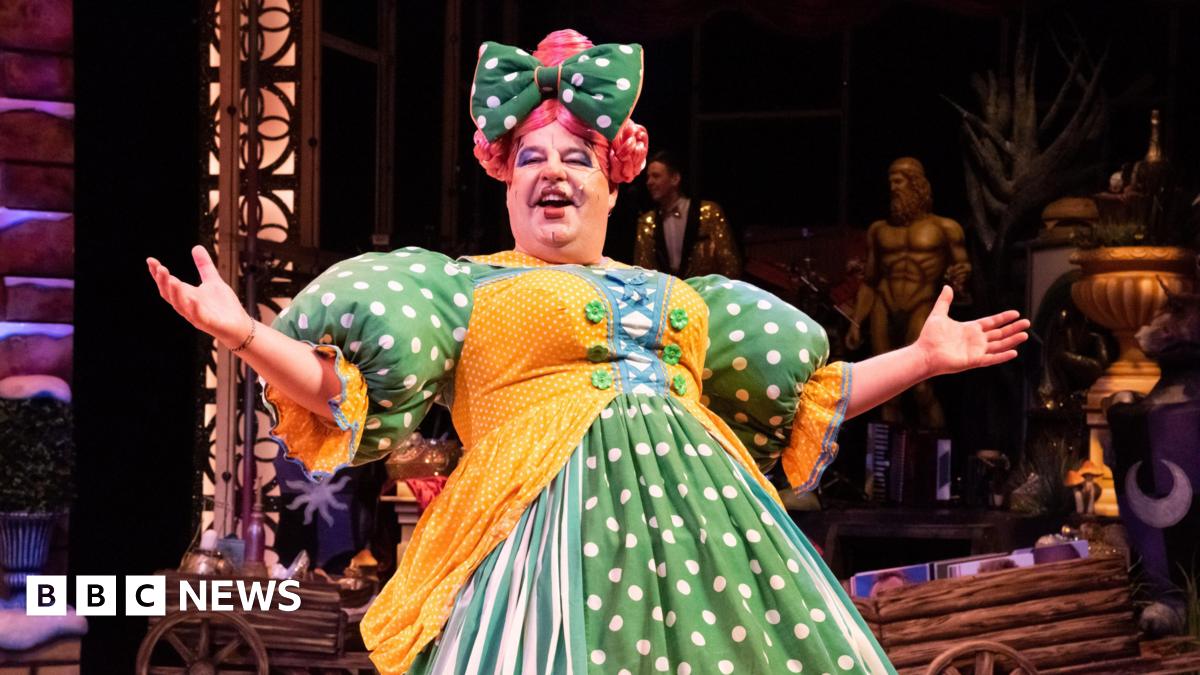
“I love the fact that panto is sometimes the first time that a person has been to the theatre and even after a thousand times, it never gets boring,” Williams says.
And it is a quaintly British phenomenon, he adds.
“Only we do it well. Other countries have tried and it doesn’t work, it just wouldn’t work in America would it?
“They just don’t get it, it would just be weird.
“The men play the women and the women play men and and you shout at the audience and they shout back at you.”
Pantomime dates back to the late 18th Century in England and was an early form of participatory theatre in London.
In its heyday in Victorian London, shows could last up to five hours, according to the Victoria and Albert Museum, external.
In more recent years, pantomime has become an important element of a theatre’s offering – and its finances.
More than 500,000 people from across Yorkshire went to see a pantomime last year and 16 regional theatres said pantos brought in between 9% and 45% of their annual income in 2024.
Darren Henley, chief executive of Arts Council England, says pantomimes are the “absolute bedrock” that regional theatre across across the country are built upon.
“It’s a couple of hours where you can lose yourself. It’s traditional, it’s modern, it’s innovative,” he adds.
Sheffield Theatres also predicted it would see more than 50,000 visitors this season.
Williams says the trend for pantomime keeps growing, despite it “taking a bit of a dive in the 90s,” when he says it went a bit “naff”.
It evolves, he says, because the songs, jokes and scripts are modern and take into account language and references that also need to change with the times.