Europe Commercial Greenhouse Market Overview
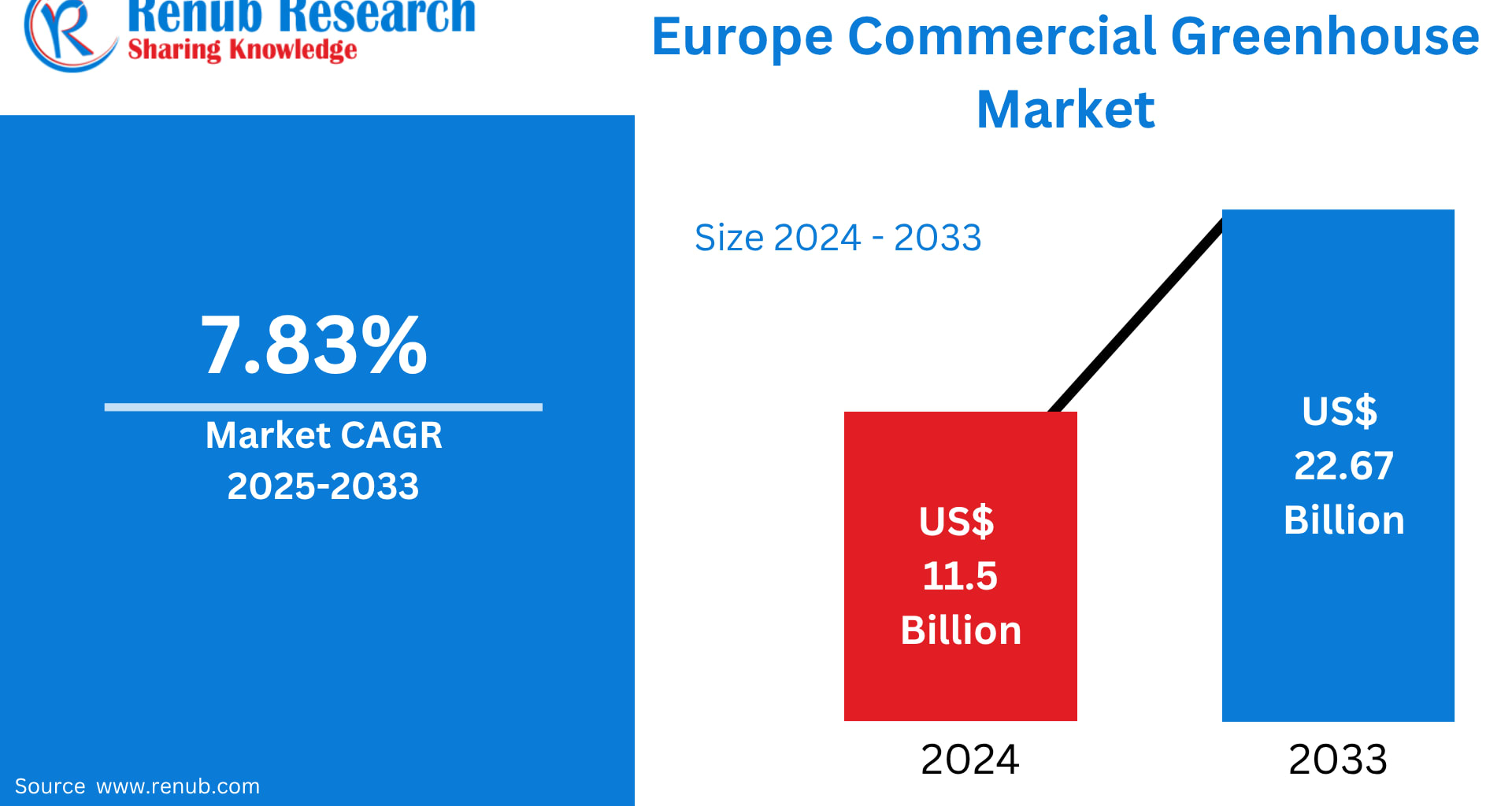
The Europe Commercial Greenhouse Market is on a strong growth trajectory, projected to expand from US$ 11.5 billion in 2024 to US$ 22.67 billion by 2033, registering a CAGR of 7.83% during 2025–2033. This robust expansion is underpinned by rising demand for year-round crop availability, accelerated adoption of Controlled Environment Agriculture (CEA), and the continent’s push toward sustainable and resource-efficient food production systems.
Across Europe, commercial greenhouses play a critical role in food security and sustainability. Countries such as the Netherlands, Spain, Italy, France, and the United Kingdom are at the forefront of greenhouse cultivation, supplying vegetables, fruits, and ornamental plants to both domestic and export markets. As climate variability, supply-chain disruptions, and environmental concerns intensify, greenhouse farming has emerged as a resilient solution for Europe’s agri-food ecosystem.
Key Growth Drivers in the Europe Commercial Greenhouse Market
Rising Demand for Local and Sustainable Food Production
European consumers are increasingly prioritizing locally sourced, traceable, and pesticide-free produce. Commercial greenhouses align perfectly with this shift by enabling consistent, high-quality food production close to consumption centers. By reducing food miles, greenhouse farming cuts transportation emissions and lowers dependency on imports, supporting Europe’s broader sustainability and carbon-reduction goals.
Greenhouse agriculture also improves land-use efficiency and significantly reduces water consumption compared to open-field farming. These advantages strongly resonate with the European Green Deal, which emphasizes sustainable agriculture, biodiversity protection, and climate neutrality. As a result, retailers and supermarket chains are forming long-term sourcing partnerships with regional greenhouse operators, further boosting market demand.
Advancements in Controlled Environment Agriculture (CEA)
Technological innovation is transforming commercial greenhouse operations across Europe. The integration of artificial intelligence (AI), Internet of Things (IoT), robotics, and automation enables growers to precisely manage environmental variables and monitor crop health in real time. CEA solutions improve productivity, enhance crop uniformity, and optimize resource utilization, significantly reducing operational inefficiencies.
Europe’s strong agri-tech ecosystem—particularly in countries such as the Netherlands and Germany—continues to drive innovation. In August 2023, Certhon Build B.V. strengthened its global footprint by acquiring DENSO’s agricultural operations, leveraging advanced horticultural technologies to develop innovative greenhouse concepts and address global food challenges.
Government Support and Policy Incentives
European governments actively support greenhouse farming through subsidies, grants, and favorable regulatory frameworks. Programs such as the Common Agricultural Policy (CAP), Horizon Europe, and national sustainability initiatives encourage investments in energy-efficient greenhouse infrastructure, water recycling systems, and renewable energy integration.
Policy alignment with climate adaptation strategies further positions greenhouses as a future-proof agricultural solution. The EU’s long-term goals—climate neutrality by 2050 and a 55% reduction in greenhouse gas emissions by 2030—are accelerating the adoption of low-emission, technology-driven greenhouse systems across the region.
Challenges Facing the Europe Commercial Greenhouse Market
High Initial Capital Investment
Despite long-term operational efficiencies, establishing a commercial greenhouse—especially high-tech glasshouses with automation and hydroponics—requires substantial upfront capital. Costs associated with land acquisition, construction materials, climate control equipment, and advanced technologies can be prohibitive, particularly for small and medium-sized enterprises.
Although government incentives help mitigate these expenses, access to financing and uncertainty regarding return on investment remain significant barriers, especially in Eastern European markets where greenhouse farming is still emerging.
Energy Consumption and Cost Volatility
Commercial greenhouses are energy-intensive, relying heavily on heating, lighting, and ventilation—particularly in colder regions of Europe. Volatile energy prices and decarbonization pressures challenge profitability and sustainability. Growers must balance productivity goals with rising energy costs, often necessitating investment in renewable energy solutions such as solar panels, geothermal heating, and biomass systems.
This challenge has intensified the demand for energy-efficient greenhouse designs, advanced insulation materials, and smart climate-control systems that minimize energy consumption without compromising crop yields.
Market Segmentation Insights
Europe Plastic Commercial Greenhouse Market
Plastic greenhouses dominate many parts of Europe due to their cost-effectiveness, flexibility, and ease of installation. Constructed using polyethylene or polycarbonate coverings, these structures offer good insulation and UV protection, making them suitable for seasonal and semi-permanent cultivation. While plastic coverings require periodic replacement, their affordability and scalability make them popular among both small-scale and commercial growers, particularly in Southern and Eastern Europe.
Europe Commercial Greenhouse Fruits and Vegetables Market
Fruits and vegetables represent the largest crop segment within Europe’s commercial greenhouse market. Tomatoes, cucumbers, peppers, strawberries, and leafy greens are extensively cultivated under controlled conditions, ensuring consistent quality and year-round supply. Retailers increasingly prefer greenhouse-grown produce due to its freshness, reduced pesticide use, and stable pricing, reinforcing the segment’s strong growth outlook.
Europe Commercial Greenhouse Nursery Crops Market
Nursery crops—including flowers, ornamental plants, and saplings—constitute a vital segment of the European greenhouse industry. Climate-controlled environments enhance propagation efficiency, reduce pest risks, and improve plant uniformity. The Netherlands, Germany, and Italy lead nursery crop production, supplying both domestic and international markets. Urban landscaping, real estate development, and export demand continue to support this segment’s expansion.
Europe Commercial Greenhouse Cooling Systems Market
Cooling systems are essential for maintaining optimal temperatures, particularly in Southern Europe. Technologies such as evaporative cooling, shading screens, fogging systems, and automated ventilation are widely adopted. As climate variability increases, demand for energy-efficient and sensor-driven cooling solutions continues to rise, supporting healthier crops and improved yields.
Europe Commercial Greenhouse Tunnel and Roof Greenhouse Markets
Tunnel greenhouses (hoop houses) remain popular due to their low cost and rapid deployment, especially in Mediterranean and Eastern European regions. Conversely, roof greenhouses are gaining traction in urban centers such as Paris, Berlin, and Rotterdam. These structures utilize rooftop spaces to produce local food, reduce transport emissions, and integrate waste heat and water recycling, aligning with sustainable city development strategies.
Country-Level Market Insights
United Kingdom Commercial Greenhouse Market
The UK market is driven by food security concerns, sustainability targets, and post-Brexit supply-chain adjustments. Greenhouses ensure consistent crop output despite unpredictable weather conditions. Innovation hubs, agri-tech collaborations, and urban rooftop projects are reshaping the UK greenhouse landscape. In July 2025, LettUs Grow launched its Aeroponic Rolling Bench™ at its Bristol innovation center, highlighting the country’s focus on advanced growing systems.
Netherlands Commercial Greenhouse Market
The Netherlands is a global benchmark in greenhouse farming, renowned for its high-tech glasshouses, automation, and export-oriented production. Continuous R&D and policy support have positioned the country as Europe’s innovation hub. In December 2024, Hazera inaugurated a state-of-the-art R&D greenhouse to develop high-yield, disease-resistant tomato varieties, reinforcing the nation’s leadership in sustainable horticulture.
Russia Commercial Greenhouse Market
Russia’s commercial greenhouse market is expanding steadily, driven by food self-sufficiency goals and extreme climatic conditions. Government subsidies and import substitution policies support domestic production of vegetables such as tomatoes and cucumbers. In November 2024, ROST Group announced plans to develop greenhouse projects in Saudi Arabia, showcasing Russia’s growing expertise in protected agriculture.
Market Segmentation Snapshot
By Product Type:
Fruits & Vegetables
Flowers & Ornamentals
Nursery Crops
Others
By Equipment Type:
Cooling Systems
Heating Systems
Others
By Greenhouse Type:
Tunnel Greenhouse
Gutter Connected Greenhouse
Hybrid Greenhouse
Lean-To Greenhouse
Roof Greenhouse
By Country:
France, Germany, Italy, Spain, United Kingdom, Belgium, Netherlands, Russia, Poland, Greece, Norway, Romania, Portugal, Rest of Europe
All major companies are evaluated across five viewpoints: Overview, Key Person, Recent Developments, SWOT Analysis, and Revenue Analysis.
Key Players Covered:
Berry Global, RICHEL Group, Certhon Build B.V., Argus Control Systems Limited, LOGIQS B.V., LumiGrow Inc., Keder Greenhouse, Agra Tech Inc., Hort Americas
Final Thoughts
The Europe Commercial Greenhouse Market is transitioning into a cornerstone of sustainable agriculture, blending technology, policy support, and consumer demand for local food. As climate uncertainty and food security challenges intensify, commercial greenhouses provide a resilient, scalable, and environmentally responsible solution.
With advancements in CEA, automation, and energy-efficient systems, Europe is well-positioned to lead the global greenhouse revolution. By 2033, commercial greenhouses will not only supply fresh produce year-round but also play a pivotal role in achieving Europe’s sustainability and climate objectives—making them an indispensable part of the continent’s agri-food future.