Even billionaires need to undergo months of training9: Longest spacewalk (hours)
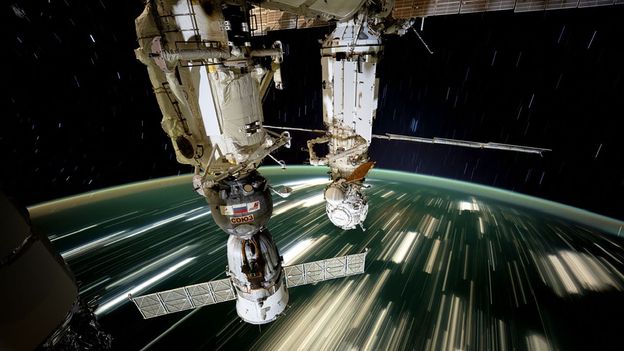
Since the first assembly mission in December 1998, there have been more than 270 spacewalks at the ISS. Initially, most of them were to help piece the station together but, today, they are increasingly to repair or replace ageing parts. The longest spacewalk remains an eight-hour-and-56-minute excursion by Susan Helms and Jim Voss in 2001. During a spacewalk in 2013, Luca Parmitano almost drowned when his helmet began filling with water.
7: Joints on Canadarm2
Apart from providing singing astronauts, one of Canada’s greatest contributions to the ISS is a complex multi-jointed robotic arm. Canadarm2, a development of the original robotic arm fitted to the Space Shuttle, is used for everything from assembly missions and spacecraft docking to carrying spacewalkers to different parts of the ISS – a truly memorable ride. Canada has also developed what it calls “the most sophisticated space robot ever built”. Known as Dextre, it has two hands, five eyes and more attachments than a Swiss Army knife.
 NasaNasa’s Frank Rubio is the astronaut who has spent the longest onboard the station (Credit: Nasa)13: Space tourists

Visiting the ISS is no longer only the preserve of space agency astronauts and cosmonauts, 13 private individuals have also flown to the ISS. Companies offering the rides prefer to call them spaceflight participants, rather than tourists. And even billionaires need to undergo months of training. Nasa is reported to charge around $35,000 (£26,500) a night for accommodation, although that does include meals and an view of the Earth.
16: Orbits in 24 hours
At 28,000km/h (17,500mph), ISS astronauts experience 16 sunrises and 16 sunsets every day. The orbital track of the station takes it over some 80% of the Earth, which gives us a chance to see them pass overhead. The ISS is one of the brightest objects in the night sky. You can use a free Nasa app to alert you to viewing opportunities.
55m: Cheapest flight ($)
Reaching the ISS does not come cheap but it is less than it used to be. According to a 2018 report, each Space Shuttle flight cost in the region of $1.5bn (£1.13bn) – although the Shuttle could carry both astronauts and a payload. Today, the going rate for a seat in SpaceX’s Dragon is around $55m (£41.6m) and a less comfy Russian Soyuz trip comes in at around $80m (£60.6m). Although competition has driven down costs, rockets are always going to be expensive with existing technology.
More like this:
• What happens when astronauts get stuck in space
• How the ISS will meet a fiery end
286: Duration of Suni and Butch’s ‘eight-day’ mission (days)
Starliner has been described as the next big thing in human spaceflight. After plenty of setbacks, Boeing’s new spacecraft was finally due for its maiden crewed test flight in June 2024. But Nasa would come to regret billing it as an eight-day mission. Multiple failures during docking led officials to decide to send Starliner back to Earth without a crew, leaving astronauts Sunita Williams and Butch Wilmore stuck on the station and spending Christmas in space. The two astronauts finally made it back to Earth in March 2025.
735,000: Power generated (KWh/year)
At 109m (356ft) the wingspan of the ISS solar arrays is longer than an Airbus A380. The arrays, which tilt to face the Sun, are connected to banks of batteries to ensure a continuous power supply. The ISS is also fitted with insulation and a cooling system to stop it overheating, with a bank of ammonia-filled radiators to dissipate heat into space. Ammonia leaks have been a cause of concern, resulting in emergency spacewalks to patch them up.
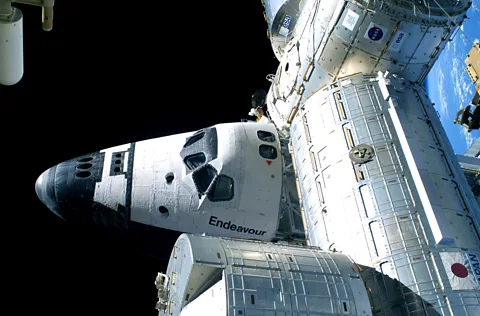 NasaThe Space Shuttle used to deliver crew and cargo to the ISS, but now these missions are handled by SpaceX flights (Credit: Nasa)3,000,000: Lines of software code
In 1969, a computer with the equivalent of only around 74 kilobyte ROM and 4 kilobyte RAM memory (a tiny fraction of what you’d find in your smartphone) enabled three astronauts to navigate the roughly 380,000km (236,000 miles) from the Earth to the Moon and descend to a precise spot on the lunar surface. The ISS requires rather more computing power and encompasses both the operating system on the station itself and mission control on the ground. In fact, there are multiple computers on the ISS – from clunky Soviet-era electronics to tablets. There are even adapted Raspberry Pi computers. Renamed Astro-Pi they have been used to run student experiments.
486,000: Items onboard
We all lose things at home – but imagine if you put them down and they drifted away. That is a frequent occurrence on the ISS and the reason why surfaces and astronaut clothes are covered in patches of Velcro. To keep track of what’s onboard, almost every item – from critical hardware to toilet roll – is given a bar code and/or serial number. The whole system is overseen by the Inventory Stowage Officer in mission control. So, if astronauts run out of toilet roll, they know who to call. (Kindly provided by Nasa’s mission control centre in Houston, this is by far our favourite ISS fact.)
150bn: Total cost ($)
The most difficult number to calculate or verify, we may never know the full cost of the ISS. We do know that Nasa alone spends between $3bn and $4bn (£2.27bn to £3bn) each year to operate the ISS. Has it been worth it? You decide.
—
If you liked this story, sign up for The Essential List newsletter – a handpicked selection of features, videos and can’t-miss news, delivered to your inbox twice a week.
For more science, technology, environment and health stories from the BBC, follow us on Facebook and Instagram.