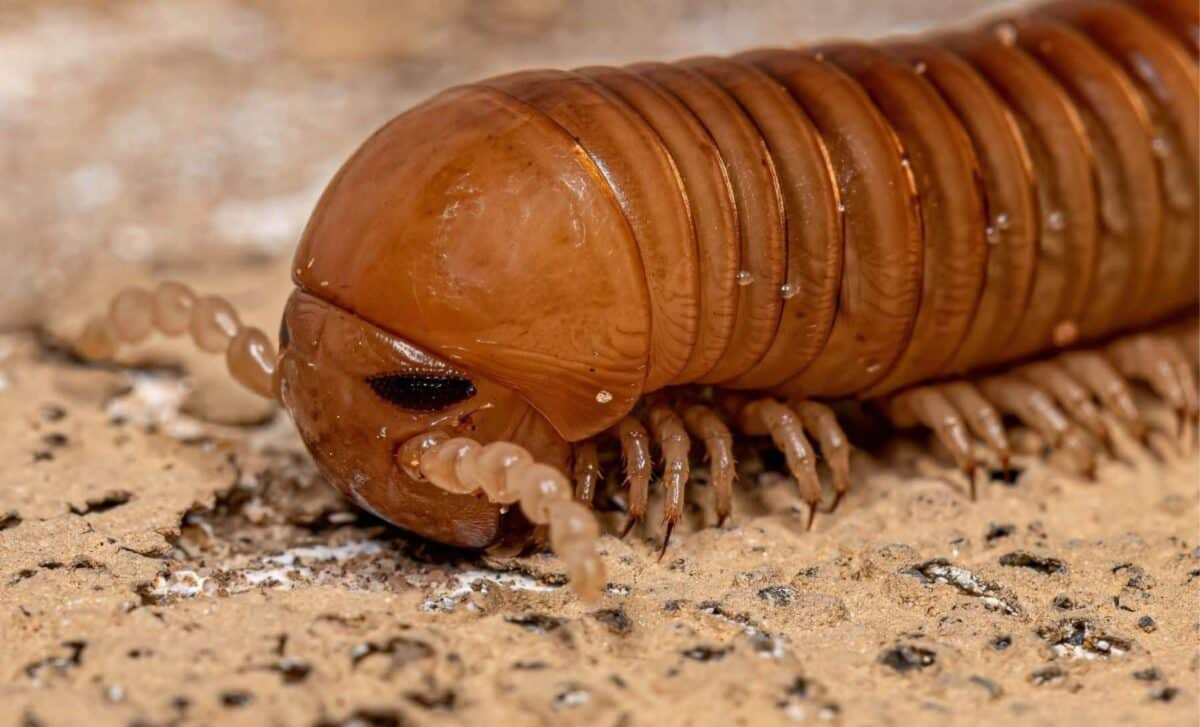
A fossil uncovered by chance on a remote beach in northern England has revealed one of the most extraordinary creatures to ever roam the planet—a giant millipede stretching nearly nine feet in length. Preserved in a sandstone boulder, the fossil belongs to Arthropleura, an extinct genus now confirmed as the largest land invertebrate in Earth’s history.
This colossal invertebrate lived more than 326 million years ago, during the Carboniferous period, long before dinosaurs appeared. The discovery is significant not just for its size but for the questions it raises about prehistoric arthropods, their environment, and how such massive creatures evolved on land.
The specimen was spotted in Howick Bay, Northumberland, after a section of cliff collapsed, exposing a perfectly split boulder containing a rare and remarkably intact exoskeletal segment. Researchers from the University of Cambridge quickly identified it as part of a creature that could grow up to 2.7 meters in length and weigh around 50 kilograms.
The Largest Land Invertebrate Ever Discovered
The Arthropleura fossil measures 75 centimeters, but represents only a portion of the animal—likely part of a shed exoskeleton. Based on scale comparisons, the full animal is estimated to have reached the length of a compact car. These prehistoric giants crawled across the tropical landscapes of what is now Great Britain, which sat near the equator during the late Carboniferous.
Unlike earlier finds in Germany, which revealed smaller fragments, this fossil is the most complete and largest of its kind to date. It was preserved in a fossilized river channel, not the coal swamps long thought to be Arthropleura’s typical habitat. This detail suggests the species thrived in open woodlands near ancient waterways, feeding on decaying vegetation and perhaps even small invertebrates.
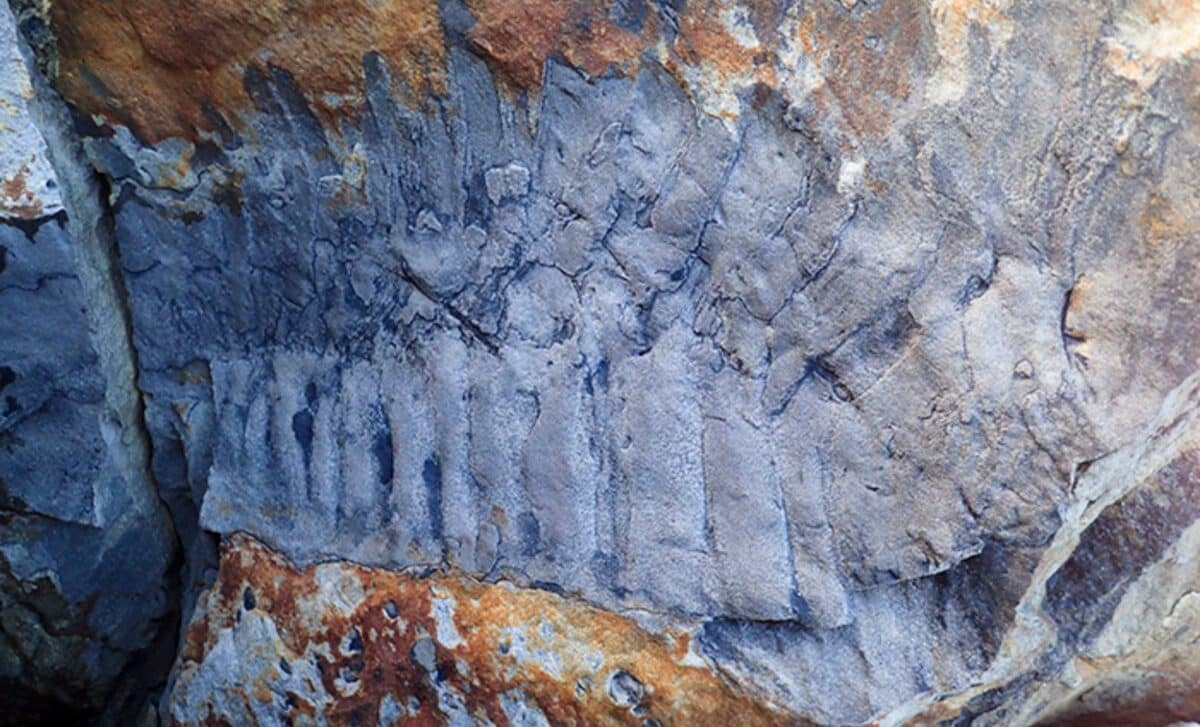 The uncovered Arthropleura fossil – © Neil Davies
Dr. Neil Davies of the University of Cambridge described the discovery as a “complete fluke” in multiple reports, after a former student noticed the fossil while walking along the coast. The team excavated the specimen with support from Natural England and local landowners in mid-2018.
The fossil’s dimensions and location are documented in the study published in the Journal of the Geological Society, which confirms the specimen as the largest-known arthropod to have walked on land.
Oxygen Alone Didn’t Drive Prehistoric Gigantism
For decades, scientists linked the gigantic size of Paleozoic arthropods to high atmospheric oxygen concentrations. But this fossil dates from a time before the known late Carboniferous oxygen peak—when levels were around 23%, only slightly higher than today’s 21%. This undercuts the prevailing assumption that oxygen was the primary driver behind their massive growth.
That contradiction has led researchers to explore alternative explanations. The likely factors now include abundant plant-based nutrition, a lack of terrestrial predators, and stable equatorial climates that supported large-bodied invertebrates.
Additional evidence comes from a 2024 study published in Science Advances, which used CT scans to analyze juvenile Arthropleura fossils from Montceau-les-Mines in France. These rare specimens revealed the head structure for the first time—featuring short antennae, protruding stalked eyes, and internal mandibles. The anatomy places the species in a now-extinct group that shares features with both millipedes and centipedes.
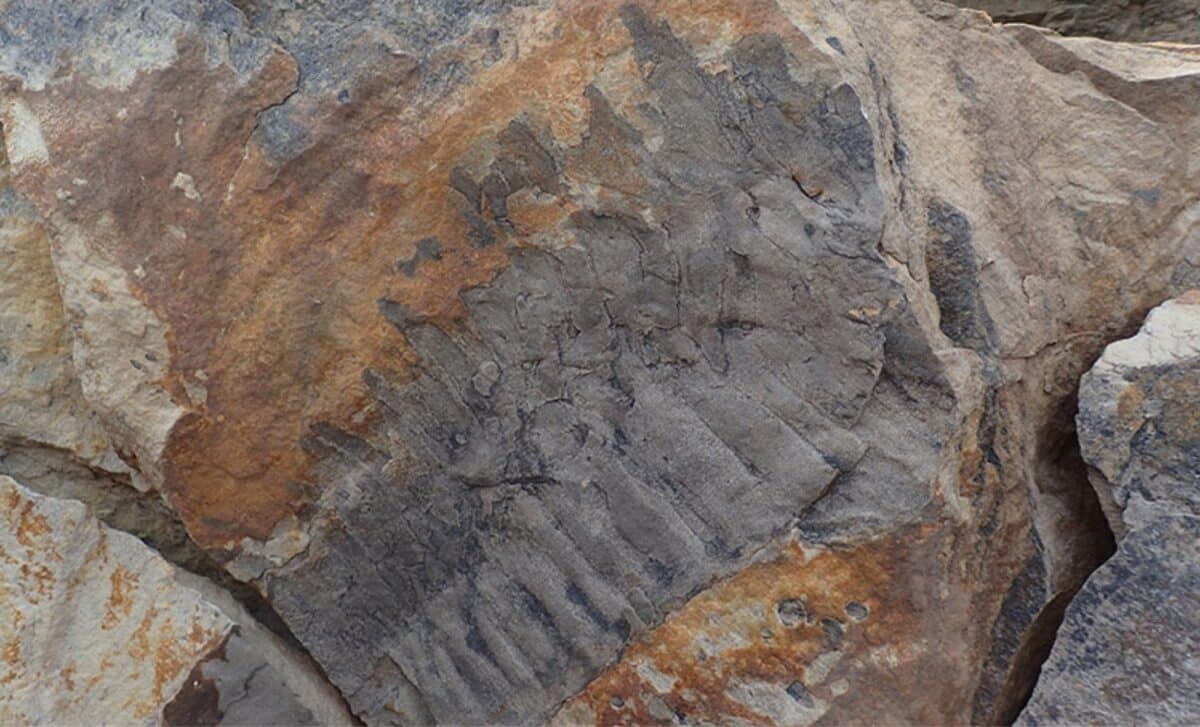 Another image of the giant millipede fossil – © Neil Davies
The scans confirmed that Arthropleura likely belonged to a stem group of millipedes, rather than modern descendants, further challenging assumptions about its behavior and biology.
Extinction of a Prehistoric Crawler
Despite dominating equatorial landscapes for nearly 45 million years, Arthropleura vanished during the early Permian period, around 290 million years ago. Climate shifts that led to drier, more seasonal conditions may have reduced their available habitat and moisture-dependent breeding cycles.
Researchers also suggest that the molting process, essential for arthropods to grow, became riskier as environmental humidity declined. For an animal of this size, molting required highly stable, moist environments—conditions that disappeared during widespread Permian desertification.
Some theories also point to the rise of early reptiles, which may have competed with Arthropleura for food or territory in the same shrinking ecosystems. However, no direct fossil evidence of such interactions has yet been uncovered.
Full adult skeletons remain elusive. Most known Arthropleura fossils—like the one discovered in Northumberland—are molted carapaces, not actual remains. The absence of fossilized heads has limited researchers’ ability to fully reconstruct their behavior and feeding strategies.
Ancient Ecosystems, Newly Reimagined
This discovery is more than a milestone in paleontology—it’s a sharp reminder that the ancient biosphere was full of evolutionary surprises. The size and survival of Arthropleura signal a dynamic ecosystem that supported giant invertebrates, not in isolated swamps but across vast open woodlands in what was once equatorial Europe.
Trackways, found in places like Nova Scotia, suggest that these creatures moved slowly across forest floors, leaving meter-wide imprints behind. These impressions have helped confirm their estimated size, even in the absence of full body fossils.
Now on display at the Sedgwick Museum of Earth Sciences, the Northumberland fossil offers the public a rare window into a world long gone. It tells the story of a planet that once teemed with megafauna not just of bone and tooth—but of armor and segment.