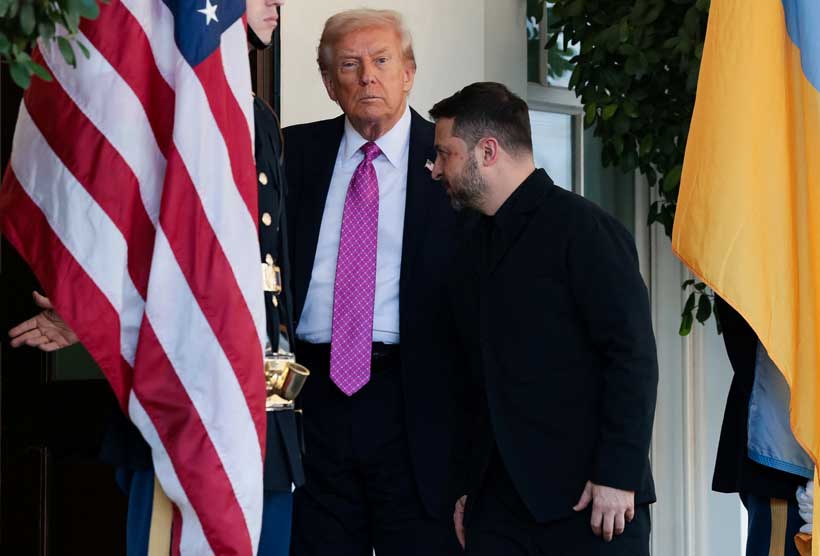
President Volodymyr Zelenskiy has for the first time outlined the main elements of a draft 20-point peace framework being discussed by Ukraine and the United States, which he said could form the basis of future agreements to end the war with Russia.
Zelenskiy said weeks of talks had narrowed differences from an earlier 28-point draft that was seen as accommodating many of Moscow’s demands. However, Ukraine and the United States have yet to reach agreement on two key issues territorial control and the Zaporizhzhia nuclear power plant which Zelenskiy said would require direct talks with U.S. President Donald Trump.
Below are the main points of the draft proposal, as presented by Zelenskiy and shared by his office on Wednesday:
- Ukraine’s sovereignty will be reaffirmed.
- A full and unconditional non-aggression agreement will be concluded between Russia and Ukraine. To ensure long-term peace, a monitoring mechanism will oversee the line of contact using space-based unmanned surveillance to provide early warning of violations and manage disputes.
- Ukraine will receive robust security guarantees.
- Ukraine will maintain its armed forces at their current strength of 800,000 personnel. An earlier U.S. proposal had envisaged a reduction in troop numbers.
- The United States, NATO and European countries will provide security guarantees to Ukraine comparable to Article 5 of NATO’s founding treaty.
- Russia will formalise a policy of non-aggression towards Europe and Ukraine through legislation and ratification, including approval by an overwhelming majority in the State Duma.
- Ukraine will become a member of the European Union on a clearly defined date and will receive short-term preferential access to the EU market.
- Ukraine will receive a comprehensive global development package, to be detailed in a separate agreement focused on investment and long-term prosperity.
- Multiple funds will be established for economic recovery, reconstruction and humanitarian needs, with the aim of mobilising $800 billion to help Ukraine fully realise its potential.
- Ukraine will accelerate negotiations on a free-trade agreement with the United States. Zelenskiy said Washington had indicated that if it granted free-trade access to Ukraine, it would seek to offer similar terms to Russia.
- Ukraine will reaffirm its commitment to remaining a non-nuclear state under the Treaty on the Non-Proliferation of Nuclear Weapons.
- Zaporizhzhia nuclear power plant: No agreement has yet been reached. The U.S. proposal envisages joint operation by Ukraine, the United States and Russia, with equal stakes and U.S. management. Kyiv has proposed a 50-50 joint enterprise involving only Ukraine and the United States, with Ukraine receiving half the power output and the United States independently allocating the remainder.
- Ukraine and Russia will implement educational programmes promoting tolerance, cultural understanding and the elimination of racism and prejudice. Ukraine will apply EU standards on religious freedom and minority language protection.
- Territory: Zelenskiy described this as the most complex and unresolved issue. Russia wants Ukraine to withdraw forces from areas of the eastern Donetsk region still under Kyiv’s control. Ukraine wants fighting frozen along current front lines. The United States has proposed demilitarised zones and a free economic zone in Ukrainian-held parts of Donetsk.
- Once future territorial arrangements are agreed, both sides commit not to alter them by force.
- Russia will not obstruct Ukraine’s commercial use of the Dnipro River or the Black Sea. Separate maritime and access agreements will ensure freedom of navigation. The Kinburn Spit at the mouth of the Dnipro will be demilitarised.
- A humanitarian committee will be established to resolve outstanding issues, including:
a) the exchange of all remaining prisoners of war on an “all for all” basis;
b) the return of all civilian detainees and hostages, including children;
c) measures to address the suffering of conflict victims. - Ukraine will hold elections as soon as possible after the agreement is signed.
- The agreement will be legally binding and monitored by a Peace Council chaired by President Trump, comprising Ukraine, Europe, NATO, Russia and the United States. Sanctions will apply in the event of violations.
- Once all parties approve the agreement, a full ceasefire will take effect immediately.
With information from Reuters.