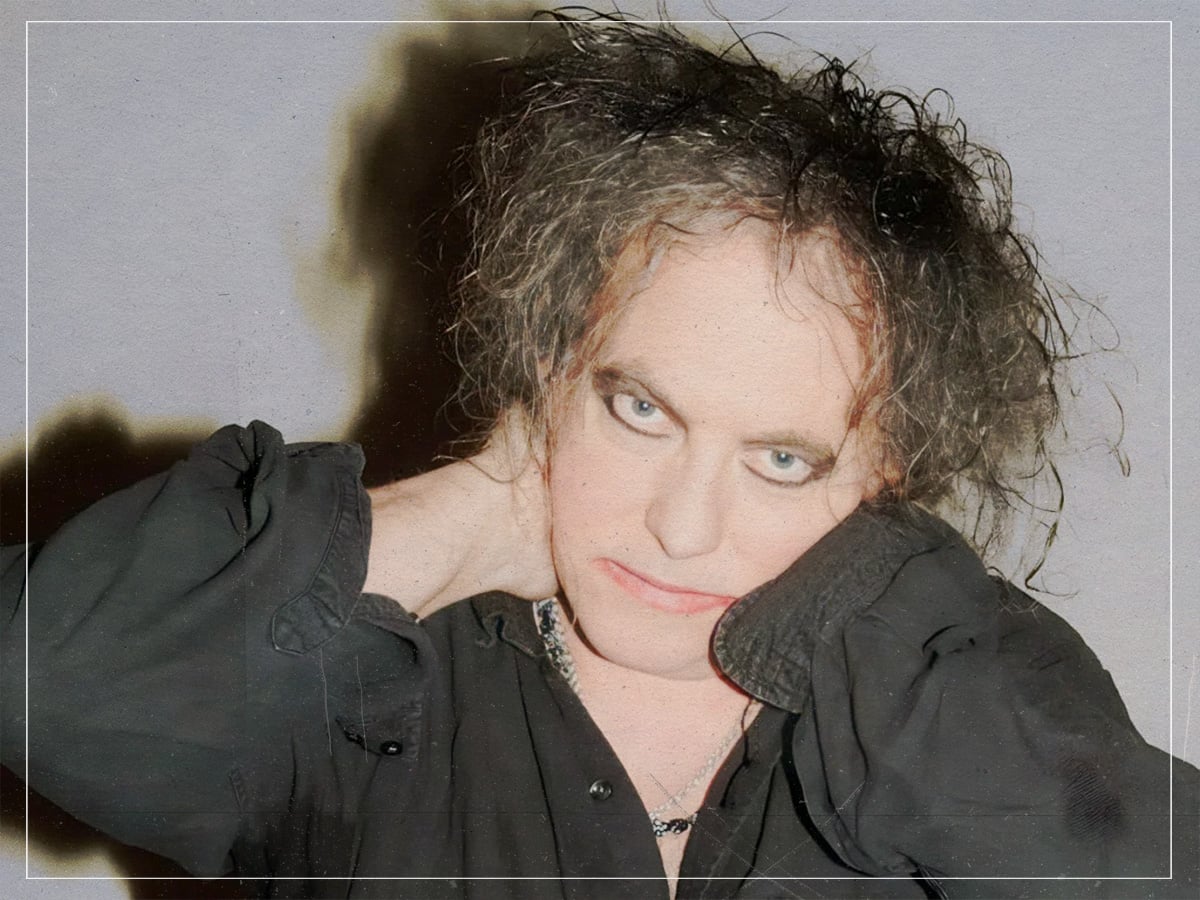
(Credits: Far Out / Sam Rockman)
Wed 24 December 2025 15:00, UK
Tackling themes like romance, mortality, and the romance of mortality, The Cure have always been shoehorned into the gothic new wave category, and that is pretty spot on. After all, most of the band’s best songs include these topics in one variant or another, and often, it’s the moments where it all swirls together more ambiguously that their music truly shines.
Robert Smith has always been aware of this, but also knows how the material is rarely ever as black and white as simple labels like gothic or post-punk, and that’s mainly because it is too simple a label to apply to the legacy of The Cure.
From the start, the frontman has taken his influences and channelled them to pour his own thoughts and ideas into art, ranging from his childhood upbringing and how he perceived the world around him in his youth to the relationships he experienced as he grew older, as well as the concept of memory in between all of those intricate lines, the kinds that rewrite our consciousness and fabricate their own emotions, even though they’re no less real.
That’s the core of The Cure, and the proof that the music extends far beyond any style or genre: much of the music, sonically and lyrically, tackles existential musings that are far too abstract and yet painfully real to be condensed into something singular, with the themes surrounding existence and its pitfalls exuding from the nucleus of everything we encounter in our short time on earth, and how the poetry in it helps us make sense of it all.
Of course, the sonic elements help to drive these points home, too, such that, if The Cure’s music didn’t sound the way it did, then these themes wouldn’t be as powerful, and if Smith’s lyrics didn’t hit home, we wouldn’t resonate with his concepts as much. But we do because there’s something familiar about it, specifically, the way that he managed to blend his different influences across rock and synth-pop to build a world that completely stood on its own.
Like many of his peers, he built those narratives on the shoulders of others, utilising cherished favourites like The Beatles, The Rolling Stones, Siouxsie Sioux, Joy Division, Pink Floyd, and countless others to bridge the gap between his generation and the things that he was experiencing in his own life. Jimi Hendrix also informed much of Smith’s musical patterns, and David Bowie was another who became a constant touchpoint across most, if not all, Cure albums.
As Smith reflected to Uncut, “Bowie obviously always informs everything: ‘Would David do that?’ ‘Life On Mars’ had a huge impact on me. There’s a certain period of everyone’s life, around 13 up to 17, when you discover your own music and books for yourself. All those things matter so much more than they should then. I’m lucky that the things I liked when I was young, musically, I still like.”
Many of the biggest and best pioneers in rock history balanced those crucial components, having the ability to maintain connections with music they fell in love with while growing up and letting it guide their musical direction when creating their own art.
Smith achieved this by keeping visionaries like Bowie as the blueprint, or basic framework for his own expression, and an invisible soundboard that kept him in check whenever he wanted to be more self-assured about his own approach. And, as we’ve seen, that mindset paid off in spades, enabling Smith to reach new levels of excellence within his own projects.
Related Topics