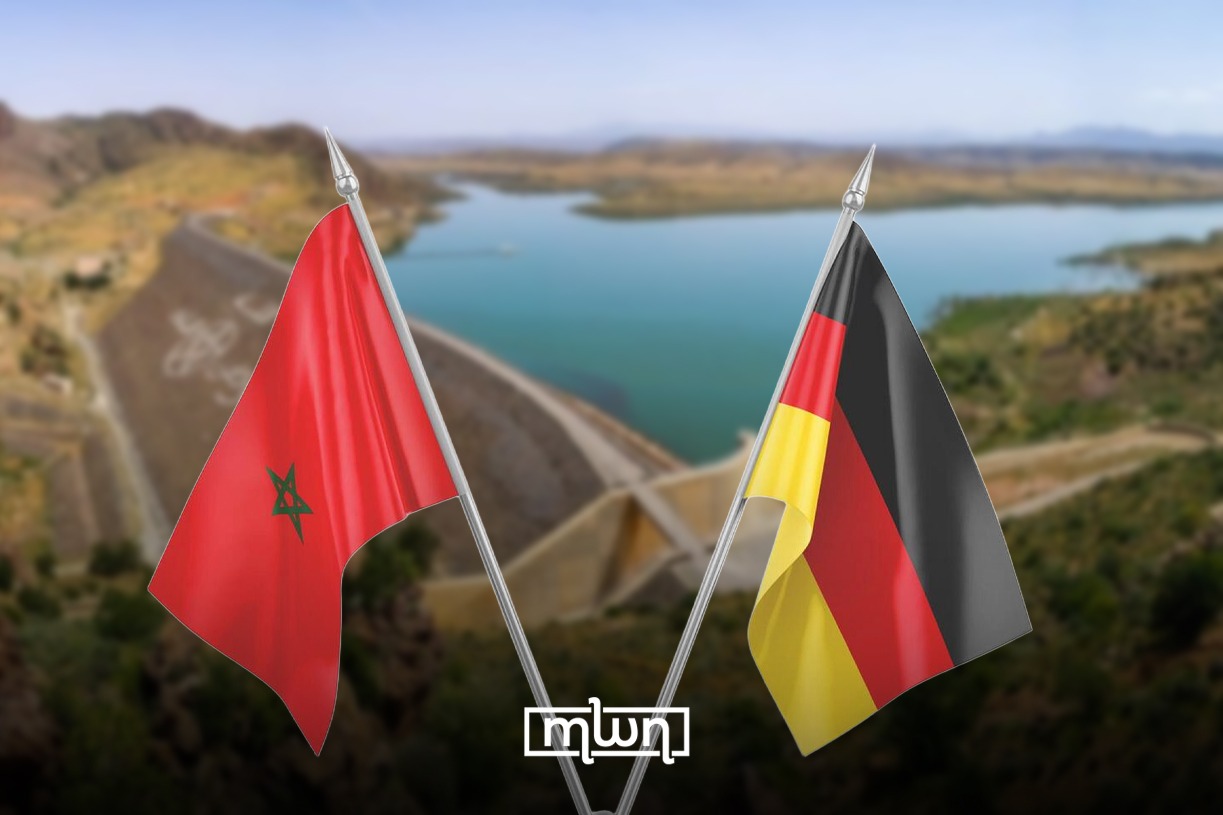
Mohammedia – As water scarcity continues to rank among Morocco’s most pressing economic and social challenges, the country is quietly strengthening its long-term water governance in one of its most vulnerable regions.
In the Tensift basin, a new climate adaptation project backed by Germany aims to modernize how water resources are measured, monitored, and managed.
Coming at a moment of cautious relief for national water reserves, the initiative places data and anticipation at the center of water policy decisions.
Following heavy rainfall in recent weeks, Morocco’s dam storage reached 5.64 billion cubic meters by the end of December 2025, marking a 16.9% increase compared with the same period last year.
While the rebound offers short-term breathing room, authorities continue to warn that structural pressures, declining availability, erratic rainfall, and rising demand—remain firmly in place.
Against this backdrop, the project known as “GIREau VI” targets the Tensift basin, one of the country’s most water-stressed areas due to the combined pressures of agriculture, urban growth, and climate variability.
The program is supported through financial cooperation with Germany, via its development bank KfW, and is being implemented by Morocco’s Agence du bassin hydraulique du Tensift.
From reactive management to data-driven anticipation
At the core of GIREau VI is the deployment of an advanced system for measuring, monitoring, and analyzing hydroclimatic data across the basin.
The project includes the upgrading and expansion of hydrological, piezometric, and meteorological monitoring networks, alongside the modernization of data collection equipment and the integration of digital platforms for real-time processing and analysis.
Its goal is not limited to technical modernization. By strengthening data reliability and accessibility, the system is designed to support more informed decision-making, helping authorities better allocate water between agricultural, urban, and environmental uses.
In a basin where competing demands are intensifying, the availability of accurate, real-time information is increasingly seen as a strategic necessity rather than a technical luxury.
A key component of the project is the introduction of a flood early-warning system based on simulation and forecasting models, supported by clearly defined operational alert protocols.
This marks a shift in approach — from responding to crises after they occur to anticipating risks before they escalate.
Officials involved in the project say the same logic applies to drought management, where early indicators can guide preventive measures rather than emergency responses.
The consulting and engineering services required for the project are fully financed by KfW as part of Morocco-Germany financial cooperation.
Specialized national and international firms will support the Tensift basin authority throughout the project cycle, from preparatory studies and procurement to system deployment and institutional capacity building.
With an estimated implementation period of 30 months, GIREau VI is designed as a long-term investment in resilience rather than a short-term fix.
Beyond the Tensift basin, the project reflects a broader shift in Morocco’s water strategy. The country is increasingly embracing data, forecasting, and governance as pillars of climate adaptation, alongside infrastructure such as dams and desalination plants.
Read also: Morocco’s Dams Reach 33.6% Capacity After Recent Rains