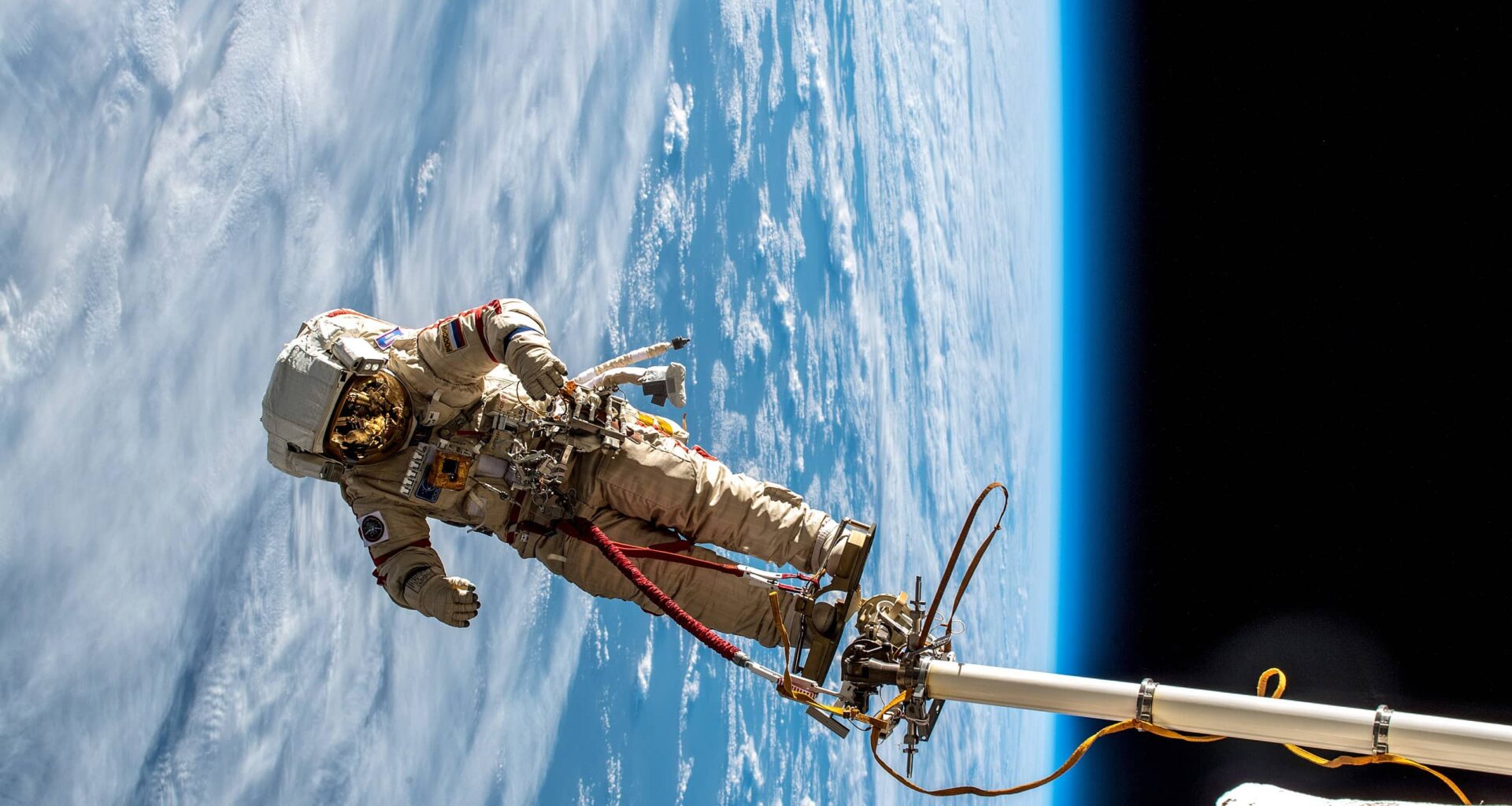
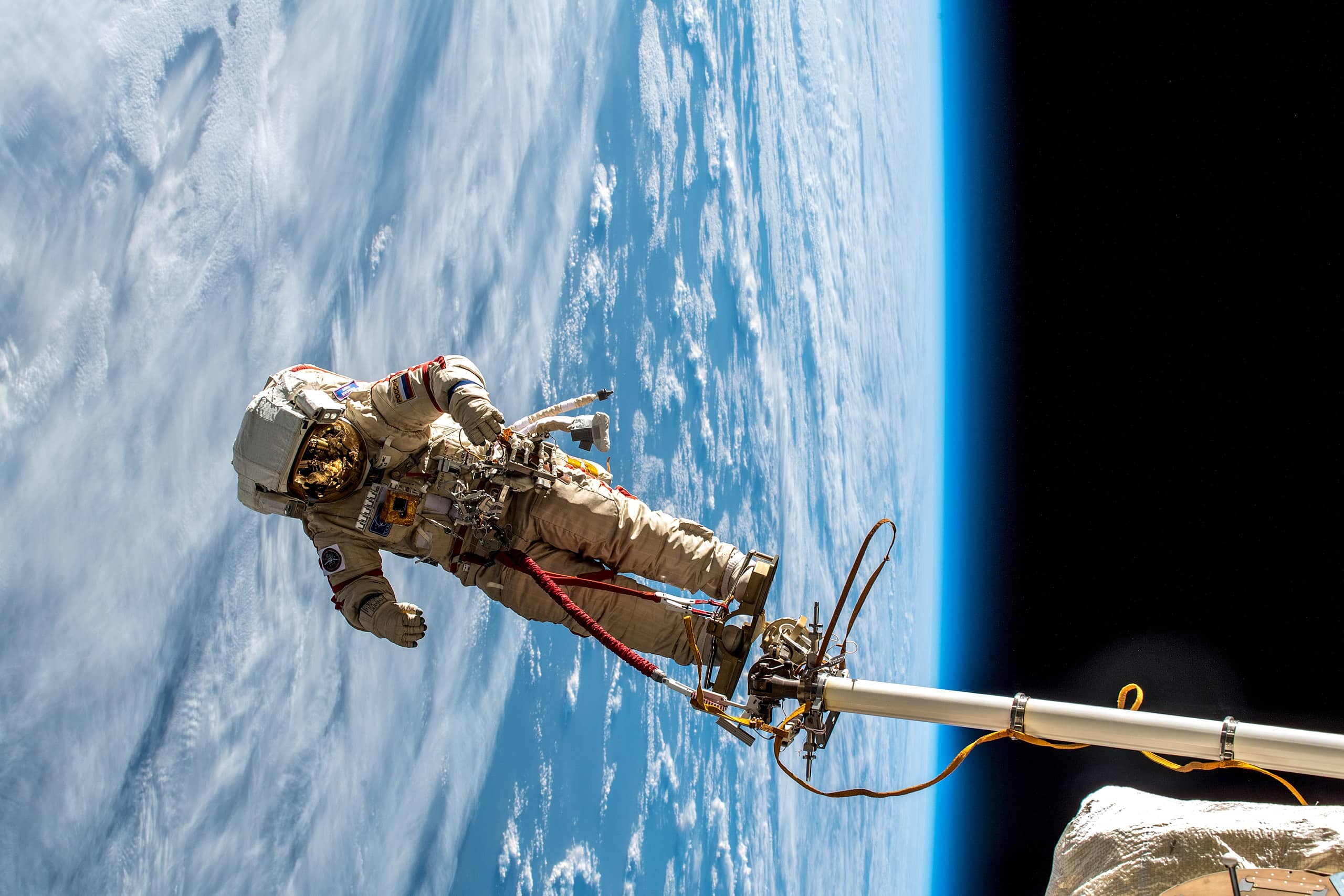
Russian spacewalk, December 11, 2018. Credit: Alexander Gerst – CC BY-SA 2.0 via Wikimedia Commons.
In a move that could reshape the future of long-duration spaceflight, Russia’s state-owned Energia rocket company has secured a patent for a space station designed to generate artificial gravity.
According to a report by the state media outlet TASS, which obtained the documentation, the novel architecture utilizes a rotating system to simulate gravitational pull for the crew.
By spinning habitable modules around a central axis, the station would produce an outward-pushing centrifugal force, creating an environment that mimics 50% of Earth’s gravity, or 0.5g.
Russia’s plans for artificial gravity could be the key to space travel
The patent illustrations depict a complex structure featuring a central axial module with both static and rotating components. Habitable modules and other compartments would be connected via hermetically sealed, flexible junctions, allowing them to spin while the core remains stable.
To achieve the targeted 0.5g force, the station would need to possess a radius of 131 feet (about 40 meters) and rotate at a speed of approximately five revolutions per minute. A structure of this magnitude would require multiple launches to ferry components into space, which would then be assembled in orbit.
The Russian company Energia has secured a patent on the design of space stations with artificial gravity-producing mechanisms.
We’ve seen these in movies (like The Martian), but to try and turn that into reality is truly commendable 👏
Img credits: Getty Images & RSC Energia pic.twitter.com/qnNyrEbyKP
— Tejaswi R Seith (@tejaswirseith) December 24, 2025
Generating artificial gravity is considered a “holy grail” for interplanetary voyages and deep space exploration. Prolonged exposure to microgravity wreaks havoc on the human body, causing significant muscle atrophy and bone density loss. A station capable of simulating gravity could mitigate these physiological tolls, potentially extending the duration humans can safely remain off-planet.
The patent acknowledges risks of implementation
While the concept offers a physiological breakthrough, the patent documentation acknowledges significant operational risks. Specifically, the design complicates the arrival of transport ships, which would need to spin and coordinate their rotation to match the station in order to dock. The patent notes that this requirement “reduces the safety” of using such a facility.
The unveiling of the patent comes as major space powers prepare for the end of the International Space Station (ISS). NASA and Roscosmos currently plan to deorbit the ISS in 2030, guiding it into the Pacific Ocean using a modified SpaceX Dragon capsule. While Russia has committed to remaining aboard the ISS only until 2028, the new patent signals Moscow’s interest in defining the architecture of the post-ISS era.
Russia is not alone in chasing this capability. NASA has previously explored similar concepts, such as the Nautilus-X rotating wheel, and commercial firm Vast has recently announced its own intentions to pursue artificial gravity stations. However, the Energia patent did not indicate specific timelines or allocated resources to back the project’s development. For now, the design remains a blueprint for a future where astronauts might finally keep their feet on the floor.