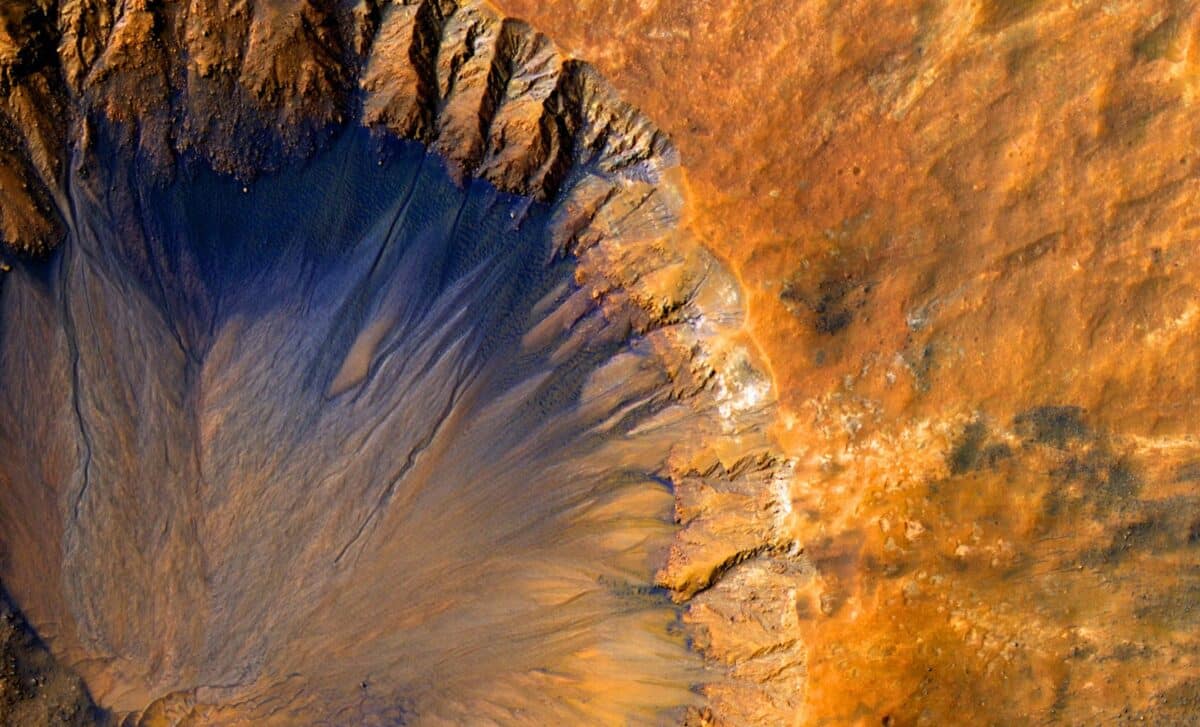
NASA’s Mars Reconnaissance Orbiter has made a remarkable discovery: the largest fresh impact crater ever confirmed on Mars, detected through a routine weather-monitoring camera. The new 50-meter-wide crater, formed in 2012, was discovered thanks to the Mars Color Imager (MARCI), a camera primarily used to monitor Martian weather patterns. This breakthrough has added to the growing body of knowledge about Mars’ surface and the dynamics of meteor impacts on the Red Planet.
MARCI’s Impact on Mars Monitoring
The discovery of the crater began with a routine weather observation. Bruce Cantor, deputy principal investigator for MARCI at Malin Space Science Systems, was reviewing daily images when he noticed an unusual dark spot near the Martian equator. According to NASA’s Jet Propulsion Laboratory, the spot initially appeared as a typical weather feature, but its distinct rays, emanating from a central point, caught his eye.
“It wasn’t what I was looking for. I was doing my usual weather monitoring and something caught my eye. It looked usual, with rays emanating from a central spot.”
A closer examination of past images revealed that the dark spot had only appeared recently, specifically after March 27, 2012. Cantor meticulously examined approximately 40 images taken before and after the event, confirming that the crater formed between March 27 and 28, 2012. This discovery is particularly significant because it was made using MARCI, a weather camera, rather than the high-resolution telescopic cameras on the orbiter like CTX or HiRISE.
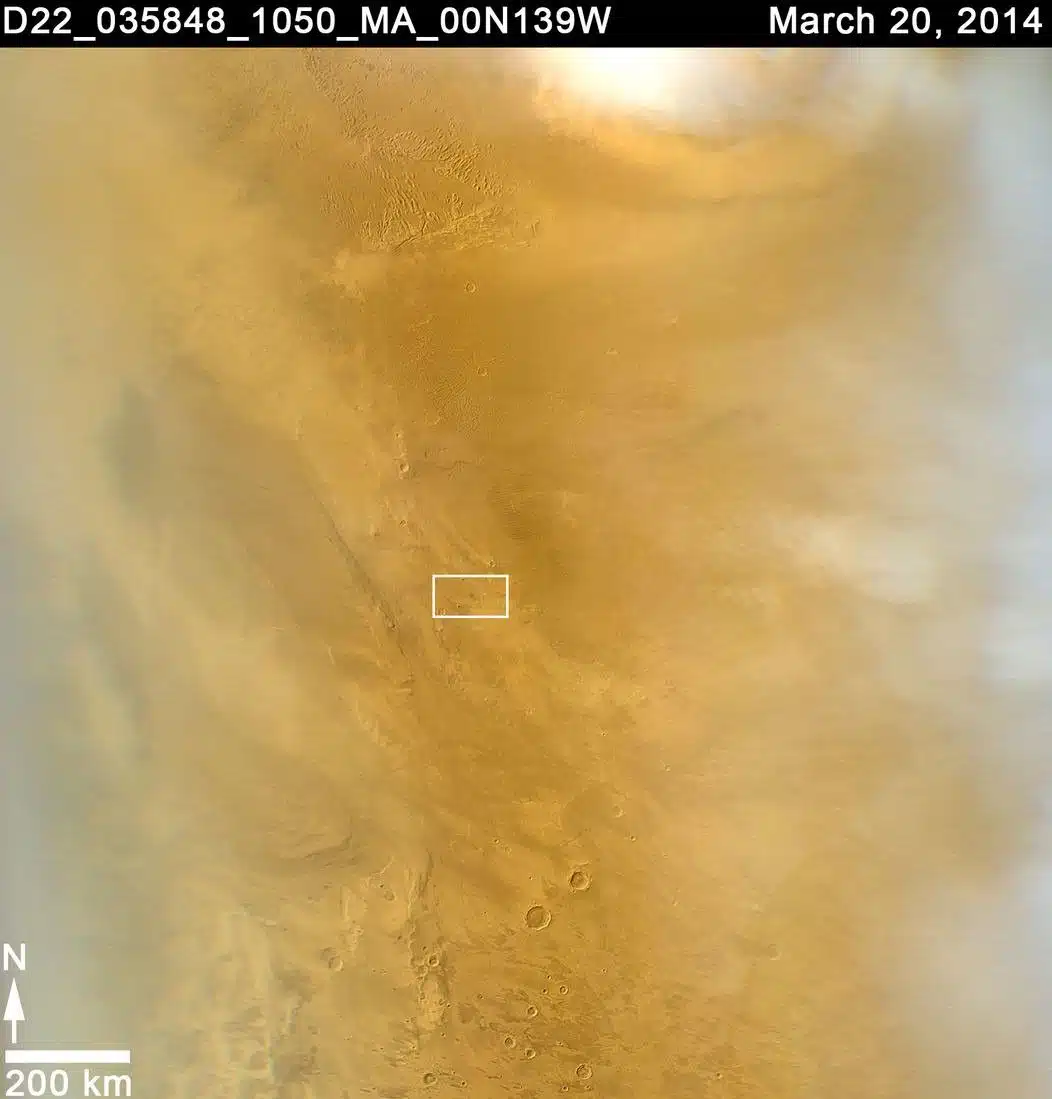 Impact mark found in Mars Weathercam image. Credit: NASA
Examining the New Crater’s Features
As stated in a release from NASA, the crater itself measures 159 feet (48.5 meters) by 143 feet (43.5 meters) and appears relatively shallow, a feature that distinguishes it from other craters on the planet. The impact is thought to have been caused by an asteroid about 10 to 18 feet in length, significantly smaller than the meteor that caused the 2013 Chelyabinsk explosion on Earth.
The HiRISE images also revealed several smaller craters nearby, likely the result of debris from the impactor or secondary impacts caused by ejected material. The surrounding area showed signs of landslides, where the shock of the impact had disturbed the Martian surface.
“Studies of fresh impact craters on Mars yield valuable information about impact rates and about subsurface material exposed by the excavations,” commented Leslie Tamppari, deputy project scientist for the Mars Reconnaissance Orbiter mission at NASA’s Jet Propulsion Laboratory. “The combination of HiRISE and CTX has found and examined many of them, and now MARCI’s daily coverage has given great precision about when a significant impact occurred.”