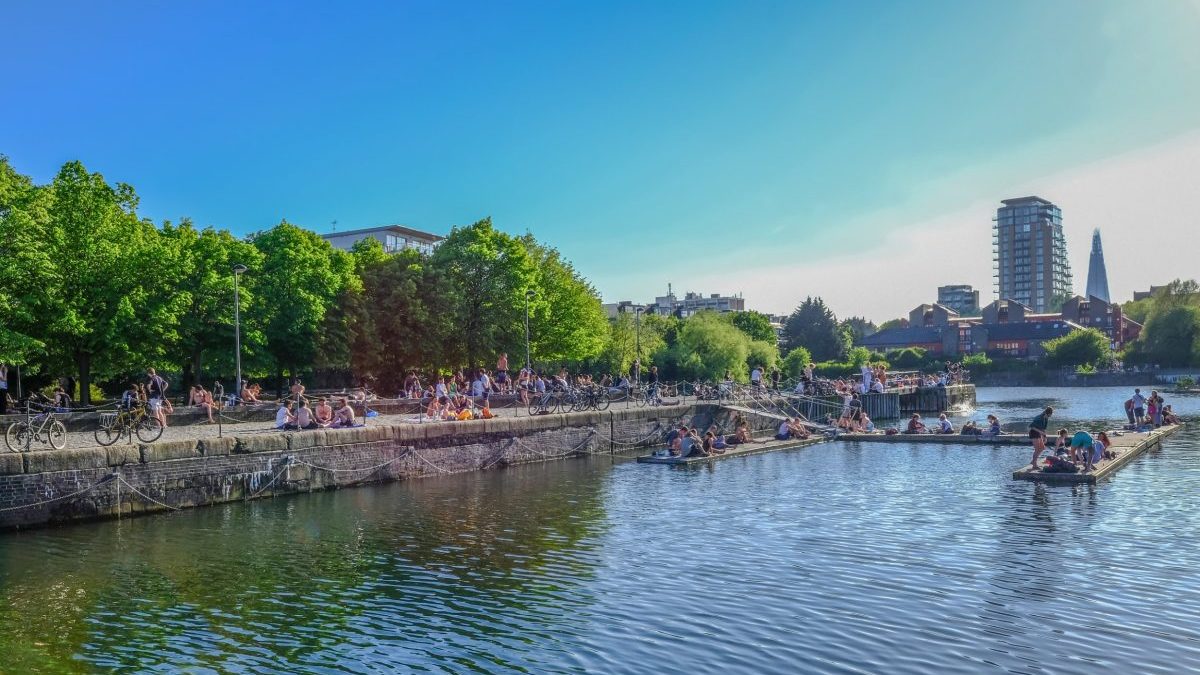
Sadiq Khan has annouced plans to create new wild swim spots across London, following in the footsteps of cities such as Paris and New York
A floating pool in the Thames and a beach in Hackney are just some of the ideas being discussed under plans to make London a “swimmable city”.
Cities across the world, including Paris, New York and Melbourne, are spending millions cleaning up their rivers to make them accessible for swimming.
Mayor of London Sadiq Khan has joined them by signing a commitment to make the UK capital’s rivers “swimmable” within the next decade.
“We have 41 rivers and waterways across the city, all of which are badly polluted and it’s an absolute scandal that we’ve just normalised it and accepted it to be that way,” London Deputy Mayor for Environment and Energy, Mete Coban, told The i Paper.
“Sewage, shipping and safety” are the three main challenges the mayor’s office will have to overcome, according to Chris Romer-Lee, the London-based founder of Swimmable Cities, an alliance of urban areas working towards cleaning up their waterways.
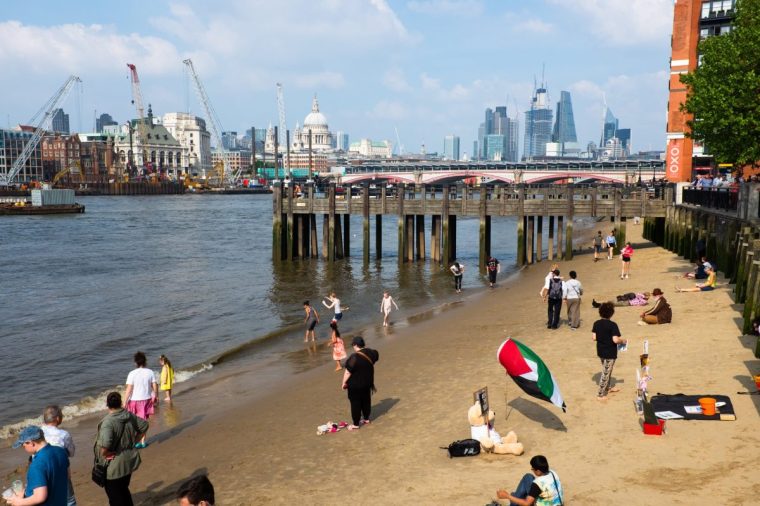 ‘Sewage, shipping and safety’ are the challenges Sadiq Khan will have to overcome to make parts of the Thames swimmable (Photo: lorenzo grifantini/Getty)
Untreated sewage was released by Thames Water into London’s rivers for over 12,000 hours in the year up until March 2024, a City Hall analysis has found.
The Thames is also by far the busiest waterway in the country, handling over half of the UK’s inland freight per year.
How to make London swimmable
There are currently eight spots across London, including Hampstead Ponds and Canary Wharf, where safe open water swimming is possible, according to a map published by City Hall.
Over the next three years, the mayor’s office will select a number of new sites to direct investment towards to ensure there is access to wild swimming in all corners of the city, Coban said.
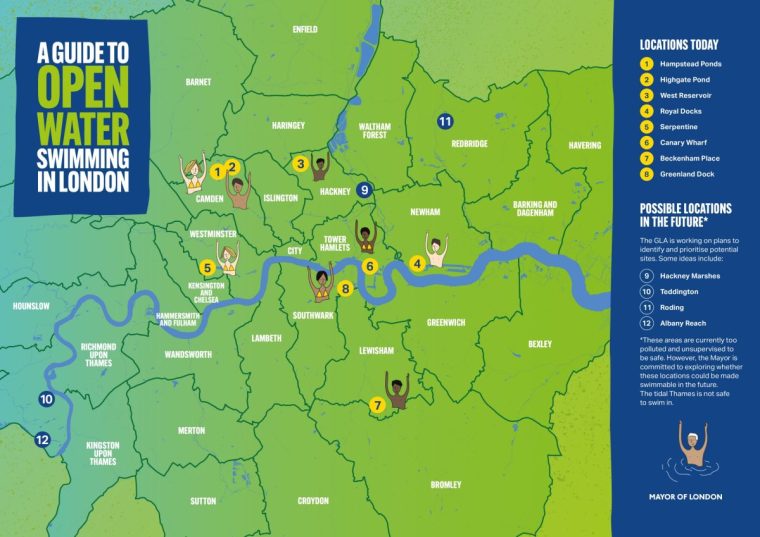 The existing and suggested open swim spots in London (Photo: Greater London Authority)
City Hall has suggested four sites where this could be, including two spots on the River Thames at Teddington and Albany Reach. The two other sites are Hackney Marshes on the River Lea and the River Roding, both in east London.
Community groups are also being asked to come forward with ideas for sites in the city that could be turned into safe outdoor swim spots.
A report by the London Assembly published earlier this year suggested the mayor should set a target of creating 10 new wild swimming spots across London over the next decade.
The Thames has recently undergone a clean-up thanks to the Thames Tideway super sewer that has captured over 12 million tonnes of sewage, or 400 Olympic-sized swimming pools – that would otherwise have been dumped into the river since it opened last year.
But the Thames is still heavily polluted with sewage and chemicals, which flow into the river from over 50 tributaries.
Romer-Lee said the entire Thames does not need to be cleaned up to create safe swimming spots, pointing to the example of Paris, where seasonal bathing areas have been created on the Seine that are tested regularly for pollution.
The Seine is also home to a floating swimming pool, Piscine Joséphine Baker, that sits on a boat in the city’s 13th arrondissement.
Meanwhile, New York is in the process of building a pool that filters river water in Manhattan’s East River.
“I would like to see us swimming in the Thames or on the Thames. I don’t think we are ever going to swim in the central London section of the Thames, it is just too dangerous….but if you put a floating boat in the Thames, which you swim in, such as Paris has, then you overcome that problem,” Romer-Lee said.
How cities across the world are becoming ‘swimmable’
Paris
Ahead of the 2024 Olympics, authorities in Paris spent €1.4bn (£1.2bn) cleaning up the River Seine so it could be used for events including the triathlon.
The investment included major upgrades to the city’s sewerage network, including treatment plant upgrades and a giant rainwater storage basin to reduce the amount of sewage spilling into the river.
People swimming at the open Bassin des Recollets in the Canal Saint-Martin on the Right Bank in Paris, France (Photo: MDoculus/Getty)
The investment has not reduced sewage pollution; the men’s triathlon had to be postponed due to heavy rain, which resulted in high levels of E.coli in the river during the Olympics.
However, the situation has significantly improved, and this summer, three official bathing sites were opened along the Seine. These sites are only open in the summer months and are tested daily, with swimming only allowed on days when the water meets EU regulations.
Rotterdam
A floating park and swim zone opened on Rotterdam’s Rijnhaven, a former shipping port in the heart of the city, in the summer of 2024. It’s open in the summer months and monitored for water quality.
The swim zone is the first stage of a wider plan to build a permanent beach and larger swimming area in Rotterdam.
The world’s first inner-city wave pool has also opened on the Steigersgracht, one of the river Rotte’s medieval canals.
Locals enjoy an early evening at Zwembad Rijnhaven in Rotterdam, Netherlands, on September 7 (Photo: Michael Nguyen/NurPhoto/Getty)
New York
In October this year, authorities in New York adopted new water quality standards as part of an effort to make the city’s rivers safe for swimming.
It follows a significant clean-up effort that has seen sewage spills decrease by 85 per cent since the 1990s.A new initiative +Pool is currently being constructed in the city’s East River that will filter river water to make it safe for swimming.
A smaller test pool is currently in the water, with hopes to install the final 2,000 sq. ft. rectangular version of the pool in May 2026. More testing will take place before it opens to the public.
Concept of +Pool river swim facility planned for New York (Photo:: +Pool)
But cleaning up the Thames remains a massively expensive task that will require pulling levers that are outside of the mayor’s control.
Thames Water plans to invest £1.8bn to clean up London’s rivers over the next five years as part of a wider industry effort, funded by hikes in water bills, to get a grip on the sewage crisis plaguing Britain’s waterways.
On top of this, City Hall and Transport for London have announced £7.15m in funding to reduce the impact of road run-off on rivers, while the mayor also has a £12m Green Roots Fund for new green and blue spaces.
Together, this amount is more than the reported €1.4bn (£1.2bn) spent by authorities in Paris to clean up the Seine ahead of the 2024 Paris Olympics, but this clean-up was far from perfect, as evidenced when the men’s triathlon was postponed due to high E.coli levels in the river.
Coban acknowledges the mayor has limited powers to clean up London’s rivers, but believes Khan has the ability to push for significant changes, equating it to Khan’s mission to improve London’s air quality.
Annual concentrations of roadside nitrogen dioxide almost halved in London between 2016 and 2023 and met UK legal limits for the first time last year, with City Hall policies, including the Ultra Low Emission Zone, given significant credit.
It’s currently unclear what policies the mayor could introduce to recreate this success with London’s waterways, beyond the investments from Thames Water that have been mandated at a national level. A policy paper will be published in the new year, according to Coban.
To Coban, the mayor’s new mission is as much as a social one as it is environmental.
“I can’t swim. There are many Londoners of a similar background to me who can’t swim and that’s not a coincidence,” he said, adding that their plan will focus around providing “access” to “blue spaces”.
“It’s about the type of city we want to live in.”