NASA’s MAVEN spacecraft is continuing to evade attempts by engineers to make contact as the solar conjunction nears, halting contact with any Mars missions until January 16, 2026.
The agency last heard from the MAVEN (Mars Atmosphere and Volatile EvolutioN) orbiter on December 6, and the last fragment of tracking data recovered by engineers indicated that the probe was tumbling and that its orbit trajectory might have changed.
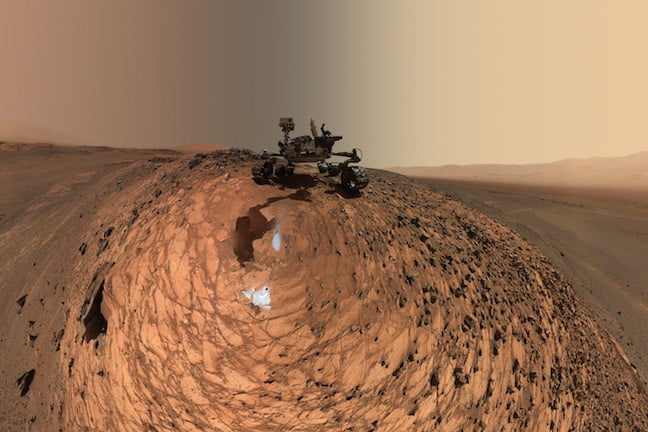
The latter point is highly significant – if any engineers can’t work out where the spacecraft is, contacting it is highly challenging, either from Earth or using one of the other Mars orbiters or rovers. According to NASA, on December 16 and 20, the Curiosity trundlebot team used the rover’s Mastcam instrument in an attempt to image MAVEN’s reference orbit, but the spacecraft was not detected.
The problem now is that the solar conjunction is approaching. The Mars solar conjunction occurs when Mars and Earth are on opposite sides of the Sun. This means that from Monday, December 29, until Friday, January 16, NASA will not have contact with any Mars missions and won’t be able to fire commands at MAVEN in the hope of getting a response from the stricken spacecraft.
Once the solar conjunction window is over, NASA will resume attempts to reestablish communications with the orbiter.
What happened to the orbiter remains unclear. A spacecraft upset usually triggers safe mode, in which the probe detects an issue, shuts down all non-essential systems, and awaits instructions. NASA, however, has not confirmed that the probe has entered this mode. A space industry insider told The Register “If it were [in safe mode] they [NASA] would be more successful in communicating with it.
“So whatever has happened, it hasn’t been able to reach safe mode.”
There are plenty of reasons why this might be. The unexpected rotation of the probe indicates that some energetic event happened. If the orbit has indeed changed, then the problem could lie somewhere in the Guidance, Navigation, and Control systems of the spacecraft. Perhaps some unbalanced thrust or an issue with the spacecraft’s attitude measurements.
In 2022, MAVEN had a brush with mission termination after problems with its Inertial Measurement Units (IMUs), used for navigation, which led to a lengthy stint in safe mode. In that instance, the spacecraft switched to a backup system while controllers worked to resolve the issue.
MAVEN is well into its extended mission and, while it has not endured as long in orbit as either NASA’s Mars Odyssey probe or the European Space Agency’s Mars Express, it has been circling the red planet since September 2014.
The probe’s orbit will, in the absence of thruster firings, eventually deteriorate, and the spacecraft will burn up in Mars’ atmosphere. Some components are expected to survive all the way to the surface. ®