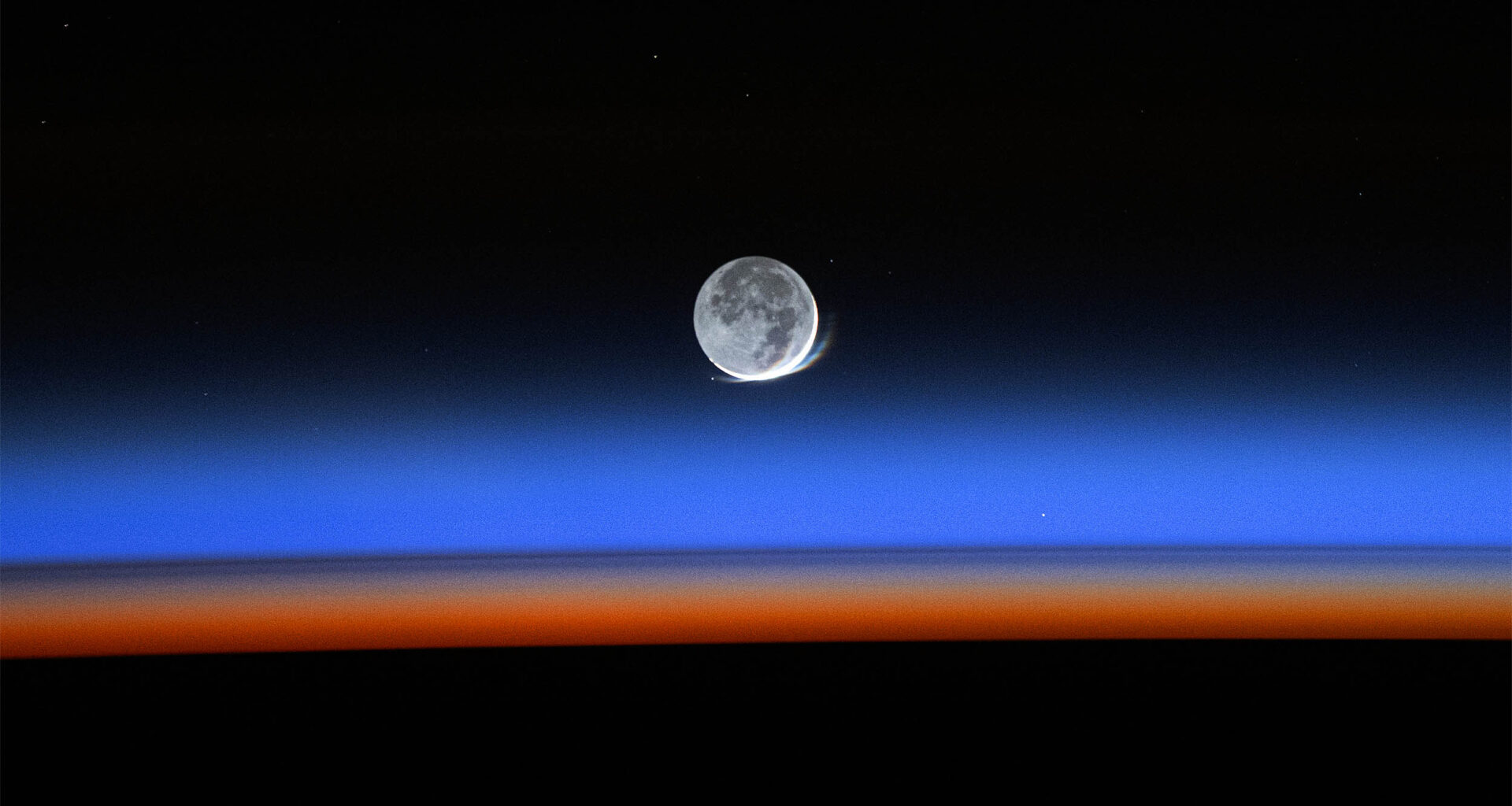
An astronaut circling above the Indian Ocean onboard the ISS captured a stunning image of the moon and what is called a “lunar halo.”
The slim arc of light cradling the Moon looks detached from Earth, hovering just above the planet’s blue edge, a sight made possible by the station’s vantage point far above the weather.

It is not magic, but simply optics sculpted by air and ice where the atmosphere thins dramatically. From that altitude, the Moon sat behind the atmosphere along the astronaut’s line of sight, and the arc revealed how moonlight bends and fans through tiny crystals.
Spotting a lunar halo
The work was led by the ISS Crew Earth Observations Facility at NASA’s Johnson Space Center. The program focuses on astronaut photography that documents Earth’s atmosphere, land, water, and light for science and the public.
From low Earth orbit, the station loops the planet a touch above 200 nautical miles, clearing nearly all clouds below.
That geometry occasionally places the Moon behind the atmosphere, turning the air into a lens that reshapes its glow for the camera.
The horizon stacks into layers: the troposphere glowing orange, the stratosphere pale white, and the upper layer deep blue.
The mesosphere, a frigid region 30 to 54 miles high where temperatures plunge, sometimes hosts the rare ice that completes this optical puzzle.
How a lunar halo forms
When moonlight crosses ice crystals, light changes direction inside those crystals and separates slightly by color, producing arcs and rings.
A halo is a ring or light that forms around the sun or moon as the sun or moon light refracts off ice crystals present in a thin veil of cirrus clouds.
The standard definition catalogs the familiar ring spanning about 22 degrees from the Moon, with a darker sky inside the circle.
The refraction, or bending of light as it crosses from one medium into another, fixes that characteristic radius for ordinary crystal shapes.
The astronaut’s photograph shows only an arc because the ice-bearing layer did not fully encircle the Moon from that line of sight.
Subtle shifts in crystal orientation at grazing angles can trim the circle into a bright, delicate curve. Crystal geometry matters enormously, since hexagonal plates and columns deflect light in different ways.
In thin high clouds, even slight tilts change where the arc sharpens or fades, which matches the partial halo recorded above the dark limb.
Ice this high is rare
Water vapor can drift upward, meet dust, and freeze into microscopic ice well above ordinary clouds.
Recent research describes how these high ice layers, the highest in Earth’s atmosphere, thrive in the coldest summer regions near 50 miles.
Their altitude makes them exquisitely sensitive to small temperature wiggles and vertical motions.
The gravity waves, upward traveling ripples in air density from storms and terrain, can seed fine structure that appears and vanishes as orbit tracks shift.
Years of satellite observations have revealed changing behavior in these night-shining formations and their tight coupling to the lower atmosphere.
The findings have altered our previous understanding of why PMCs form and vary according to Dr. James Russell III, principal investigator of NASA’s AIM mission at Hampton University.
That context helps explain why the halo sat near the top of the blue layer rather than inside common lower clouds.
The ice was not typical cirrostratus; it likely resided where cold and chemistry allow only the thinnest veils to survive.
Why the Moon looked full
During the pass, the Moon was a waxing crescent, but the camera’s exposure brightened the entire disk and smeared highlights along its edge.
The result makes a sliver appear rounded, while the hard bright crescent still marks the sunlit limb with clinical clarity.
Longer exposures also amplify the faint glow from Earth-lit terrain on the lunar night side. That glow, called Earthshine, softens the disk and deepens the impression of a fuller phase.
Lessons from this lunar halo
Photographs from Earth orbit capture momentary alignments that automated sensors often miss, and they carry the context of a human vantage point.
Each frame can connect textbook physics to real skies, turning an arc of light into evidence of ice and motion in the thin air.
This image reads like a field note from the edge of space, where optics meets weather and chemistry.
A partial lunar halo hanging above the limb lets us watch physics work at planetary scale without leaving the comfort of a 200-mile-high perch.
—–
Like what you read? Subscribe to our newsletter for engaging articles, exclusive content, and the latest updates.
Check us out on EarthSnap, a free app brought to you by Eric Ralls and Earth.com.
—–