
In a remarkable breakthrough, astronomers have uncovered the first known triple system where three galaxies, each harboring an active, radio-bright supermassive black hole, are caught in the midst of a merger. This rare cosmic configuration provides a unique opportunity to study the complex interaction between these black holes and their host galaxies. Published in The Astrophysical Journal Letters, this discovery adds a new chapter to our understanding of galaxy evolution and the dynamics of supermassive black holes.
The Discovery of a Rare Triple Black Hole System
Astronomers have recently confirmed the existence of an exceptionally rare system: a trio of actively feeding supermassive black holes within three galaxies that are merging. This triple system, observed through powerful radio emissions, marks a significant milestone in the study of galaxy mergers and the cosmic role of black holes. The discovery is not just an astronomical curiosity; it sheds light on the intricate relationships between galaxies and their supermassive black holes during one of the most dramatic events in cosmic evolution: a galaxy merger.
Mergers between galaxies are thought to be a critical phase in the life of galaxies, where gravitational interactions can trigger star formation, disrupt galactic structures, and potentially lead to the fueling of their central black holes. In this newly discovered system, however, the merger involves not just one, but three actively feeding black holes. Each of these black holes is emitting powerful radio signals, an indication that they are actively consuming surrounding matter and launching energetic jets into space.
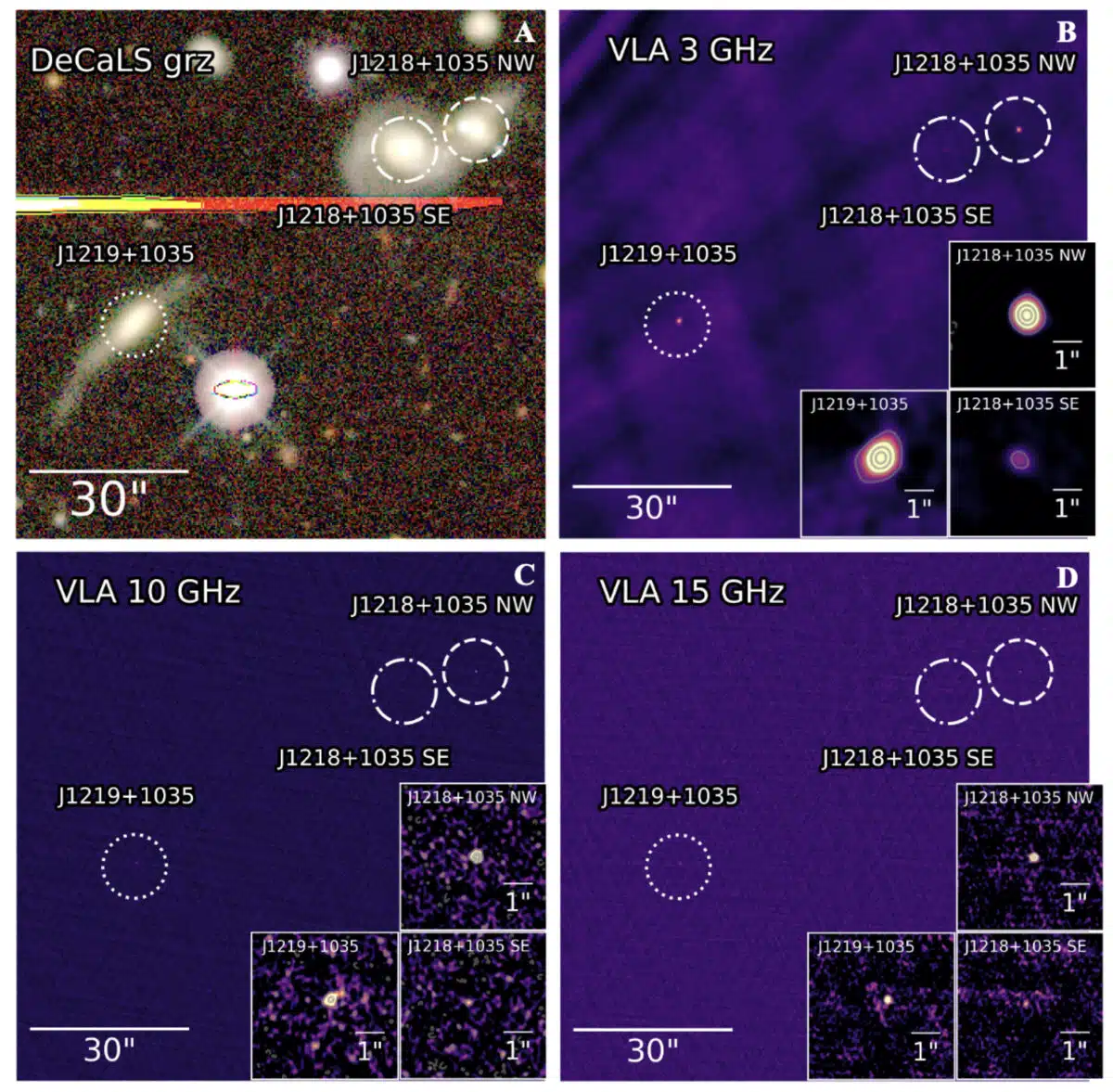 Optical DeCaLS grz images and radio VLA images of J1218/J1219+1035. Credit: The Astrophysical Journal Letters (2025). DOI: 10.3847/2041-8213/ae2002
The Significance of Triple Active Galaxies
“Triple active galaxies like this are incredibly rare, and catching one in the middle of a merger gives us a front-row seat to how massive galaxies and their black holes grow together,” said Dr. Emma Schwartzman of the U.S. Naval Research Laboratory, who led the study. The discovery of this trio of supermassive black holes actively feeding and interacting with their surrounding galaxies provides a crucial look at the evolutionary process of galaxies that would be impossible to study without such an extraordinary event.
The rarity of this type of system makes it a valuable target for astronomers. Most known supermassive black hole systems involve either a single black hole or pairs of black holes, typically found in the process of merging or interacting with their galaxy’s center. However, a triple system presents a completely new dynamic for researchers to analyze. These observations allow scientists to study the forces and interactions that govern galaxy mergers and black hole growth on a much larger scale than previously imagined.
Observing Radio Emissions from Supermassive Black Holes
One of the standout features of this discovery is the fact that all three supermassive black holes in the system are emitting strong radio waves. This type of emission is characteristic of active galactic nuclei (AGN), where the black hole at the center of a galaxy pulls in vast amounts of gas and dust. As this material spirals toward the black hole, it heats up and emits radiation across the electromagnetic spectrum, including in the radio wavelengths.
By observing that all three black holes in this system are “radio-bright” and actively launching jets, scientists have effectively moved the concept of triple radio AGN from theoretical models to reality. The discovery opens a new window into understanding the life cycle of supermassive black holes. As Dr. Schwartzman points out,
“By observing that all three black holes in this system are radio-bright and actively launching jets, we’ve moved triple radio AGN from theory into reality and opened a new window into the life cycle of supermassive black holes.”
This phenomenon of three actively emitting supermassive black holes is not only rare but also incredibly informative. It allows astronomers to examine the processes that lead to the formation of massive black holes and how they interact with the surrounding galaxy. The study published in The Astrophysical Journal Letters marks a turning point in how scientists observe and understand the birth and evolution of supermassive black holes.
The Role of Merging Galaxies in Black Hole Growth
Galaxy mergers are fundamental to the understanding of how galaxies evolve. When two or more galaxies collide, their central supermassive black holes are often drawn toward each other by gravitational forces. This process can lead to the eventual coalescence of the black holes into a single, even more massive black hole. However, in this rare case, the merger involves three black holes—each feeding off its own galactic core. This unusual configuration presents a unique opportunity to study how black holes of this size interact in a dynamic, high-energy environment.
The discovery highlights the importance of studying such mergers, as they provide a glimpse into the future of our own Milky Way. Our galaxy is expected to collide with the Andromeda galaxy in about 4.5 billion years, possibly resulting in the formation of a larger, more massive black hole. Understanding the behaviors of black holes in these mergers is essential for predicting the eventual fate of our galaxy.