
For years, we’ve believed that the universe is a vast, uniform expanse, with the same properties stretching across the cosmos. But what if that’s not the case? A surprising new discovery suggests that the universe may not be as symmetrical as we once thought, hinting at a potential cosmic anomaly that could reshape our understanding of space itself. This revelation is challenging everything we know about the universe, prompting scientists to rethink its very structure. The findings were published in Reviews of Modern Physics.
A New Era in Cosmology: The Lopsided Universe
The study, featured in Reviews of Modern Physics, has revealed that our universe may exhibit an unexpected asymmetry. For decades, scientists have operated under the assumption that the universe is essentially uniform, with the same properties and characteristics throughout. However, recent observations of the cosmic microwave background (CMB) radiation, the faint afterglow of the Big Bang, have suggested something different. These findings challenge the principle of isotropy, which holds that the universe looks the same from all directions. The “Cosmic Dipole Anomaly” introduces the possibility that our universe may be lopsided, a discovery that could change everything we know about the cosmos.
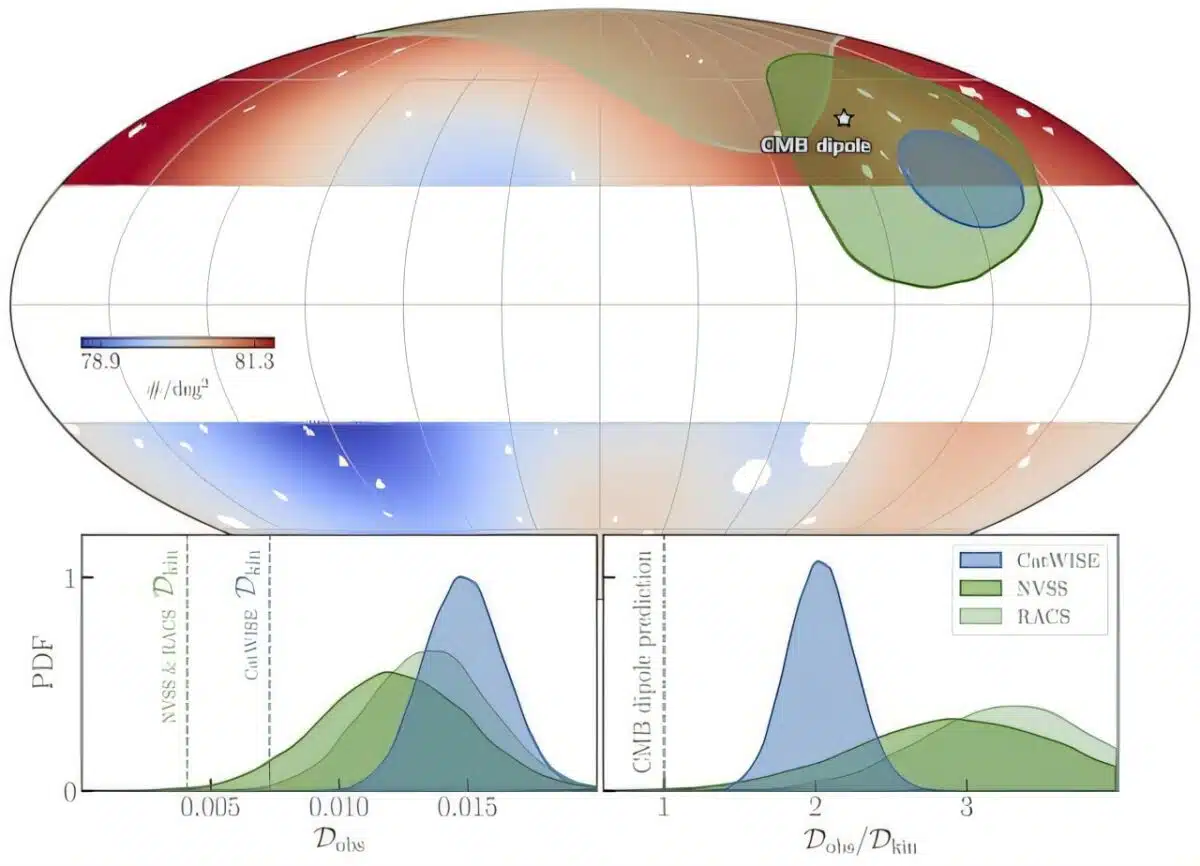 The matter and CMB dipoles do not match up – the directions are consistent (top panel) but the amplitudes are not (bottom panel). Credit: Secrest et al., Reviews of Modern Physics 97 (2025) 041001
The anomaly was first detected through measurements of the CMB, where slight differences in temperature were observed. These irregularities, albeit small, appear to correlate with the motion of our solar system relative to the rest of the universe. This suggests that our galaxy may be moving through a “preferred” direction in space, which is unlike anything predicted by current cosmological models. The discovery is both exciting and perplexing, as it opens up new questions about the fundamental nature of the universe.
The Cosmic Microwave Background: A Window into the Early Universe
The Cosmic Microwave Background (CMB) is often referred to as the “fossil radiation” of the universe, providing a snapshot of the universe’s conditions just 380,000 years after the Big Bang. For over 50 years, the CMB has been one of the primary tools used by cosmologists to understand the universe’s origins, evolution, and large-scale structure. The radiation is remarkably uniform, with only minor fluctuations in temperature, which scientists have used to infer the distribution of matter in the early universe.
However, the “Cosmic Dipole Anomaly” has revealed that these fluctuations are not perfectly symmetrical. The temperature variations appear to be biased in one particular direction, suggesting that the universe might not be isotropic on the largest scales. This could imply that some unknown factor is influencing the distribution of matter, or perhaps, the properties of space itself.
The Implications of a Lopsided Universe
If the “Cosmic Dipole Anomaly” is confirmed, it would have profound implications for our understanding of the universe. One possibility is that the large-scale structure of the cosmos is not uniform, but rather exhibits a preferred orientation. This could reshape our models of cosmic inflation, the rapid expansion that occurred shortly after the Big Bang, which is thought to have set the stage for the universe’s large-scale structure.
A lopsided universe also raises questions about dark energy and dark matter, two of the most mysterious components of the universe. Dark energy, which is believed to be responsible for the accelerated expansion of the universe, might interact with the universe in a way that causes these asymmetries. Alternatively, dark matter, the unseen substance that makes up much of the universe’s mass, could be distributed unevenly across space, influencing the CMB in unexpected ways.
Challenging the Standard Model: Could New Physics Be at Play?
The discovery of a potential cosmic asymmetry raises the tantalizing possibility that new physics may be involved. For decades, the Lambda Cold Dark Matter (ΛCDM) model has been the standard framework for cosmology, explaining the formation and evolution of the universe. This model assumes that the universe is isotropic and homogeneous on the largest scales. However, the “Cosmic Dipole Anomaly” challenges this assumption, suggesting that our current understanding of cosmology might be incomplete.
Could there be a new, undiscovered force or particle affecting the fabric of space? Perhaps there is something about the universe’s early conditions that we still don’t fully grasp. Some scientists speculate that the anomaly could point to interactions between dark matter and ordinary matter that have yet to be observed. Others wonder if it could signal the existence of extra dimensions or other phenomena that haven’t yet been incorporated into the standard model.
Reexamining the Universe’s Origins: A New Perspective on the Big Bang
One of the most profound implications of the “Cosmic Dipole Anomaly” is its potential to reshape our understanding of the Big Bang. For years, the theory of the Big Bang has been central to our understanding of the universe’s origin. However, if the universe is lopsided, this could suggest that the Big Bang was not a singular, uniform event, but rather a more complex process with inherent asymmetries.
This new perspective might require cosmologists to revise their models of early universe conditions. For instance, the distribution of matter in the primordial universe could have been uneven from the start, leading to the formation of large-scale cosmic structures in a non-uniform pattern. If this is the case, our understanding of cosmic inflation, the period of rapid expansion in the moments after the Big Bang, would need to be reconsidered