
- English News
- Originals
- Akash NG Explained: India’s Indigenous Missile System, Pakistan Threats & Surprise Attacks
2 hours agoAuthor: Anjali Rajgovind

When news breaks about India testing a new air defence missile, it often sounds technical and distant. But systems like Akash-NG directly affect everyday security, especially when tensions rise on the western border.
From fighter jets to missiles and drones, the threats in modern warfare come fast and low, leaving little time to react. That is where air defence becomes critical.
Recently, the successful trials of Akash-NG have raised many questions among ordinary Indians. How effective is it? Can it protect border cities? And does it really strengthen India’s hand against Pakistan?
To find clear, simple answers, we spoke to Lt Col JS Sodhi (Retd), who explained what all this system can do.
What exactly is Akash-NG? How far can its range span?
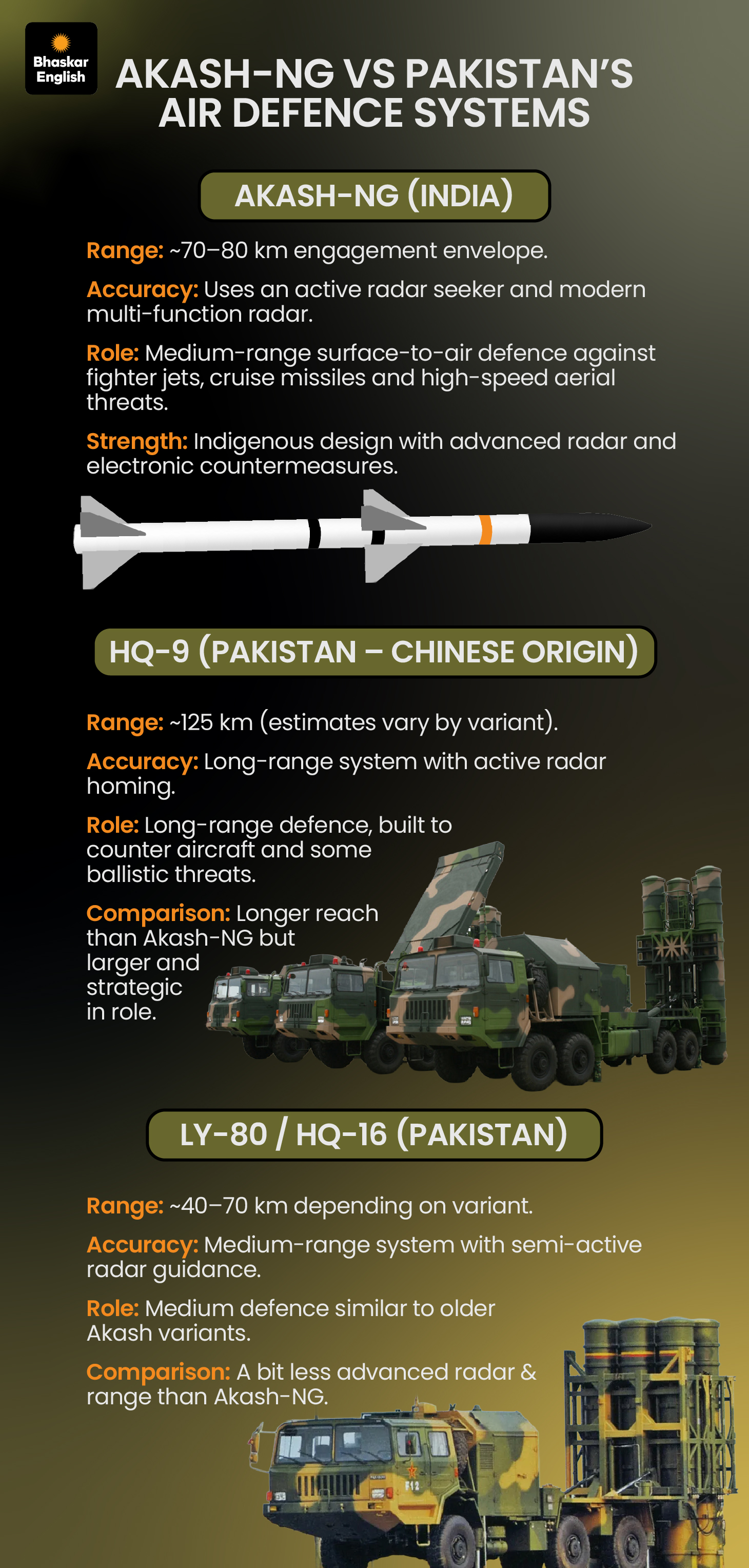
- Akash-NG is India’s latest surface-to-air missile (SAM) designed to protect the skies from hostile aerial threats.
- It is part of the Akash missile family developed by the Defence Research and Development Organisation (DRDO) and built largely under India’s ‘Make in India’ initiative.
- According to reports, Akash-NG’s interception range is significantly improved over earlier versions.
- Officially it is said to be capable of engaging targets at around 70-80 km, compared with about 30 km for the older Akash systems.
- It uses a dual-pulse solid rocket motor, an active radar seeker and advanced radars and command systems to locate, track and destroy aerial threats in all-weather conditions.
- The system is mobile and can be moved quickly into position.
Can Akash-NG realistically stop missiles or fighter jets launched from Pakistan before they enter Indian airspace?
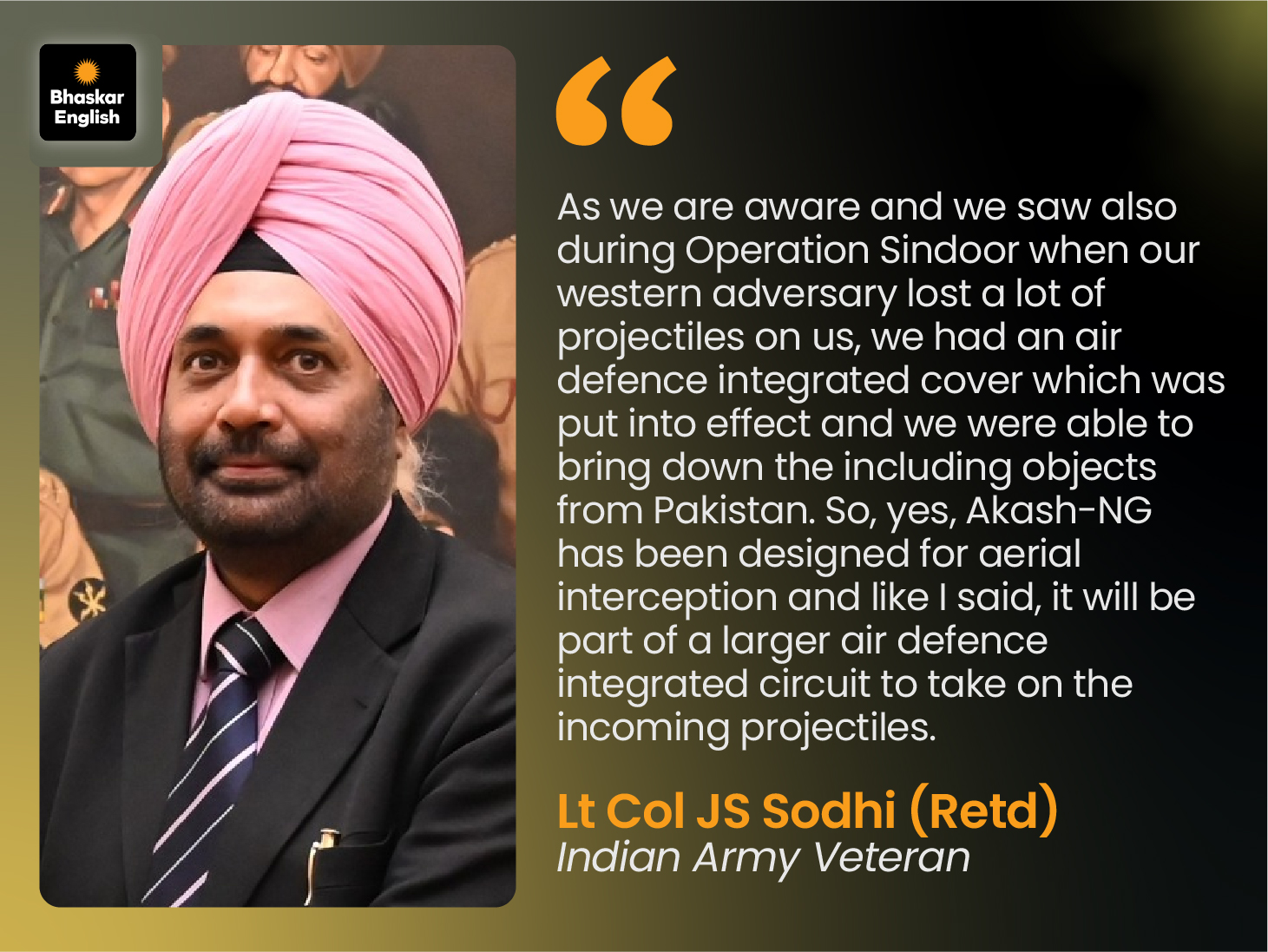
According to Lt Col Sodhi, Akash-NG is designed for aerial interception and forms part of India’s larger integrated air defence network.
- He emphasises that it is one element in a broader cover that includes other systems working together.
- In real scenarios, Indian air defence has a record of intercepting incoming projectiles from the west.
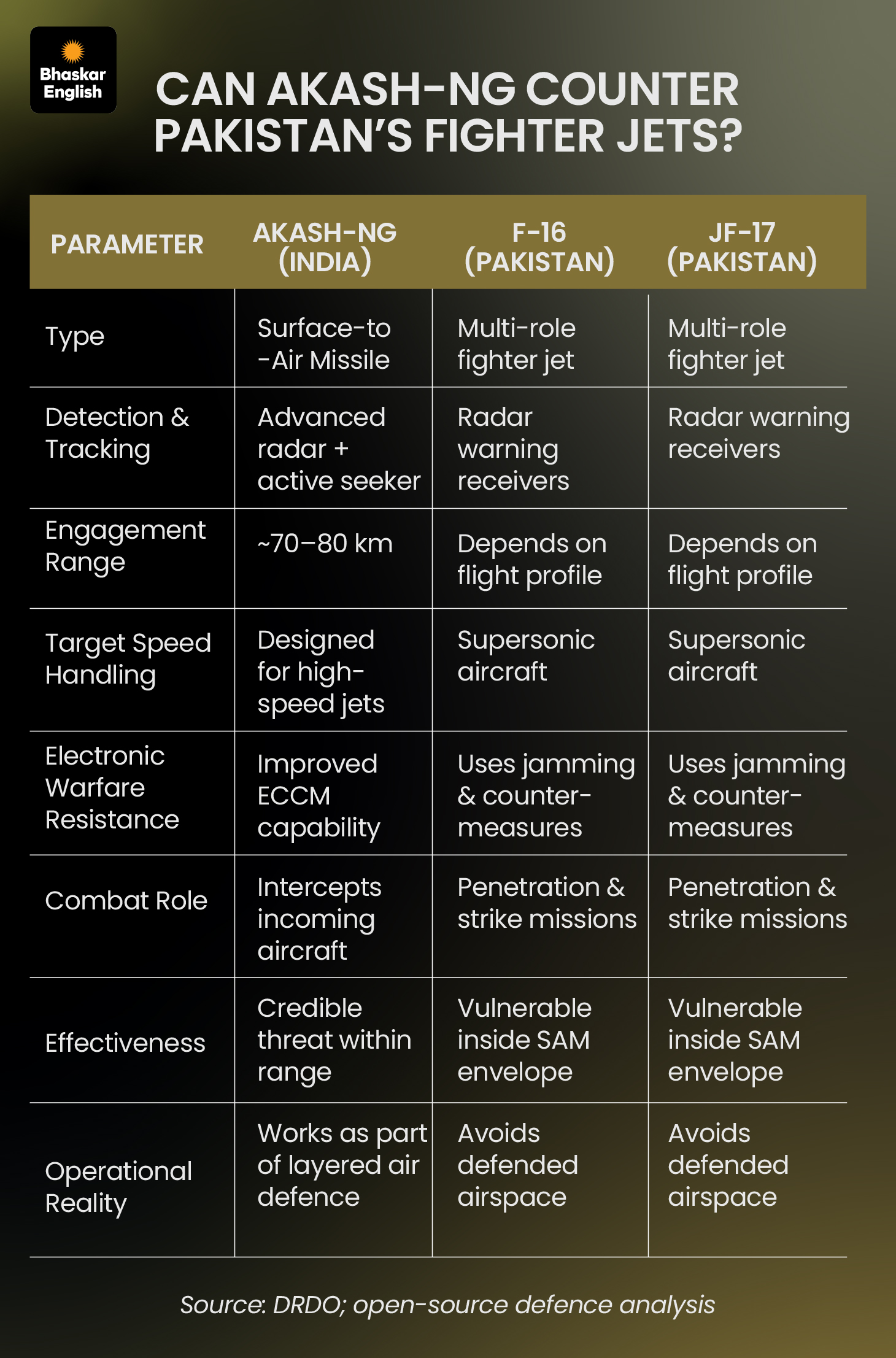
- The improved range and precision of Akash-NG mean it can engage high-speed targets like fighter jets or cruise missiles before they penetrate deeply into Indian airspace.
That said, successful interception also depends on early detection, tracking and coordination with radar and command systems, not just the missile itself.
The whole network needs to operate in harmony to ensure airspace security.
If tensions rise, can Akash-NG protect Indian cities near the western border, like Amritsar or Jaisalmer?
- Lt Col Sodhi makes it clear that Akash-NG is part of a layered, nationwide air defence system rather than a single stand-alone shield.
- It can contribute to protection of western border areas, including cities like Amritsar or Jaisalmer, by intercepting hostile aerial threats at medium ranges.
In practice, these systems are positioned based on strategic need and can be relocated as required.
- They work with other radars and weapon systems to create a layered defence, so when tensions rise, the integrated network would try to cover critical cities and military assets.
- No single battery can guarantee full protection, but as part of the network, Akash-NG enhances overall coverage and response against aircraft or missiles approaching from Pakistan.
Is this missile system capable of intercepting Pakistani drones, cruise missiles or low-flying aircraft used in surprise attacks?
Lt Col Sodhi explains that technically Akash-NG can intercept a wide range of aerial objects, including drones and low-flying craft.
However, he also notes that the cost per missile is high, so in practice the system will be prioritised for larger, high-signature threats such as fighter aircraft or bigger cruise missiles.
- For small drones or very low-signature targets, other dedicated lower-cost defence systems (like short-range guns or specialised anti-drone systems) may be more appropriate.
- That said, Akash-NG’s advanced radars and seekers do give it the capability to detect and engage these threats if needed, especially in a high-intensity scenario.
How fast can Akash-NG respond if Pakistan launches a sudden aerial strike?
According to Lt Col Sodhi, India’s air defence network is always on active alert, even in peacetime.
- The moment a foreign object is detected approaching Indian airspace, countermeasures are activated within seconds.
- Akash-NG itself has been reported to have a quick reaction time: it can fire one missile within about 10 seconds of target acquisition, and launch a salvo of three in about 20 seconds.
- This rapid response capability means it can react swiftly to sudden aerial threats such as a surprise strike from Pakistan.
- In combination with radar and command systems, this immediate readiness helps India respond effectively to fast-moving threats.

Does Akash-NG reduce India’s dependence on foreign air defence systems in case of conflict with Pakistan?
Lt Col Sodhi emphasises that Akash-NG is largely indigenously designed and manufactured, with very few foreign components.
- He says this is a strong point for India’s ‘Make in India’ strategy, reducing reliance on foreign-made systems like Russia’s S-400.
- By producing advanced air defence missiles domestically, India gains greater strategic autonomy and easier logistics, especially in prolonged conflicts.
- Although India will still operate a mix of systems, including some imported ones for layered defence, Akash-NG strengthens India’s self-sufficiency and decreases dependency on defence imports.
- Overall, it adds confidence and capability to India’s indigenous defence infrastructure.
Can this system be deployed close to the Line of Control (LoC), or is it meant mainly for deep-area defence?
Lt Col Sodhi explains that Akash-NG and other air defence assets are dispersed across the country and integrated into a nationwide network, rather than being fixed at one spot.
This means they can be positioned nearer the Line of Control if needed, but deployment decisions are based on the overall defence plan, not just one system’s capability.
- Akash-NG is mobile and can be moved to areas of heightened risk, but it normally functions as part of a layered air defence belt that includes systems at various ranges and altitudes.
- Its strength lies in integration with early-warning radars and command control, whether deployed near the LoC or deeper in strategic areas.
How many incoming targets can one Akash-NG unit handle at the same time during a large-scale attack?
Akash-NG is designed with multi-target capability.
- According to available information, each unit can track and engage up to ten targets simultaneously.
- This means it can respond to multiple threats in a saturating aerial attack, such as several aircraft or missiles approaching at once.
- This capability is crucial in large-scale conflicts, where a single incoming enemy strike may involve dozens of threats.
Of course, effective engagement also depends on linked radar systems, command control and other elements of the integrated air defence network.
But the ten-target engagement capability makes Akash-NG a robust layer in India’s layered air defence shield.
Does the induction of Akash-NG change the military balance between India and Pakistan in the air domain?
Lt Col Sodhi states that India already maintains military superiority over Pakistan, having prevailed in conflicts since 1947, and that Akash-NG adds further strength to India’s defence.

- While no single system can entirely change a strategic balance, the addition of a capable, modern medium-range air defence missile does enhance deterrence.
- It tightens India’s air defence envelope and complicates planning for any adversary’s air operations.
- Against Pakistan’s air assets, it adds another layer that threats must penetrate.
- Combined with other systems and early warning networks, Akash-NG makes India’s airspace more difficult to challenge, reinforcing the existing advantage.
Graphics by Anas Shakir