For years, the dream of a fully secure quantum Internet has been held back by a single, stubborn obstacle: repeaters. Whenever quantum networks needed them, scientists had to fall back on traditional models — a compromise that opened the door to potential security flaws. But now, researchers have finally filled in the missing piece of the puzzle, bringing the first true quantum relays within reach.
Unlike traditional data systems, quantum communication relies entirely on light. Instead of sending electrical signals, it uses pairs of entangled photons to create an unbreakable secret key between sender and receiver. Theoretically, this makes eavesdropping impossible — any attempt to intercept the signal would immediately destroy it.
Quantum teleportation: the foundation of a true quantum Internet
Even with its promise of speed and security, quantum communication hasn’t yet reached everyday use. The main challenge lies in preserving quantum information. Only a handful of photons can travel together, and their light signal fades quickly over long distances.
In classical fiber networks, repeaters can boost the signal — but in quantum systems, photons can’t be copied, cloned, or amplified without being destroyed.
That’s where quantum teleportation comes in. Instead of amplifying a photon, scientists can transfer its state — the information it carries — to another photon without ever touching the original. And a team of researchers has now taken this concept a giant step forward.
Until recently, teleportation experiments only worked between photons generated by the same source. That restriction made it impossible to link multiple network nodes and build large-scale systems. But now, for the first time, researchers have successfully teleported the polarization state of a single photon emitted from one quantum dot to another photon created in a separate quantum dot — located 270 meters away in a different building on the same campus.
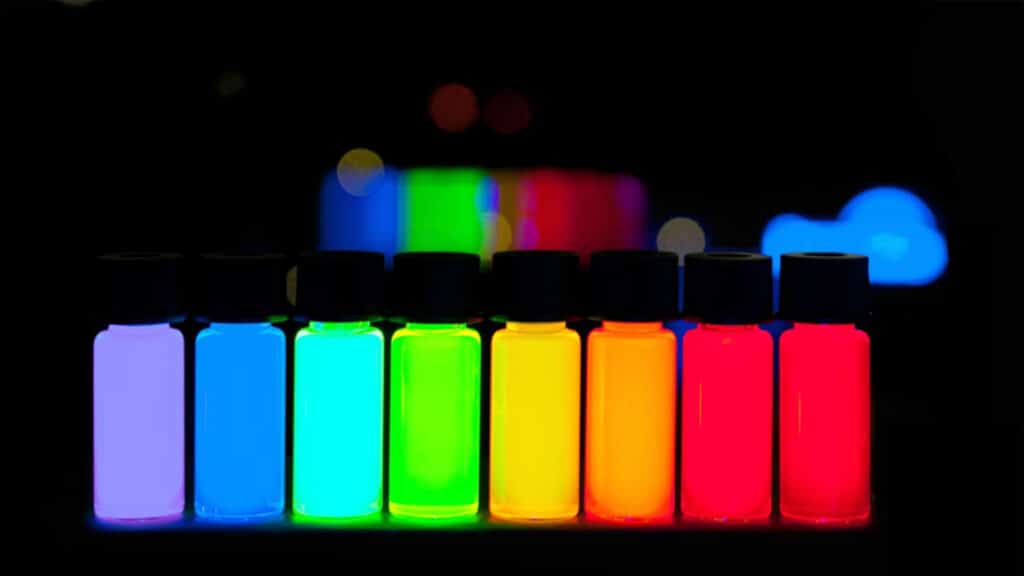
A quantum dot is a semiconductor crystalline structure containing a few hundred atoms, which can serve as a photon source. © Antipoff
Two sources, one shared state
Here’s how they did it. The team used three photons. Two of them, produced by one quantum dot, were entangled. The third photon — from a completely different source — carried the quantum information meant for teleportation.
This lone photon was then sent to interact with one of the entangled photons through a semi-reflective mirror. After their interference, the two became indistinguishable (though not entangled themselves). Measuring their shared polarization allowed the information to jump — or “teleport” — to the remaining entangled photon hundreds of meters away.
“Successfully teleporting quantum information between two different emitters is a critical milestone,” said Professor Jöns, co-author of the study. “It brings us much closer to creating reliable quantum relays and, eventually, a functioning quantum Internet.”
In the near future, these intermediate nodes could link photons across vast distances. A locally generated photon could connect with an incoming one, transferring the quantum state without loss. The result: a quantum network capable of moving information securely across the globe — one teleportation at a time.

Alicia Aloisi
Journalist
From Research to Journalism: An Assumed Transition
What if it all started there? With an argument with my PhD supervisor. I had one request: “I want to write my scientific publication.” But his answer wasn’t what I expected: “A PhD student’s place is in the lab, not at a desk.” After several attempts on my part, he finally gave in. And me… nothing. Blank page. Three painfully written sentences to describe part of my experiments.
Yet, a seed was planted. I wanted to write. And as luck would have it, the last months of a PhD are all about writing a manuscript. A nightmare for some, a pleasure for others. One hundred and fifty pages later, I decided to make it my career. I realized it wasn’t so much about actively participating in new discoveries that interested me, but rather about sharing scientific and technological advances. My path took me further north, to Lille, its journalism school, and its specialty: science journalism. For a year, I learned, and from then on, the white void of a Word document no longer scared me.
Ecology and Environment
Now, writing, yes — but for whom and about what? The subject of my PhD was no small matter: the valorization of CO₂ and hydrogen. Energy and environmental topics have always had a strong appeal for me. And they often reappear in my freelance work.
But not only that… Writing for Phosphore, a magazine aimed at high school students, I sought to make science approachable for a non-specialist audience and covered much broader topics. After a few years as a freelancer, I landed a position at the professional magazine Electroniques, where I took charge of the “Applications” section.
Needless to say, the topics were varied — electronics have become omnipresent around us: aviation, cars (especially electric ones), computers, mobile phones, solar energy, connected health. Day after day, I followed the latest developments in these sectors, with a particular focus on innovations: hydrogen planes, bidirectional charging, e-waste recycling, reconfigurable smart surfaces to democratize faster 5G.
Quantum: Computing and Sensors
At Electroniques, I also ventured into a new field that quickly became a passion: quantum. The infinitely small, which seems so strange to us, is now on the verge of revolutionizing high-performance computing. The race between qubit technologies fascinates me. Will they coexist? Will one prevail? Will France manage to turn its advantage into reality?
But the quantum world is not limited to computing… Innovative sensors also promise major breakthroughs in health, defense, and navigation. But I won’t spoil it all for you. Read my articles to find out more.
New Horizons
And then one day, somewhere between a Christmas tree, a warm glass of milk, and a roasted capon, a new urge arose. A few months later, I returned to freelancing, once again exploring energy and environmental topics while keeping a foot in quantum and industrial innovations.
The goal now is no longer just to address professionals but to reconnect with a broader audience. To make complex subjects accessible while maintaining rigor and accuracy. To understand in order to make others understand.