
Britain can prosper again if it returns to being a nation of doers — that’s the argument I made in my Christmas guest edit of Today on Radio 4.
Having highlighted many doers, from dementia researchers to school teachers, I’ve come away more convinced that we should reject what the doomsayers say about Britain. Our decline isn’t inevitable, nor beyond our control. There is so much raw potential in our country that can be realised — if only we embrace aspiration and inventiveness.
Napoleon once dismissed Britain as a “nation of shopkeepers”. These days we might better be described as a “nation of family businesses”, since they employ more than half of private sector workers and account for nine in ten private businesses.
As I told Nick Robinson, my fear is that British family businesses will be wiped out in a generation. The brutally destructive taxes imposed on them — still hitting the vast majority despite the latest meaningless U-turn — spell disaster for the economy. The policymakers responsible haven’t appreciated how ruinous their approach is — nor how much investment it is snuffing out.
Amid the focus on inheritance taxes on farms and the government’s reversal, this point has been lost: the tax looms over all other British family businesses, the employers of most private sector workers. They will be forced to sell so they can pay the taxman. In this scenario, why would anyone risk everything to start a business? Entrepreneurship killed at a stroke.

James Dyson on the Today programme
ROLAND WATSON FOR THE TIMES
As much as I am an optimist who believes that if we back the doers they will create the wealth that will benefit all of us, I am also aware that if government policy is used to knock back the doers and attack wealth creators, the doers do not stand a chance.
When countries become wealthy, they often forget what made them successful in the first place. In the case of Britain, we are rather snooty about engineering and manufacturing and very complacent about global competition. We look down our noses at people who make things, here or in other countries.
Some might say: “Hang on, it’s all very well James Dyson telling Britain to support doers and makers, but he took his company’s manufacturing to Malaysia in 2002 and then set up a global headquarters in Singapore in 2019.”
The answer is worth exploring. In 2002 Dyson was expanding rapidly and urgently needed a new factory, but planning permission was refused. We were able to use empty factories in Singapore and Malaysia. However, Dyson now employs about 2,000 people in Britain, which is about twice the number we employed at the time of the move.
We now make 25 million machines a year (it was 500,000 in 2002) and sell only about 4 per cent of what we make in Britain. Consumer electronics companies such as Dyson need to be very close to their suppliers (we had none in Britain) for the speed of technology development. And Asia is the home of consumer electronics, as it was 20 years ago. It would be arrogant to think Dyson could be successful without being there. That’s also why we established our global HQ in Singapore in 2019 — to be close to manufacturers and the most dynamic markets in the world.
Yet despite having gone global, we also pay a lot of tax here — £1 billion in the past ten years directly, plus another £1 billion of VAT generated on the sale of our products. Our R&D campus has expanded dramatically and we have 160 undergraduate engineers at the Dyson Institute who are paid a salary while studying for their master of engineering degree and working on real Dyson projects from day one.
In other words, staying globally competitive has been good for Dyson and we have been able to keep the flame of aspiration alive in our home market too. Could there be a broader lesson here?
A cure for dementia
Dementia is a devastating disease and one in three of us will contract it. It is a problem that needs solving, quickly, and requires people to take a different approach.
Sir Jackie Stewart, the racing driver and my friend, founded Race Against Dementia to bring Formula 1 speeds into medical research and I support one of his research groups, led by Claire Durrant, both with funding and access to Dyson’s Malmesbury R&D labs.
• Jackie Stewart: ‘Dementia is a terrible illness’
Claire and her team are approaching the problem from a new and exciting angle. Rather than experimenting on rats or mice, she is the first person to experiment on human brain tissue, taken from tumour surgery, donated in altruistic acts by patients.

Dyson with Jackie Stewart, right, and Claire Durrant
DOUGLAS ROBERTSON FOR THE TIMES
She applies the toxic chemicals that are thought to cause Alzheimer’s disease to the healthy living brain tissue in petri dishes and, using incredibly powerful microscopes, observes what’s happening in real time.
The James Dyson Foundation provides Claire with funding, but also access to equipment and our engineers’ expertise. Our subatomic battery research provides a fresh perspective on brain tissue, which Claire has observed and drawn upon. It is this cross-pollination of ideas that most excites me.
This is groundbreaking and I am hugely optimistic that Claire, a fantastic example of a doer, can solve this terrible affliction — at the fastest possible pace.
Food security and farming
Far from being a quaint and nostalgic pastime, farming is brutally hard work and full of risk. We saw how quickly supply chains can unravel and shelves become empty during the pandemic. Yet the government ignores food security and vindictively attacks our farmers, sparing only the very smallest. What do they think will replace them?
In contrast, the Netherlands offers a fascinating case study of where farming is valued. It is a country that went from famine, in the war, to feast, becoming the “Silicon Valley” of farming technology. They lead the way in growing fruit and vegetables under glass, which is what I am doing with strawberries in Lincolnshire, using waste heat from an anaerobic digester. Ripe summer fruit is picked by robots and available even in December.
• Record farm closures in run-up to inheritance tax U-turn
I’m sometimes accused of going into farming to avoid inheritance tax. Utter rubbish. I’m interested in growing food, bringing an engineer’s mindset of doing more with less to improve yields in harmony with nature.
Dyson Farming is now a top five food producer in Britain, producing 1,250 tonnes of strawberries — sold in Ocado and M&S — 40,000 tonnes of wheat, 9,000 tonnes of spring barley and 12,000 tonnes of potatoes every year, among other crops. I’ve invested £140 million, in addition to buying the land, in improving my farms. Investment and new technology — as the Netherlands has shown — is the way forward for farming. But it requires a long-term approach that we too often spurn in Britain.
Family businesses
I care deeply about family businesses because I have one myself and see the good that they do. They employ 16 million people and contribute more than £400 billion in taxes. They are among the country’s most productive doers but they are now being hit with a wrecking ball.
The government has singled out family firms with a 20 per cent inheritance tax. In fact, when you include the additional tax payable on the dividend a family will have to raise to meet the inheritance tax bill, they will end up paying closer to 40 per cent of the theoretical value of the business. This is not based on assets, but rather a multiple of earnings.
No other type of firm has to pay this tax, whether it is one owned by a foreigner, private equity or a public company listed on the stock market. In one fell swoop, the government has put British family firms into an existential crisis. No business can find the money to pay this tax and will be forced to sell up. These new taxes sound the death knell for family businesses.
It’s hard to fathom what Labour has against hardworking families who take risks, invest and create jobs. It is vindictive and an example of how some politicians fail to grasp the importance of doers as the engine of ideas, jobs, exports and the nation’s growth. Instead of punishing those who create jobs and contribute to our national wealth, why not cheer them on?
Inspirational teachers
If we are going to be a nation of doers, then that starts at school and we need teachers to show us how. I invited some of my friends to write a letter of appreciation to a teacher who had inspired them at school or afterwards. Joanna Lumley, Eric Idle, Richard E Grant and Stella McCartney were kind enough to take part.
My own parents were teachers and I am forever grateful for the generosity my school, Gresham’s in Norfolk, showed me when my father, who was head of classics at the school, died when I was nine. Logie Bruce-Lockhart, the headmaster, allowed me to continue my studies for free, giving me the most valuable but unusual advice as I departed for art school: “The academic side, although we have to pretend it is important, matters comparatively little …”
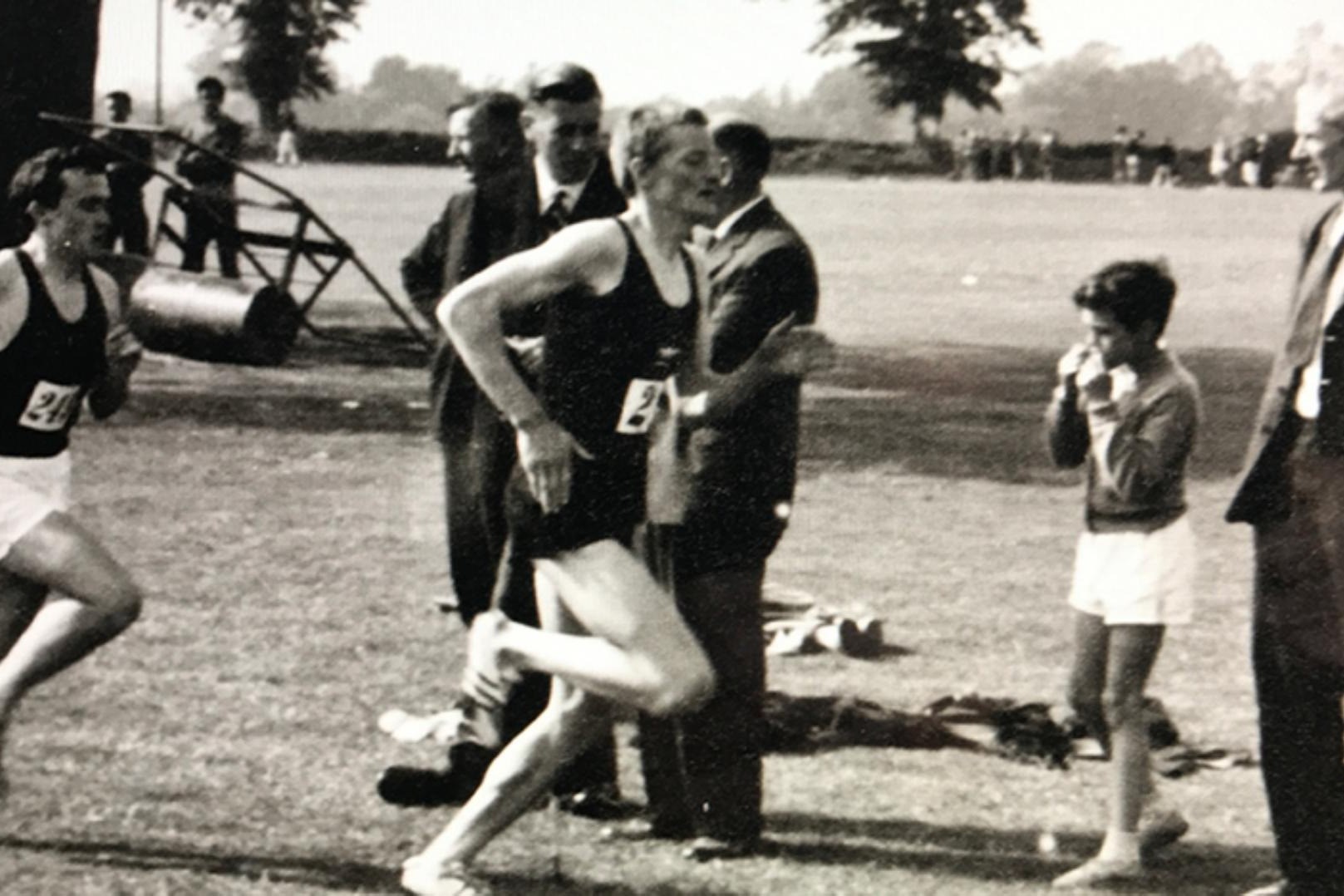
Dyson running in the Eastern County Championships at Diss, Norfolk
I was delighted I was able to take Today to a year 6 class at Malmesbury C of E primary school, in Wiltshire, who were in the middle of an engineering workshop led by Dyson engineers. I’m thrilled to be supporting this wonderful state primary school by funding a £6 million Steam centre (Stem plus the arts). Young people are natural and passionate problem-solvers but that spirit tends to get stamped out of us as we get older. Give the right facilities, and a curriculum that inspires the doers, and many more will grow up to be engineers, scientists and inventors.
The importance of failure with Anna Wintour
No doer can be successful without failing, as I found out through the 5,126 prototypes of the first bagless vacuum — all failures! If you never fail, you aren’t experimenting or taking risks. And if you aren’t taking risks, you will never make progress. My conversation with Anna Wintour was about the value of perseverance, overcoming failure and dogged hard work. Often, some idea of innate talent is seen as a prerequisite for success but it is important to explore how success is achieved, at least in part as Anna described, because of past failures, not in spite of them.
My own story is one of constant failure but also determination and perseverance. Anna talked enthusiastically about those, in the worlds of fashion and journalism, who have overcome failure to achieve great things.
Long-distance running
Finally, running was the first thing I knew I was good at, and something I had taught myself as a schoolboy. I still run today. I wanted to find out, helped by Matthew Parris — who once ran a marathon in 2 hours and 32 minutes — and a leading A&E doctor, how beneficial it is, even if it wears out joints, and I was told it really does help you live longer. A good one for the list of new year’s resolutions!