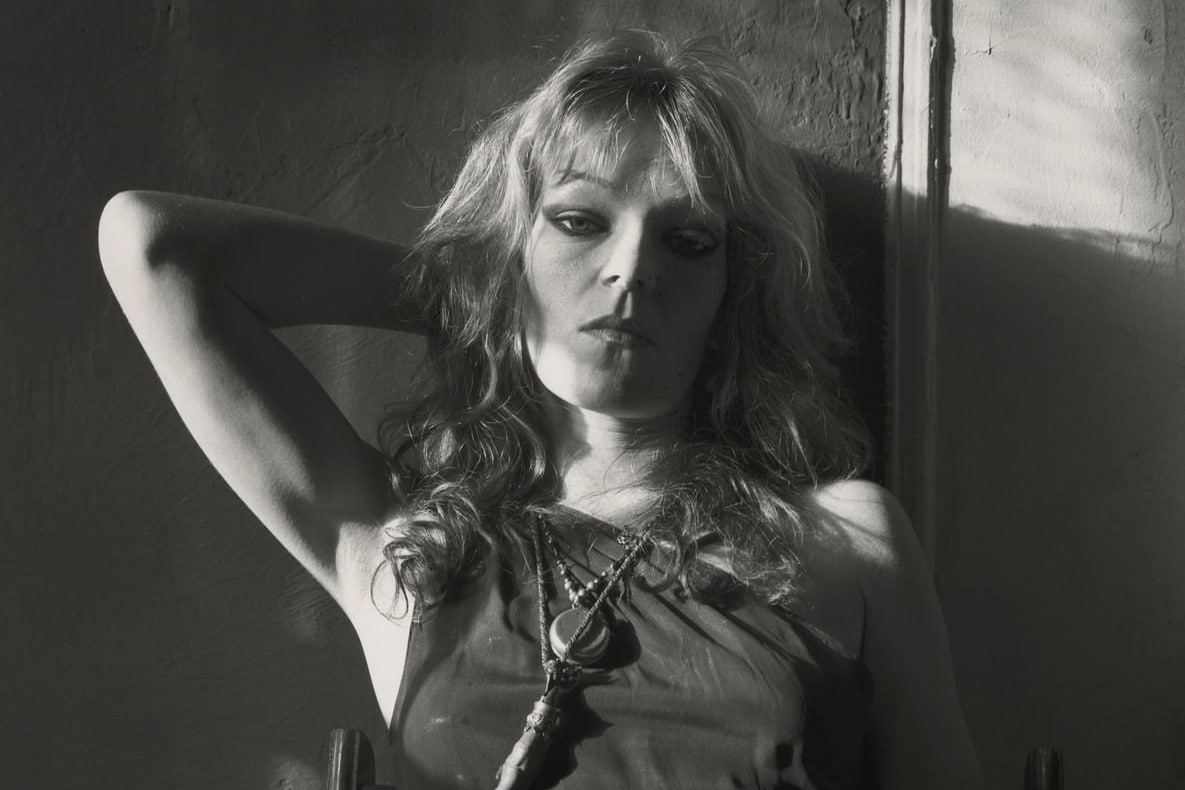
This shortlist encompasses the most inspirational photography stories by some of the most revered image-makers we’ve published on Dazed this year. From Kikuji Kawada’s visions of Hiroshima to Daniel Arnold’s gaze on New York in the anarchic present, they span many decades, yet all share a timeless quality.
Peter Hujar’s portraits from the late 1960s through to he early 1980s testify to the fact that great art can remain as resonant and meaningful as ever, while Yorgos Lanthimos’s 2024 series of images possesses a timeless, haunting quality that makes it hard to pin down to a particular decade.
What is equally apparent is how artists’ fierce connections to their subjects powerfully draw us in. There are Linder’s humorous but pointedly critical collages, the revival of Sophy Rickett’s thrilling and defiant Pissing Women, a glimpse into the 90s by way of Davide Sorrenti’s era-defining sketches and Polaroids, and David Armstrong’s indelible portraits of friends Nan Goldin, Cookie Mueller – none of which have dimmed one bit despite the passing of time.
The past is potent. It makes our turbulent reality feel part of a wider narrative. Seeing artists who’ve gone before us representing beauty and hard times alike, we’re reassured that inevitably the pendulum will swing back again. The world is heavy, but those who channel that fact into memorable aesthetics and worthwhile chronicles give us a sense of hope we so badly need. Enjoy.
Peter Hujar, Eyes Open in the Dark
Gallery / 8 images
Despite not having been recognised in his lifetime, this year seems to have been a landmark year in the legacy of Peter Hujar. His life is the subject of a new film, Peter Hujar’s Day, a biographical drama starring Ben Whishaw, written and directed by Ira Sachs; a new photo book, Stay Away From Nothing, about his relationship with Paul Theck was released by Primary Information; and the year opened with a major exhibition, Eyes Open in the Dark, at London’s Raven Row. Fran Lebowitz to Divine and Peter Wojnarowicz, the depth and weight of his portraits of New York’s outré figures and downtown art world figures still resonate as powerfully today as ever.
Read the full story here on Dazed.
Linder, Danger Came Smiling (2025)
Gallery / 8 images
Having emerged from the punk scene in 1970s Manchester, Linder’s critique of the commodification of women’s bodies, homogenised ideas of beauty, consumerism and pornography is as sharp and – sigh! –as necessary as ever. As her retrospective at the Hayward Gallery opened this year, she told Dazed: “It’s important to leave your mark, whatever age you are, that’s something to be really mindful of: how to leave a trace for people coming after you.” Deploying photo montage (or, as she put it, “the love of the cut”), her images speak to ongoing issues about embodied womanhood.
Read the full story here on Dazed.
Yorgos Lanthimos, Photographs
Gallery / 8 images
The Greek-born director is certainly prolific in cinema, but also in his photo output. His cloth-covered photo book, Dear God, the Parthenon is still broken, was published last May, followed by the monograph, i shall sing these songs beautifully, this September. His first gallery exhibition, at Los Angeles’ Webber space, featured portraits and still lifes. “I’ve really strived to have something out there that is not the films,” he told Dazed, adding, “I’ve consciously become interested in photography as a very separate thing to filmmaking.” He built a darkroom while filming Poor Things – its star, and Lanthimos’ frequent collaborator, Emma Stone, helped him with film processing.
Read the full story here on Dazed.
David Armstrong
Gallery / 30 images
This retrospective of carefully composed black-and-white portraits by the late American photographer David Armstrong depicts “a world of drug-fuelled hedonism, of sexual freedom and gender fluidity”. On view ealier this yeat at Luma in Arles (coinciding with this year’s Rencontres d’Arles photography festival), curator Matthieu Humery told Dazed: “he knew how to deal with the light, the character and the environment all together.” In addition to his signature portraits were a series of display cases filled with hundreds of contact sheets, providing an insight into his eye and editing process, as well as color slideshows of friends at parties.
Read the full story here on Dazed.
Kikuji Kawada, Endless Map – Invisible
Gallery / 19 images
Describing his work as an “enigmatic polyhedra”, Kikuji Kawada’s exhibition was co-produced by KYOTOGRAPHIE × SIGMA as part of this year’s Rencontres d’Arles photography festival.
In 1958, seven years after the atomic bomb was dropped on Hiroshima, 25-year-old photographic assistant Kikuji Kawada accompanied another photographer on assignment to document the remains of the devastation at the bomb site. The images Kawada produced there were later published as part of his landmark series The Map (1965). “The hidden knowledge that photography possesses lies in the search for the real,” Kawada told Dazed, “or illusory reality.”
Read the full story here on Dazed.
Sophy Rickett, Pissing Women
Gallery / 4 images
Images of women dressed in corporate attire may not sound fascinating, but they are when shown pissing across London’s financial district. They’re photographed at “sites that carried symbolic weight that related to finance, communication, and security”, with an unequivocal spirit of transgression and subversion. “Men seem so carefree; they [piss] in the open while we have to perform it in private,” the artist reflected on gendered urinating customs in an interview with Dazed. Dismissed as perverse by art institutions and coopted by fetish websites (“How quickly female and queer bodies are funnelled into frameworks of sexualisation and consumption,” Ricketts lamented), the series “still makes people uncomfortable,” she noted of the work. “In republishing the photographs now, I want to hold onto that tension rather than neutralise it.”
Read the full story here on Dazed.
Glen Luchford, Atlas
Gallery / 3 images
British-born, self-taught fashion photographer and portraitist had a show rewinding through his career in Milan, held at the 10-Corso-Como Gallery, nestled in Italy’s ultimate concept store. In addition to Gucci and Prada campaigns, Glen Luchford photographed the likes of model Stella Tennant, a baby-faced Kate Moss, and Sonic Youth guitarist Thurston Moore. In addition to the photographs, the gallery presented collages, outtakes, and even displayed Luchford’s “mistakes”.
Read the full story here on Dazed.
Davide Sorrenti Journals: Volume 1, 1994-1995
Gallery / 9 images
Davide Sorrenti’s recently published Journals 1994-1995 not only emphasise his creativity but are notable because the pages “show a moment in the 1990s that people talk about constantly, but rarely understand from the inside. These pages are the inside”. So stated Francesca Sorrenti, mother of the late photographer and streetwear hustler. Sorrenti was a rangy New York kid who covered every surface of the city with stickers, but his untimely passing at the age of 20 (from a lifelong genetic blood disorder compounded by heroin use) became part of a wider panic around fashion’s hard drug-infused aesthetic and lifestyle. The journals are an on-the-ground look at an era we can’t get enough of.
Read the full story here on Dazed.
Daniel Arnold, You Are What You Do
Gallery / 15 images
“Although there is gravity in my trudge through the world,” American photographer Daniel Arnold told Dazed, “a lot of it is flippant and very casual and kind of fun.” In his landscape-format monograph, typically ideosynchratic moments channel “snap storytelling” with his own wry slant. Those moments include affection on subway cars, someone giving the finger to a helicopter from a balcony, glittering boots on the go at night, and many shared cigarettes. Arnold embraces and reflects back the chaos of New York, never tiring of the thrill photography provides as a medium, saying: “I still feel like I’m new.”
Read the full story here on Dazed.
Nan Goldin, This Will Not End Well
Gallery / 44 images
Once again, Nan Goldin moved and mesmerised audiences with This Will Not End Well at Pirelli HangarBicocca in Milan (an exhibition which previously circulated in Stockholm, Amsterdam and Berlin). Held in the colossal former factory space of the tyre brand, the show, which focused on her output as a filmmaker, included her most seminal works, including The Ballad of Sexual Dependency (1981–2022), The Other Side (1992-2021), Sisters, Saints, Sibyls (2004–2022), and Stendhal Syndrome (2024). One of the curators, Roberta Tenconi, described Goldin’s approach thusly: “The way she photographs comes from relationships; it’s not about documenting, it’s about emotion and communication.”
Read the full story here on Dazed.