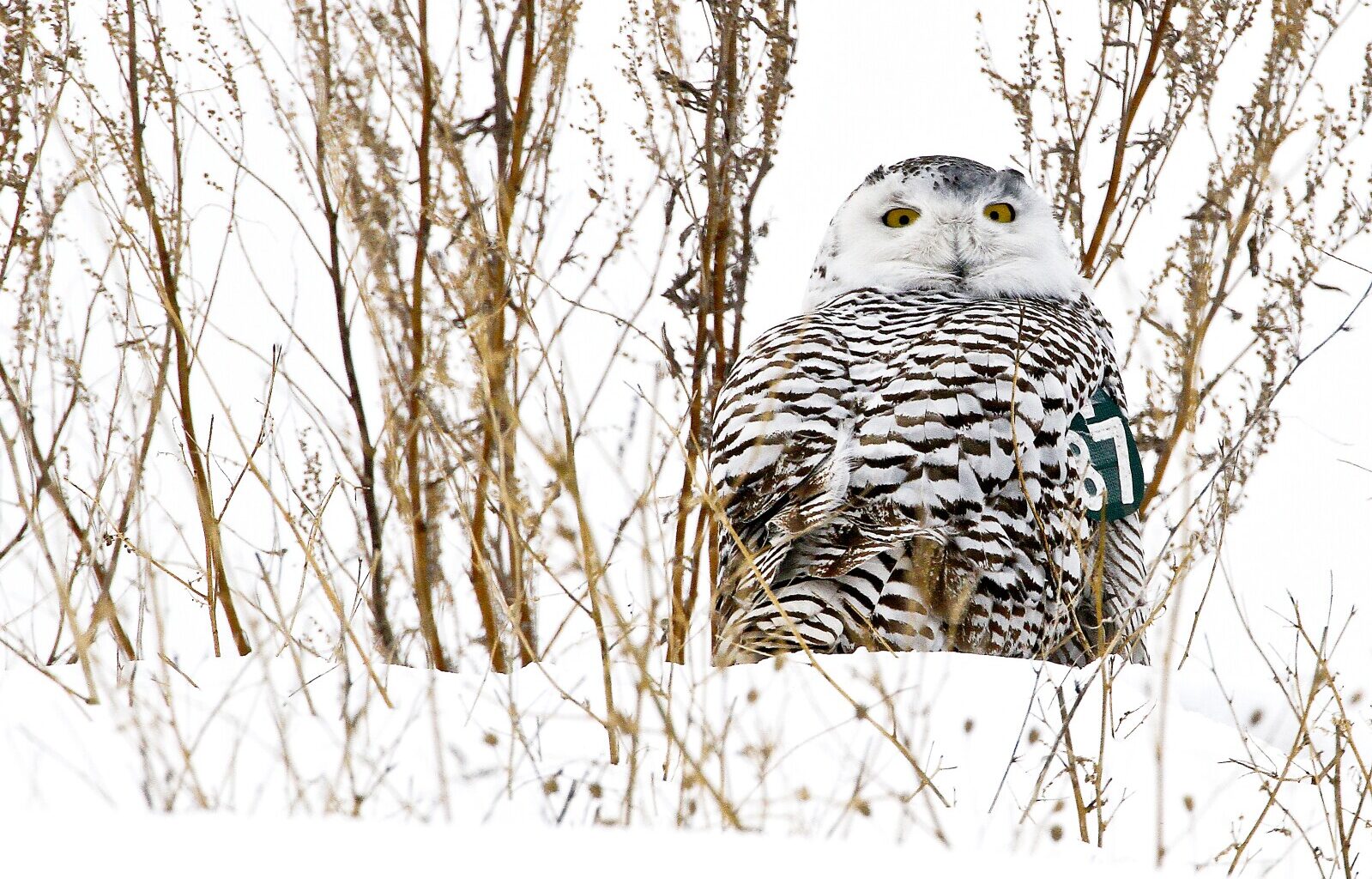
Question: Near Duluth last week, I saw a very large white owl by the side of the road. It looked like the owl from Harry Potter. What was it, and why haven’t I seen one like it before in Minnesota?
Answer: The owl was likely a snowy owl, and Minnesota is experiencing a rare event, called an irruption, when certain owls fly south in the winter in search of food and habitat.
Snowy owls are black and white, with some mostly white so they are camouflaged against a snowy background. They are just under 2 feet long, with a round head, yellow eyes and a black beak. They nest in the arctic tundra of northern Canada and Alaska, but during some years, they will relocate south during the winter to hunt voles, mice and other small animals.
Conventional wisdom is that hunger drives them south. However, a detailed study during the last irruption in the winter of 2013-14 revealed this was likely a myth: there were bountiful lemmings, the owls’ favorite food, in the Arctic the previous summer, yet an irruption occurred anyway. The new theory is that the large population of lemmings fueled an owlet boom. The abundant juvenile owls had to fly south for a suitable place to spend their first winter because the best Arctic habitat was taken by older, dominant owls.
Question: Are there irruptions of other owls in Minnesota?
Answer: Yes, the most common one is that of the great gray owl, which may live year-round in the northern part of Minnesota. This owl, the largest in Minnesota, is up to 33 inches tall with a 4- to 5-foot wingspan. It’s gray with streaks on its breast, and its call is a deep, repeated hoot.
The great gray owl hunts mostly during the daytime for rodents. They will dive into the snow to catch their preferred food, which is the mouse-like vole.
There was an irruption of great gray owls last winter, with the previous irruption happening in 2005. Irruptions are dangerous for owls, especially great grays. They like to hunt along open-road ditches, and when they dive for prey, they often don’t see cars in their path. Unlike most birds, owls’ eyes are on the front of their faces, giving them great depth perception but poor peripheral vision. During the irruption of 2005, The Raptor Center at the University of Minnesota in St. Paul admitted more than a hundred great grays, most of which didn’t survive their car collisions.
Question: How do I tell the difference among these owls?
Answer: Identifying all owls is for bird experts better than me, but each owl has some key characteristics, including their calls. There are only a handful of year-round owls in Minnesota. The most likely ones you’ll see are:
Barred owl. This owl is common in Minnesota, with barred lines on a brown and gray body, with a wingspan of 3½ feet. Have you ever heard an owl that sounds like it’s saying “who cooks for you?” That’s a barred owl.
Great horned owl. Similar in size to the barred owl but with bright yellow eyes and ear tufts that look like horns. This owl is fearless and is known as the flying tiger! It will not only eat rodents, but will even attack skunks and porcupines. When eating mice, they can consume over 4,000 a year. Its call is “hoo-hoo-hoo-hooo.”
Eastern screech owl. About half the size of the barred and great horned, this screech owl has yellow eyes and mottled gray and white, or rust and white, coloration. Its common call sounds like a horse whinny, followed by a trilling whistle. Occasionally it may screech, thus its name. One summer evening, I heard loud screeching sounds outside my house coming from two different locations, which made the hair rise on my neck. It sounded like the velociraptors calling each other in “Jurassic Park,” and I recorded it on my phone, fearing what was lurking in my wooded yard. Later, after some research, I concluded it was juvenile eastern screech owls, either giving warnings of danger to each other — or just being loud teenagers announcing their presence to the night.
Northern saw-whet owl. This owl is tiny in comparison to the other owls — only 7-8 inches long and is only found in the northeast part of the state. Its most common call is a long series of short, whistled notes. Other larger owls will kill this diminutive owl.
Long-eared owl. Found in the northern two-thirds of the state, it has a 3-foot wingspan, a round, orange face, and a body of black, white and brown stripes. It usually lives in forests. These owls make a variety of calls, which are most likely heard during the breeding seasons of March and April.
Many other owls are less common but possible to spot in Minnesota, including the barn owl (southern part of state): boreal owl (only northeastern Minnesota); burrowing owl (only the far-west prairie, but uncommon now due to intense agriculture); northern hawk owl (uncommon, but may come from Canada during the winter); and the short-eared owl (no longer common, as their native grasslands used for nesting have mostly disappeared).
If you want to attract owls to your property, leave dying trees with cavities for the owls or build owl nests. Both barred and eastern screech owls are cavity nesters, so an owl nesting box may attract them to your yard. Because owls eat so many rodents, they are a great addition to your property.
Do you have any questions about the natural world, such as birds, bugs, critters, or native plants? Are you a Master Naturalist or other naturalist expert and want to write an article? Email me at
.