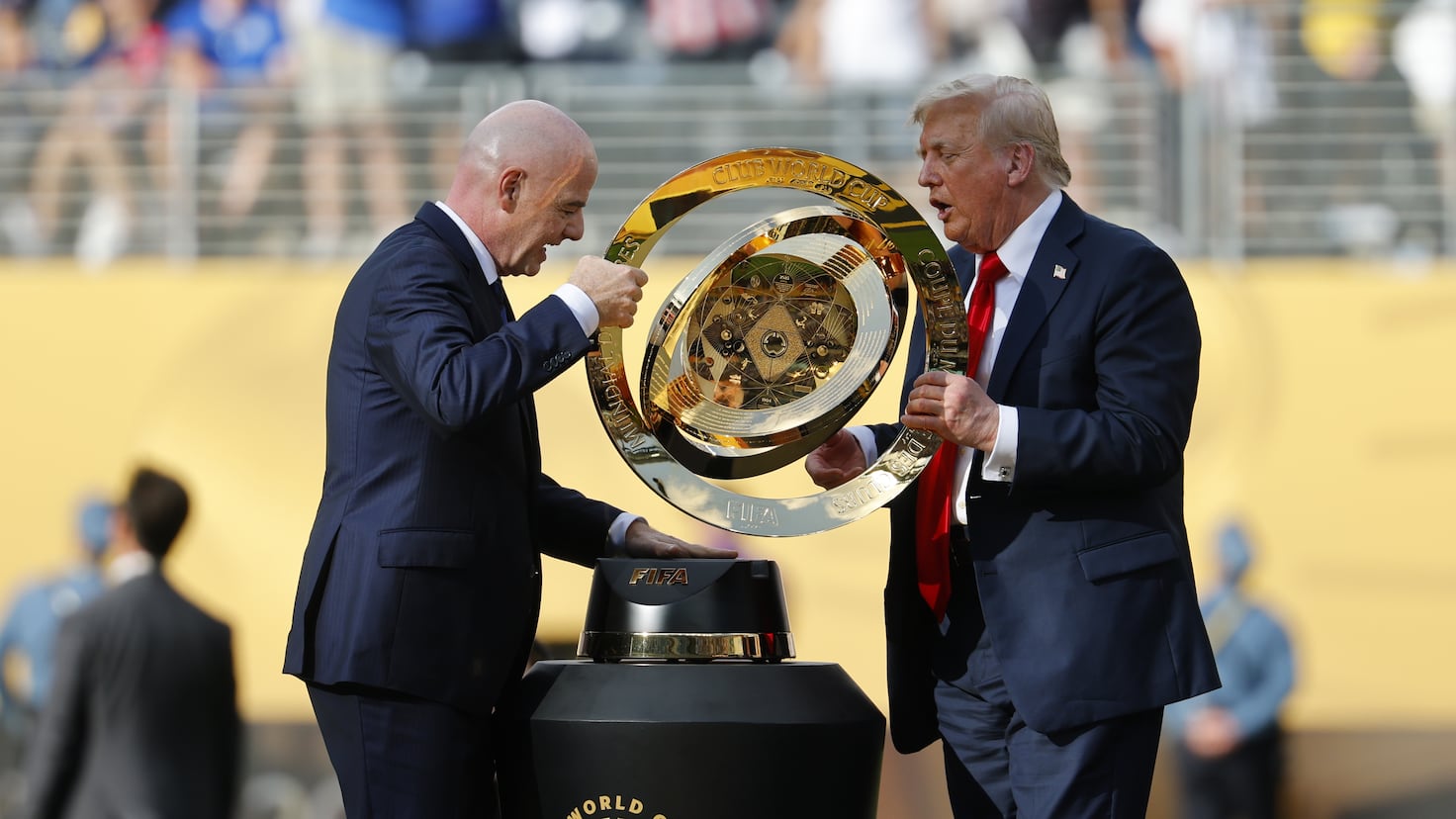
The United States is on track to become the new center of global sports. And this is not just about 2026, when it will host the biggest FIFA World Cup in history, expanded to 48 teams. The process began in 2024 with the Copa América, which ended with Argentina crowned champions, and continued in the middle of this year with the inaugural FIFA Club World Cup, widely considered a success and backed by a key figure of influence: President Donald Trump. Trump even took part in the final, not only during the trophy presentation ceremony but also joking and even dancing with Chelsea’s victorious players.
In addition to the 2026 World Cup, the United States is preparing to host what is widely regarded as the largest sporting event of all time, the 2028 Olympic Games, which will be held in Los Angeles and promise to be among the most technologically advanced in history.
This week, The Athletic also reported that the 2028 Copa América could be staged in the United States. According to the outlet, CONMEBOL and CONCACAF are already in talks, with the only obstacle being the fact that the Olympics would take place in the same year. For this to happen, the organizations would need to reschedule dates so the events do not overlap.
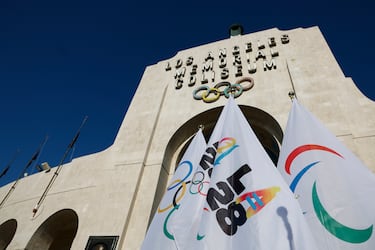 The 2028 Olympic Games will be held in Los Angeles. CAROLINE BREHMAN
A report jointly produced by FIFA and the World Trade Organization estimates that spending associated with the 2026 World Cup will generate a $17.2 billion impact on U.S. GDP and $40.9 billion globally. The tournament is also expected to create 185,000 full-time equivalent jobs in the United States and 824,000 worldwide.
The big remaining question is whether the United States will truly become the new global hub of sports in the coming years and whether it will manage to popularize soccer in the country, where the sport still lags well behind others in terms of popularity. Competition will come from the Middle East, and Qatar and Saudi Arabia in particular.
“Previously known in the sports world mainly for the NBA and the NFL, the United States is now experiencing a growing move toward soccer, partly driven by large-scale events. This agenda not only attracts international attention but also catalyzes investment in infrastructure, media, and advertising, while creating a range of business opportunities for the market, such as hospitality and premium services for fans,” explains Joaquim Lo Prete, national manager at Absolut Sport.
“The U.S. market has become the epicenter of a globalized audience. By hosting the world’s most important soccer tournaments, the United States is establishing itself as a destination for global sports tourism, offering a massive showcase for the sport that connects fans from every continent in a single place,” says Thales Rangel Mafia, marketing manager at Multimarcas Consórcios.
Amid all of this, major NBA and NFL games will continue to take place, further energizing daily life in these cities and, as a result, bringing enjoyment to the tourists who will be in the area during these events.
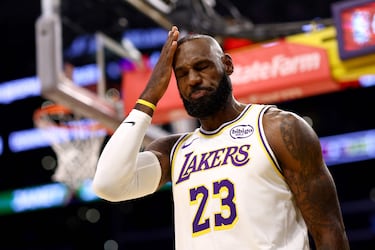 LeBron James is one of the United States’ biggest sporting stars. KATELYN MULCAHY
“To give a sense of this expansion, FIFA moved its operations to Miami in 2023, taking into account the investments made by the country’s top league, Major League Soccer, especially after the arrival of stars such as Lionel Messi and Luis Suárez at Inter Miami. In addition, more than 100 employees from world soccer’s governing body have relocated from its headquarters in Switzerland to Coral Gables, which will house the organization’s legal, audit, compliance, and risk management departments. The United States has begun to explore global events, investing heavily in soccer and once again hosting major competitions. On the other hand, when it comes to American football, the most popular sport among Americans, there has been a process of internationalization of brands. In Brazil, we have followed NFL games in recent years, but now we will also host college football events, which attract a more engaged audience. We expect to welcome 20,000 American tourists for the game in Rio de Janeiro,” says Bruno Guilherme, CEO of Sports Business, the company responsible for organizing the game between the Virginia Cavaliers and the NC State Wolfpack, which will be played at Nilton Santos Stadium in Rio de Janeiro in August 2026.
The rise of the United States as a global sports hub is creating a domino effect: clubs, leagues, and stadiums in other countries are adopting more advanced technologies to avoid losing relevance. Event operations in the U.S. are already based on automation, data intelligence, and integrated systems, setting a new standard of excellence that tends to be replicated internationally, says Tironi Paz Ortiz, CEO and founder of Imply Tecnologia.
“I believe brands can benefit enormously from the visibility and opportunities offered by major sporting events in the United States in the lead-up to the 2026 World Cup. By adopting an integrated and creative approach, leveraging sponsorships, strategic partnerships, engagement campaigns, and interactive consumer experiences, brands can increase visibility, build loyalty, and align with positive values, ensuring a lasting and meaningful impact,” says Wagner Leitzke, digital director at the agency End to End.
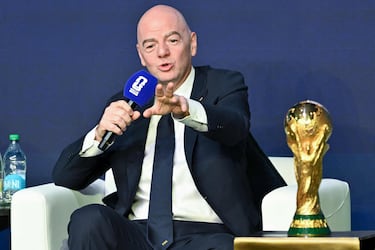 FIFA President Gianni Infantino during a promotional event for the 2026 World Cup.ROBERTO SCHMIDT
“After several historical attempts to popularize soccer, the growing influence of Latino culture, combined with the hosting of major events and the presence of top-tier stars in the domestic league, has proven to be a winning formula for elevating the importance of the sport in the most competitive market in the world. Competing for attention with the other four well-established major leagues is a major challenge, but soccer has everything it needs to solidify its presence this time,” analyzes Ivan Martinho, a professor of sports marketing at ESPM.
According to Heraldo Evans, commercial and marketing manager at Recoma, the United States is no longer just a major consumer market and is positioning itself as a global hub for the sports industry. “The country has invested heavily in infrastructure, content, and experiences, expanding interest in sports that historically were not part of the local imagination and attracting major global events to the country. This movement creates new business opportunities, draws an international audience, and redefines standards for production and management in sports. For companies in the sector, such as Recoma, this scenario represents opportunities to integrate into an increasingly sophisticated ecosystem that values innovation, sustainable operating models, and projects capable of interacting simultaneously with different sports cultures. It is an environment that expands boundaries and requires all of us to think about sports in a more global way.”
The Recoma executive emphasizes that the United States’ approach follows a logic similar to China’s in 2008. “Identify the sports with the greatest medal potential and direct investments toward them. At the same time, the country is taking advantage of the renewal of the Olympic program, which has incorporated younger sports such as skateboarding, surfing, climbing, and breakdancing, bringing the Games closer to a new audience. By strengthening these sports and attracting sponsors who previously did not invest in the Olympic environment, the United States aims to reclaim its historic prominence precisely in the edition it will host in Los Angeles.”
From soccer to football
Donald Trump’s interviews are often surrounded by controversy or reveal new information. During the draw ceremony for the 2026 World Cup, the U.S. president once again mentioned, in a critical tone, a possible name change from “soccer,” typically used in the United States, to “football,” which is commonly referred to as “American football”, outside the U.S. “It makes no sense. We have to think of another name,” he said briefly.
The statement came as no surprise. After the FIFA Club World Cup final earlier this year between PSG and Chelsea at MetLife Stadium in New Jersey, Trump gave an interview to DAZN, the network that holds the competition’s broadcasting rights, and said he was considering signing an executive order to require that the term “soccer” be called “football” in the United States. “I think we can do it. I think I could do it,” he said.
Trump was one of the guests of honor of FIFA president Gianni Infantino, and the relationship between the two leaders has grown increasingly close. So much so that the U.S. president was one of the central figures in the award ceremony and trophy presentation to Club the World Cup finalists, and FIFA itself maintains an office in Trump Tower in New York in the run-up to the tournament.
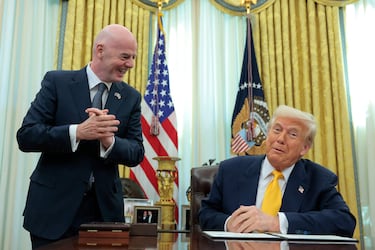 FIFA chief Gianni Infantino with US President Trump in the Oval Office.ANNA MONEYMAKER
Soccer, or in the future “football,” as Trump suggests, does not even rank among the five most popular sports in the United States. It still trails American football (NFL), basketball (NBA), baseball (MLB), boxing, ice hockey (NHL), and even college football. Soccer may emerge later through Major League Soccer, which has seen a surge in popularity over the past two years following multimillion-dollar investments in world-class players such as Lionel Messi, now with Inter Miami.
Trump has said he wants to see soccer grow in the United States, hoping it can soon match the country’s other global positions. But could changing the name have any effect?
“I think it would be a historic change that would reveal a global truth: the United States resisted for years a sport invented by the English, not by Americans. More traditional fans will not like it. Fans of Latino heritage, who already make up nearly 20% of the population, will like it, and its popularization will come in future generations, who will learn to call ‘fútbol’ the sport played with the feet,” analyzes Ivan Martinho, a professor of sports marketing at ESPM.
“There could be a kind of antagonism, intentional or accidental, between soccer and American football. If it is a form of social engineering, it could even be part of a proposal for cultural division. But it could also have a geopolitical agenda, linking the ‘money’ that is so strong in modern soccer with American football, involving Saudi Arabia, Qatar, and the Emirates,” explains Alexandre Vasconcellos, regional manager at Flashscore.
“I think it helps to ‘popularize’ the sport in the U.S., even if it is through the force of controversy and antagonism. Even if it is legally complex or practically unfeasible, at least in terms of everyday language, it can be quite effective at drawing attention and provoking divisions, for example between a more ‘traditional’ local population and another with a more cosmopolitan or internationalist outlook,” the executive adds.
“Italians have ‘Calcio’ in the name of their federation instead of ‘football,’ and that is not a problem. What matters is the willingness of the most powerful president in the world to help the sport grow in his country like nowhere else. The name is secondary if everyone knows what it refers to,” says Thiago Freitas, chief operating officer at Roc Nation Sports. “Women’s soccer is a success. The national team is even one of the global powerhouses. Men’s soccer has not taken off yet and is in a phase of slow, gradual growth. In my view, changing ‘soccer’ to ‘football’ could cause unnecessary confusion, especially because I do not believe that would be the trigger for a breakthrough. I prefer the formula of planning, strategy, investment, and time,” adds Fábio Wolff of Wolff Sports and Marketing.
“I think it would be interesting, but without major changes in the sport’s evolution. Still, it is another positive point for the Club World Cup. The president clearly understood firsthand the power of soccer,” says Renê Salviano, CEO of Heatmap and a sports marketing specialist who manages brand contracts involving professional athletes.
“At a time when the United States is hosting the World Cup, aligning the name of the sport with international vocabulary has a strategic effect. It makes global marketing easier, improves connections with new fans, and strengthens synergy with brands and sports properties,” concludes Wagner Leitzke, club director at End to End.
Even weather-related stoppages during World Cup matches can turn into opportunities for fan engagement and sponsor sales.
Climate change has been altering the global sports calendar, creating impacts that go far beyond the sport itself. At the Club World Cup, six of the 59 matches played were affected by stoppages due to “severe weather alerts.” Despite the logistical challenges, these moments also create opportunities for strategic actions by brands and sponsors looking to connect with fans in creative ways and boost in-stadium consumption. Even at the Club World Cup, cooling breaks were sponsored.
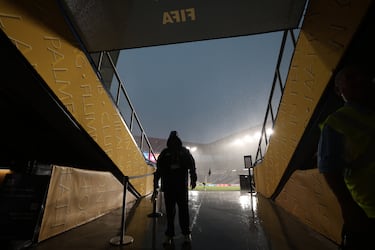 The Club World Cup game between Pachuca and Red Bull Salzburg is delayed. Juan Ignacio Roncoroni
“Organizers of the World Cup must be prepared for situations caused by climate change. These require attention to public transportation and safe shelters for fans, but they can also be used to connect with supporters and generate value for sponsors,” says Anderson Rubinatto, CEO of Goolaço, a company specializing in sports events.
During these pauses, the mobile phone becomes the fan’s main ally. Statistics and live score apps see spikes in usage while matches are suspended. This window, once viewed only as a problem, is now being seen as an opportunity for real-time digital activations.
Creativity is a key differentiating factor in this scenario. With the support of technology, tools such as QR codes on stadium screens can direct fans to challenges, giveaways, or exclusive content during forced stoppages. Joaquim Lo Prete, national director of Absolut Sport in Brazil, believes the key lies in offering something unique and time-limited.
“It is possible to launch contests, giveaways, or challenges with instant prizes, such as products, discounts, or VIP experiences, accessed through QR codes displayed on stadium screens or during broadcasts. The action must be exclusive to the moment of the interruption. With planning and strong execution, this strategy keeps fans engaged and also stimulates consumption,” he explains.
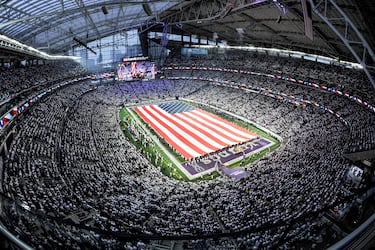 The NFL remains the USA’s No.1 sporting attraction. Jeffrey Becker
In the United States, leagues such as the NFL, MLB, and MLS have been dealing with these types of situations for years. While there is no specific federal legislation governing weather-related stoppages, each league follows its own protocols and carries insurance that covers financial losses caused by delays or cancellations.
So-called event cancellation insurance is common and guarantees coverage in the event of unforeseen weather conditions. In addition, policies such as the Weather Research and Forecasting Innovation Reauthorization Act help improve weather forecasting and risk monitoring for large-scale events.
Related stories
Get your game on! Whether you’re into NFL touchdowns, NBA buzzer-beaters, world-class soccer goals, or MLB home runs, our app has it all.
Dive into live coverage, expert insights, breaking news, exclusive videos, and more – plus, stay updated on the latest in current affairs and entertainment. Download now for all-access coverage, right at your fingertips – anytime, anywhere.