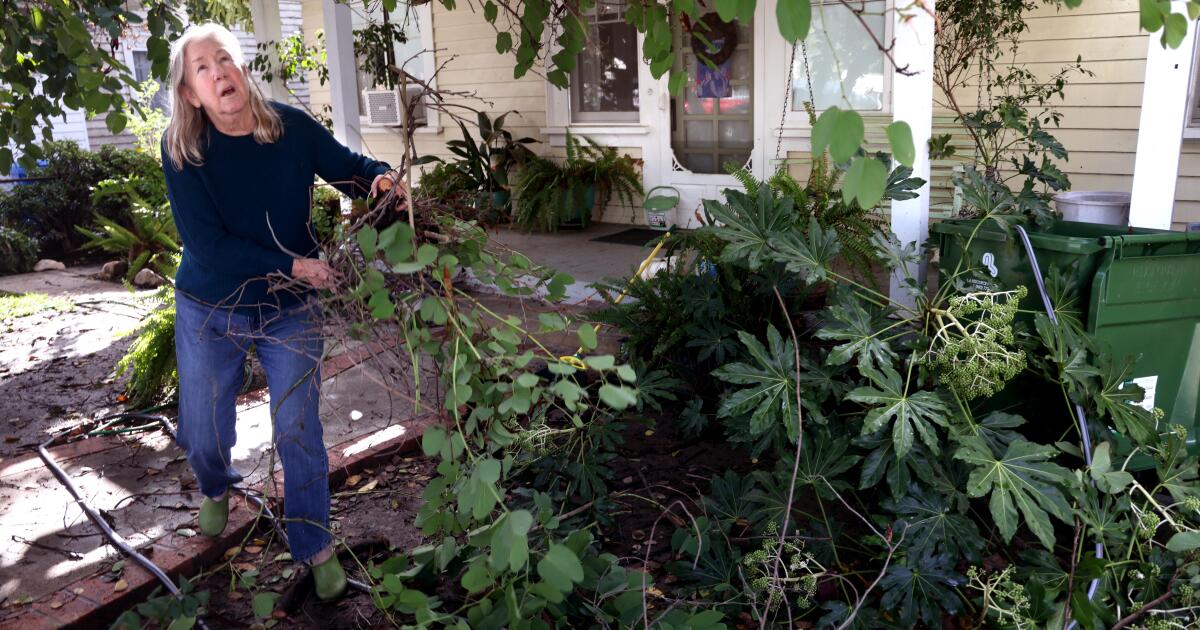
Susan Orozco thought she had seen everything in her 40 years living in Boyle Heights, until she received a Christmas Day surprise — a tornado.
The Lee Street homeowner was weathering the week’s relentless storm when she heard a roar just after 10 a.m. and figured the rain might have picked up. That was until she looked out her window.
“The trees started shaking so violently, and it was so sudden that I figured it probably was something strange going on and probably was a tornado,” said Orozco, 70. “I’ve now been through a tornado. I don’t think I want to go through a hurricane. And this was a small one.”
With the rain finally ceasing Saturday, Orozco was surveying the damage to her white picket fence and picking up branches that had been ripped from trees. She spied a piece of roofing in her yard from one of the two homes on the other side of the street that suffered damage.
A twister rated an EF-0 on the Enhanced Fujita scale, the weakest kind of tornado, had visited Orozco’s neighborhood — and in about 10 minutes had made its presence felt.
With a wind speed of up to 80 mph, it traveled for about a third of a mile in the community east of downtown Los Angeles.
It landed first on Lee Street, where it damaged the roof of a home, causing rainwater to leak inside. It also damaged the roof and wooden awning of a home two doors down.
The twister then hit a strip mall on the northeast corner of Whittier Boulevard and South Lorena Street, breaking windows at two restaurants, bending a utility pole and destroying several business signs at the intersection.
No one was injured.
Los Angeles Mayor Karen Bass toured the neighborhood on Friday, calling the safety of every Angeleno her “top priority.”
Los Angeles City Councilmember Ysabel Jurado, who represents Boyle Heights, said her team was working to find city funds to assist residents and business owners.
“We want to make people whole, and provide those people with resources,” she said.
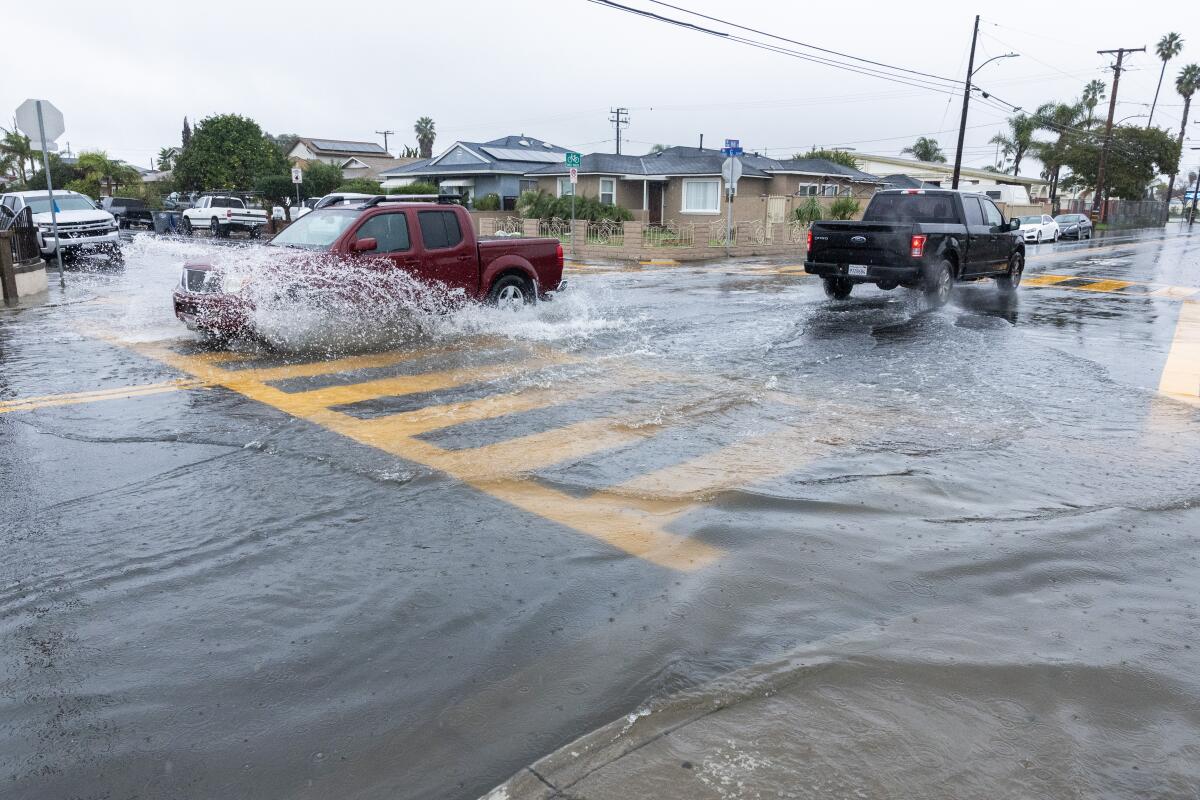
A flooded intersection at Hill and G streets in Oxnard on Wednesday.
(Myung J. Chun / Los Angeles Times)
The confirmation that a tornado, albeit a small one, had struck Los Angeles was the latest illustration of the power of the Christmas Eve-Christmas Day Pineapple Express storm, which brought record amounts of rain to a wide swath of Southern California for the two-day holiday period and played a role in the deaths of at least five people.
Gov. Gavin Newsom declared emergencies in Los Angeles, San Diego, Orange, Riverside, San Bernardino and Shasta counties.
On Friday night, a large boulder fell from a mountainside and rolled onto Highway 18 west of Big Bear Lake; two cars were then involved in a vehicle collision. Five people were reported injured, including two children; all injuries were minor, but four people were sent to a nearby hospital, the San Bernardino County Fire Department said.
At Mammoth Mountain, two ski patrollers suffered significant injuries Friday morning when a slide hit as they performed “avalanche mitigation work.” One patroller sustained serious injuries and was transported out of the area for further care; the second patroller may have suffered broken bones.
Mammoth Mountain was closed Saturday and will reopen Sunday. On its Facebook page, the ski resort said the closure was “to allow mountain operations and patrol teams time to mitigate storm-related hazards across the entire mountain.”
Some of the worst damage hit the San Gabriel Mountains, where a debris flow — a fast-moving flow of mud and rocks — rammed into homes and left cars buried in debris in Wrightwood, a town on the border of L.A. and San Bernardino counties.
In the mountainous community of Lytle Creek in San Bernardino County, a bridge connecting parts of the town was covered with water and was possibly destroyed.
Roughly 50 homes in San Bernardino County were severely damaged during the Christmas holiday storm, including at least two dozen in Wrightwood alone, the Sheriff’s Department said.
L.A. County firefighters rescued more than 100 people, including lifting 21 people to safety from cars into a helicopter.
Rich Thompson, a meteorologist for the National Weather Service in Oxnard, said that tornadoes occur in Southern California “much more often than people actually think.”
“Fortunately, they are weak,” he said. “They don’t do a lot of damage, or are not long-lived, which is nice — but they do occur.”
Typically, the tornadoes are the result of an unstable atmosphere that develops during a large storm. That causes a “shear,” during which “at one level of the atmosphere, the wind’s blowing this direction and another level’s blowing in another direction,” he said.
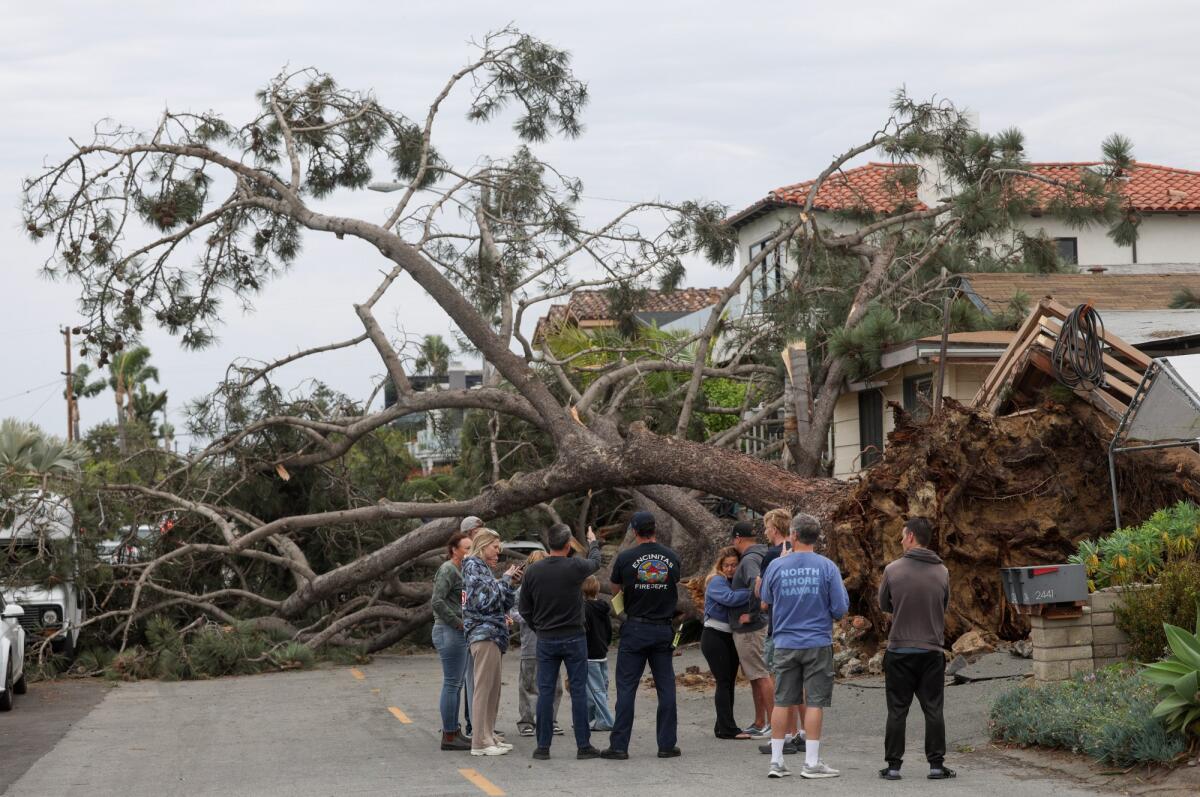
In Encinitas, a large tree fell on Wednesday. A separate incident of a downed tree proved fatal Wednesday in San Diego.
(Hayne Palmour IV / TNS)
At least three tornadoes occurred in California during the last rainy season. One that lasted about five minutes touched down a year ago in Scotts Valley in Santa Cruz County, injuring three people. With wind speeds that peaked at 90 mph, the tornado overturned vehicles, damaged street signs, downed trees and power poles, and stripped trees of branches.
In February, a tornado with winds of up to 85 mph tore roofs off mobile homes in Oxnard and ripped power cables to the ground. A tornado in March uprooted trees in Pico Rivera, with wind gusts of up to 85 mph sending some crashing into vehicles and homes.
In 2023, a tornado that hit Montebello was the strongest to land in L.A. County in 40 years, bringing winds of 110 mph. Fifty yards wide, it injured one person and left 17 buildings damaged and 11 structures red-tagged. That tornado was classified as an EF-1 on the Enhanced Fujita Scale.
The previous time a tornado with a strength of EF-1 or greater hit L.A. County was back in 1983, when an even stronger EF-2 tornado tore through a residential area of South Los Angeles. That tornado injured 25, mostly from flying glass, and destroyed 37 homes and severely damaged more than 100 others.
Between 1950 to 2024, there have been 478 recorded tornadoes in California, with the highest number in Los Angeles County, which had 49, followed by San Bernardino County, which had 33, and Orange County and Fresno County, which each had 31, according to data from the National Centers for Environmental Information analyzed by meteorologist Jan Null. San Diego and Riverside counties each had 27 tornadoes.
Authorities on Friday reported additional possible storm-related deaths — the fourth and fifth in California in recent days. A deceased man was found in a partially submerged vehicle Friday morning in the Lancaster area, the Los Angeles County Sheriff’s Department said. And the body of a 21-year-old was found in a vehicle, 12 feet underwater in a canal, in Fresno County, according to ABC30 in Central California.
Earlier storm-related deaths involved a motorist who drove into floodwaters in Redding; a woman who was knocked off a rock by a large wave at a beach in Mendocino County; and a man struck by a falling tree in San Diego.
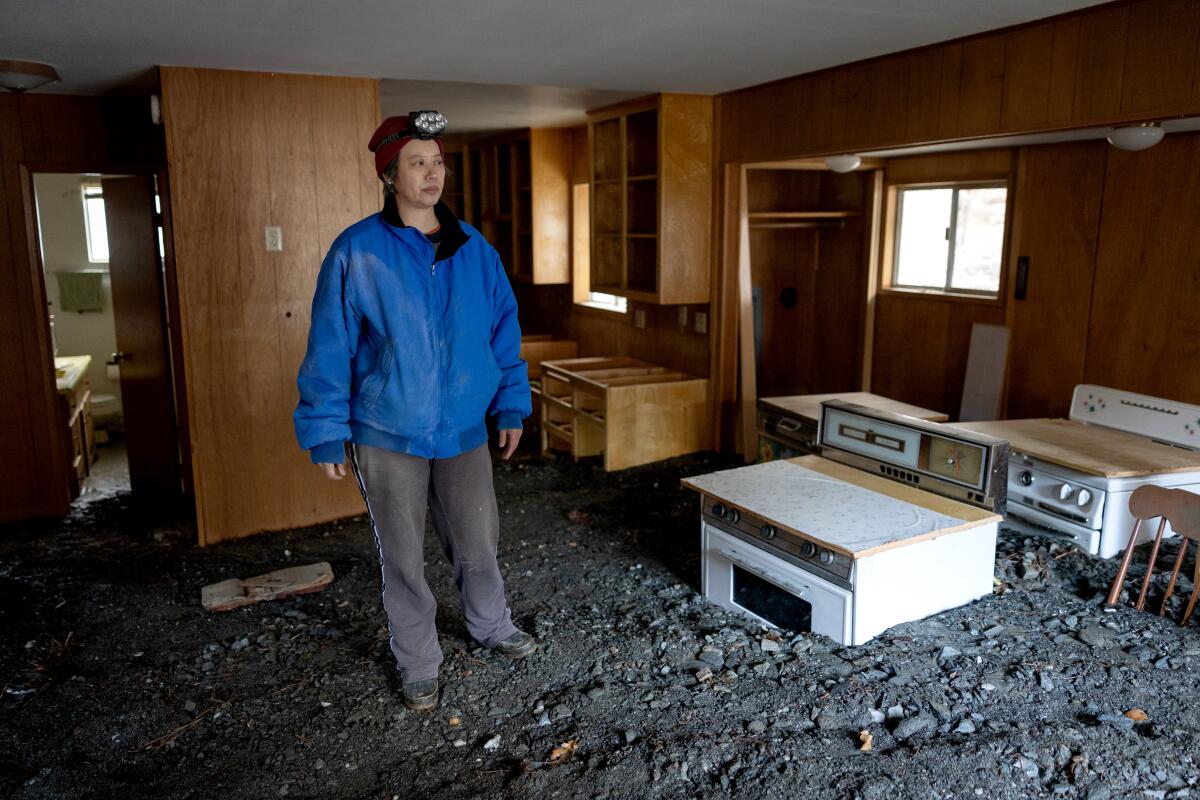
Misty Cheng looks at flood damage to her home in Wrightwood on Thursday.
(Eric Thayer/Los Angeles Times)
On Saturday morning in Boyle Heights, a Los Angeles city emergency management coordinator was visiting damaged houses and businesses with Noel Middleton, a volunteer leader with Team Rubicon, a veteran-led humanitarian organization that delivers disaster relief.
Middleton said Team Rubicon has been busy this year, starting with victims of the Jan. 7 wildfires, which occurred during bone-dry weather. The group now has volunteers assisting in Wrightwood.
“We are seeing lots of disasters out of season,” he said. “It’s an ever-changing landscape as the climate changes.
Times staff writers Jack Dolan, Noah Goldberg and Noah Haggerty, as well as staff photographer Genaro Molina, contributed to this report.