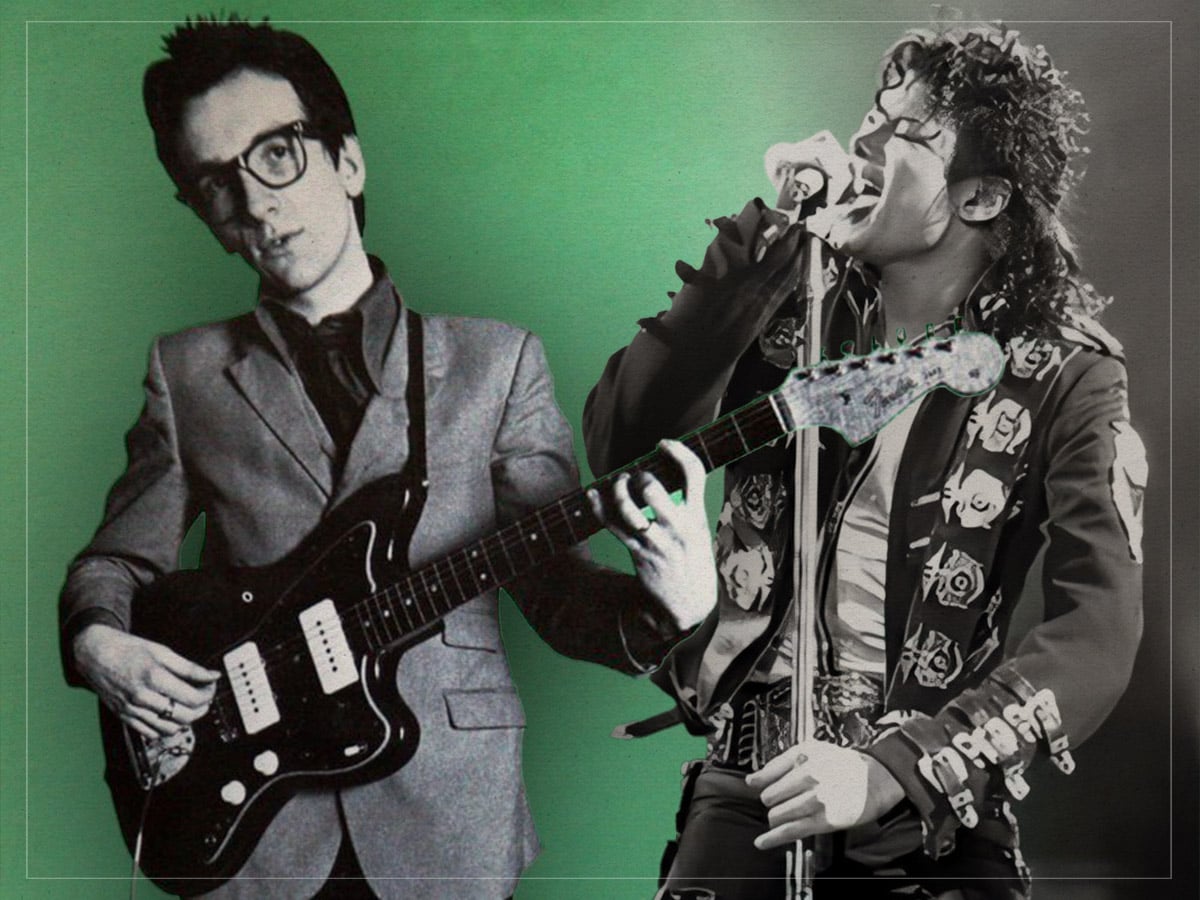

(Credits: Far Out / Alamy / Zoran Veselinovic)
Sat 27 December 2025 21:15, UK
It’s a long-forgotten miniature controversy now, but when the cult comedy film Napoleon Dynamite came out in 2004, its producers were briefly forced to explain whether they’d stolen the name for their titular character from the intellectual property of one Mr Elvis Costello.
Back in the mid-1980s, Costello, who was already operating under a permanent pseudonym after professionally changing his name from Declan MacManus, adopted another alter-ego, crediting some of his work during the Blood and Chocolate era to “Napoleon Dynamite”. As such, Costello was obviously quite surprised when he heard about the film using that same name almost 20 years later. The filmmakers, in turn, pleaded ignorance, saying they’d based the title on an actual person they’d met in Cicero, Illinois.
Elvis decided to accept the highly coincidental version of the story and kept the whole issue out of the courts. He might have thought twice had he known how much of a surprise box office hit Napoleon Dynamite was going to be. Then again, Costello didn’t need more reasons to be bitter about sales numbers.
For much of his career, going all the way back to the days of singles like 1980s ‘Radio Radio’, Costello was quite open about his disappointment with the state of mainstream popular music and the way the old taste-making channels of the ‘50s, ‘60s, and ‘70s had gradually been co-opted by corporate interests.
“It comes right down through the advertising agencies,” Costello told the Philadelphia Inquirer in 1989, “who get on the record companies, who get on the artists, who get onto the market research people, who get on the program directors, who get on the DJs.”
Elvis was actually enjoying one of his more successful commercial periods in 1989, as the release of the album Spike that year, and its Paul McCartney co-written hit single ‘Veronica’, had helped end a bit of a radio slump for the 35-year-old. Nonetheless, when he looked at the artists above him on the charts, or the ones getting the high volume of rotations on MTV – Madonna, Michael Jackson, Paula Abdul, Milli Vanilli, etc – he saw a sort of pantomime of sellout culture on display.
“Money talks,” he said. “In fact, it talks quite loudly; so loudly, you can’t hear anything else. You can only hear Michelob rock, or Pepsi rock, or Pepsi pop. It’s the only kind of music there is these days, to most people.”
The depressing thing to Costello wasn’t that a lot of talentless people were cashing in, but that it was actually some of the most talented artists – Whitney Houston and Michael Jackson among them – who were willing to play the cola-selling game, despite clearly not needing the extra money.
“The really ironic thing is, I do firmly believe in 50 years’ time nobody will remember Michael Jackson,” Costello said in 1989, comparing the King of Pop to Rudy Vallee, one of the biggest stars of the 1930s whose fame later faded. “He’ll be like a forgotten kind of icon because the music won’t last, because it’s been superseded by another image and that image is fizzy sugar water.”
Costello’s prediction isn’t looking too accurate at the moment. Over the subsequent 36 years, despite Jackson’s death and the many major controversies that tarnished much of his legacy, the Michael Jackson songbook shows no signs of fading into oblivion, and certainly won’t by 2039.
Meanwhile, among Gen Z, it could be argued that Napoleon Dynamite, the film, has sustained more recognition than the man who first invented the name, as the proliferation of memes and TikTok clips – the modern version of a Pepsi sponsorship – has done wonders for the movie’s legacy, while Elvis Costello, one could argue, hasn’t crossed fully back into the mainstream since his cameo in Austin Powers.
Related Topics