Golf is the ultimate Marmite sport: either you love it or you think it’s a Victorian eccentricity that has got out of hand. Alongside rugby, it’s also a favourite pastime of corporate Ireland – presumably why it receives coverage out of proportion to its popularity.
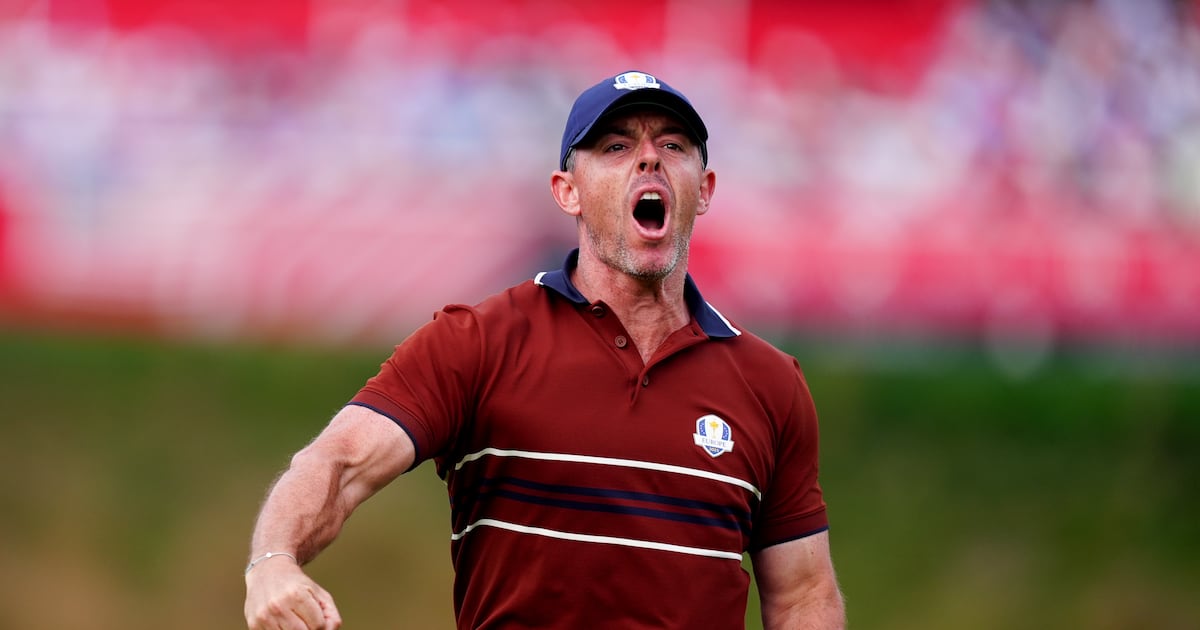
All that being said, it’s hard not to warm to Rory McIlroy, the Holywood, Co Down golfing superstar, and an athlete who, at 36, still has the quality of a boy wonder. He certainly achieved wondrous things in 2025, as we discover in the engaging Rory McIlroy: A Battle Won (RTÉ One, 9.30pm). In April, he ticked the last of the big four Grand Slam titles off his bucket list when he won the Masters in Augusta, Georgia. Then, in September, he faced down the Maga hordes to help Europe to victory over the USA in the Ryder Cup.
The Ryder Cup was such an ugly event – the aggressive American crowds a disgrace – that it overshadowed almost everything else in golf in 2025. However, at a personal level, the Masters meant much more to McIlroy. He has been a professional since he was 18, yet the tournament had eluded him throughout his career. His belated victory came as both a delight and a relief.
Sporting heroes are always more interesting when they have the same strengths and weaknesses as the rest of us – which is undoubtedly true of McIlroy. When he’s on his game, he is an unstoppable golfing force, we hear. However, before the Masters, he had a reputation for “choking” – throwing away tournaments in which he had a commanding lead. Top-level golf is obviously hugely competitive, but the suggestion here is that McIlroy’s biggest opponent was himself.
You can see why the “choker” label has stuck, but his friend Paul McGinley dismisses the caricature. “That narrative is very unfair … just look at his win ratio. He wins 15 per cent of tournaments he plays [in] … 15 per cent is phenomenal.”
A Battle Won is a fascinating character profile that tracks his story from a 10-year-old golf whiz in Co Down to one of the world’s most highly paid athletes. But because this is Ireland, nothing can ever be straightforward, and that is especially true when it comes to McIlroy and his complex feelings about identity.
McIlroy grew up in a middle-class Catholic family in greater Belfast, and his attitude towards Irishness has evolved. He was torn about whether to represent Ireland or the UK at the 2016 Rio Olympics – and there was much eye-rolling when he cited the Zika virus as a reason not to attend. But he went on to play for Ireland at the Tokyo games, giving it his all.
The most revealing segment in the film comes when interviewees such as Pádraig Harrington are asked about the civil war in golf around the emergence of the Saudi-backed LIV circuit, which used a magic chequebook to lure players away from the established PGA. The golfers are reluctant to get into the politics of it – many of their friends went over to the dark side of LIV and nobody wants to burn bridges. That determination to be diplomatic stands in contrast to McIlroy, who emerged as a vocal opponent of the new competition, only to be sold down the river when informed late in the day of plans for a merger between the tours.
“Any decision you make that’s purely for money, it never seems to go the way you want,” we hear him declare in a press conference. It’s easy to say that when you’re a millionaire – but you nonetheless have to credit McIlroy for possessing something all too rare in professional sport: a moral compass.