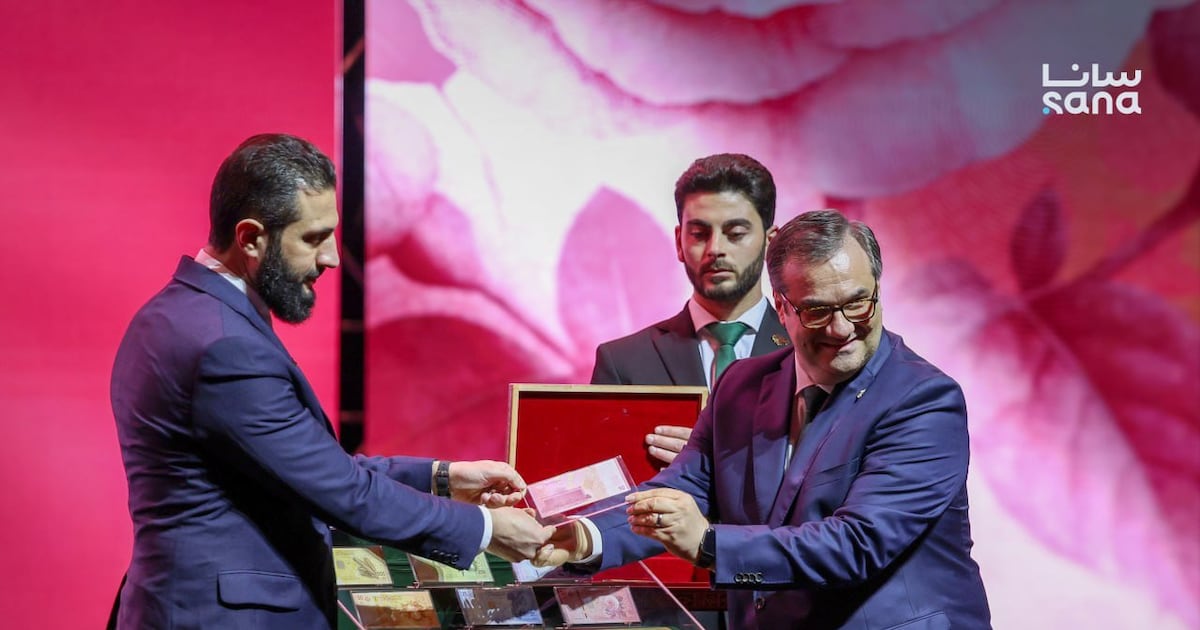
Syrian President Ahmad Al Shara and central bank governor Abdulkader Husrieh on Monday unveiled the country’s new currency, which will be introduced gradually from January 1.
The move is intended to strengthen the Syrian pound after its purchasing power collapsed to record lows during the civil war that ended last December, when rebels toppled president Bashar Al Assad’s regime.
Speaking at the unveiling in Damascus, Mr Al Shara said the design of the new banknotes, which feature images only of animals and plants, “is an expression of the new national identity and a move away from the veneration of individuals”.
“The currency change event marks the end of a previous, unlamented phase, and the beginning of a new phase that the Syrian people and the peoples of the region who are hopeful about the modern Syrian reality aspire to,” he said, according to state news agency Sana.
Images of the new notes projected on a screen showed a 25-pound note with mulberries, a 50-pound note with oranges, a 200-pound note with olives, and a 500-pound note with ears of wheat.
Mr Al Shara said there were “many concepts that need to be clarified during the currency exchange phase”.
“The first is that changing the zeros and removing two zeros from the old currency to the new currency does not mean improving the economy, but rather it is easier to deal with the currency,” he said.
“Improving the economy depends on increasing production rates and reducing unemployment rates in Syria, and one of the basics of achieving economic growth is improving the banking situation because banks are like arteries for the economy.”
Mr Husrieh said last week that the new currency would be introduced gradually from the start of the new year, and that the exchange of old notes for new ones would be “smooth and organised”, with guidelines to be announced later.
Mr Al Shara described the changeover as “sensitive and delicate”, saying the most important consideration was “to avoid panic among the people and not to rush to throw away the old currency and replace it with the new one”.
“Everyone who has old currency will have it replaced with the new one, so there is no need to insist on changing it because that may harm the exchange rate of the Syrian pound,” he said.
“We need a calm approach to currency replacement, and the central bank has made it clear that this will be done according to a specific timetable.”
Mr Husrieh said the currency change would not affect the exchange rate and was intended to encourage people to rely on the Syrian pound in daily transactions.
He said the exchange should last 90 days, but might be extended if needed. “This will help stabilise prices, and we confirm that pricing during this phase will be in both the old and new currencies,” Sana quoted him as saying.
“There will be a media campaign to accompany the currency change and explain the details in the coming days.”
About Housecall
Date started: July 2020
Founders: Omar and Humaid Alzaabi
Based: Abu Dhabi
Sector: HealthTech
# of staff: 10
Funding to date: Self-funded
Ten tax points to be aware of in 2026
1. Domestic VAT refund amendments: request your refund within five years
If a business does not apply for the refund on time, they lose their credit.
2. E-invoicing in the UAE
Businesses should continue preparing for the implementation of e-invoicing in the UAE, with 2026 a preparation and transition period ahead of phased mandatory adoption.
3. More tax audits
Tax authorities are increasingly using data already available across multiple filings to identify audit risks.
4. More beneficial VAT and excise tax penalty regime
Tax disputes are expected to become more frequent and more structured, with clearer administrative objection and appeal processes. The UAE has adopted a new penalty regime for VAT and excise disputes, which now mirrors the penalty regime for corporate tax.
5. Greater emphasis on statutory audit
There is a greater need for the accuracy of financial statements. The International Financial Reporting Standards standards need to be strictly adhered to and, as a result, the quality of the audits will need to increase.
6. Further transfer pricing enforcement
Transfer pricing enforcement, which refers to the practice of establishing prices for internal transactions between related entities, is expected to broaden in scope. The UAE will shortly open the possibility to negotiate advance pricing agreements, or essentially rulings for transfer pricing purposes.
7. Limited time periods for audits
Recent amendments also introduce a default five-year limitation period for tax audits and assessments, subject to specific statutory exceptions. While the standard audit and assessment period is five years, this may be extended to up to 15 years in cases involving fraud or tax evasion.
8. Pillar 2 implementation
Many multinational groups will begin to feel the practical effect of the Domestic Minimum Top-Up Tax (DMTT), the UAE’s implementation of the OECD’s global minimum tax under Pillar 2. While the rules apply for financial years starting on or after January 1, 2025, it is 2026 that marks the transition to an operational phase.
9. Reduced compliance obligations for imported goods and services
Businesses that apply the reverse-charge mechanism for VAT purposes in the UAE may benefit from reduced compliance obligations.
10. Substance and CbC reporting focus
Tax authorities are expected to continue strengthening the enforcement of economic substance and Country-by-Country (CbC) reporting frameworks. In the UAE, these regimes are increasingly being used as risk-assessment tools, providing tax authorities with a comprehensive view of multinational groups’ global footprints and enabling them to assess whether profits are aligned with real economic activity.
Contributed by Thomas Vanhee and Hend Rashwan, Aurifer
COMPANY%20PROFILE
%3Cp%3E%3Cstrong%3EName%3A%20%3C%2Fstrong%3EKinetic%207%3Cbr%3E%3Cstrong%3EStarted%3A%3C%2Fstrong%3E%202018%3Cbr%3E%3Cstrong%3EFounder%3A%3C%2Fstrong%3E%20Rick%20Parish%3Cbr%3E%3Cstrong%3EBased%3A%3C%2Fstrong%3E%20Abu%20Dhabi%2C%20UAE%3Cbr%3E%3Cstrong%3EIndustry%3A%3C%2Fstrong%3E%20Clean%20cooking%3Cbr%3E%3Cstrong%3EFunding%3A%3C%2Fstrong%3E%20%2410%20million%3Cbr%3E%3Cstrong%3EInvestors%3A%3C%2Fstrong%3E%20Self-funded%3C%2Fp%3E%0A
More from Neighbourhood Watch:Citadel: Honey Bunny first episode
Directors: Raj & DK
Stars: Varun Dhawan, Samantha Ruth Prabhu, Kashvi Majmundar, Kay Kay Menon
Rating: 4/5
Killing of Qassem SuleimaniKey figures in the life of the fort
Sheikh Dhiyab bin Isa (ruled 1761-1793) Built Qasr Al Hosn as a watchtower to guard over the only freshwater well on Abu Dhabi island.
Sheikh Shakhbut bin Dhiyab (ruled 1793-1816) Expanded the tower into a small fort and transferred his ruling place of residence from Liwa Oasis to the fort on the island.
Sheikh Tahnoon bin Shakhbut (ruled 1818-1833) Expanded Qasr Al Hosn further as Abu Dhabi grew from a small village of palm huts to a town of more than 5,000 inhabitants.
Sheikh Khalifa bin Shakhbut (ruled 1833-1845) Repaired and fortified the fort.
Sheikh Saeed bin Tahnoon (ruled 1845-1855) Turned Qasr Al Hosn into a strong two-storied structure.
Sheikh Zayed bin Khalifa (ruled 1855-1909) Expanded Qasr Al Hosn further to reflect the emirate’s increasing prominence.
Sheikh Shakhbut bin Sultan (ruled 1928-1966) Renovated and enlarged Qasr Al Hosn, adding a decorative arch and two new villas.
Sheikh Zayed bin Sultan (ruled 1966-2004) Moved the royal residence to Al Manhal palace and kept his diwan at Qasr Al Hosn.
Sources: Jayanti Maitra, www.adach.ae
Our legal consultant
Name: Dr Hassan Mohsen Elhais
Position: legal consultant with Al Rowaad Advocates and Legal Consultants.